


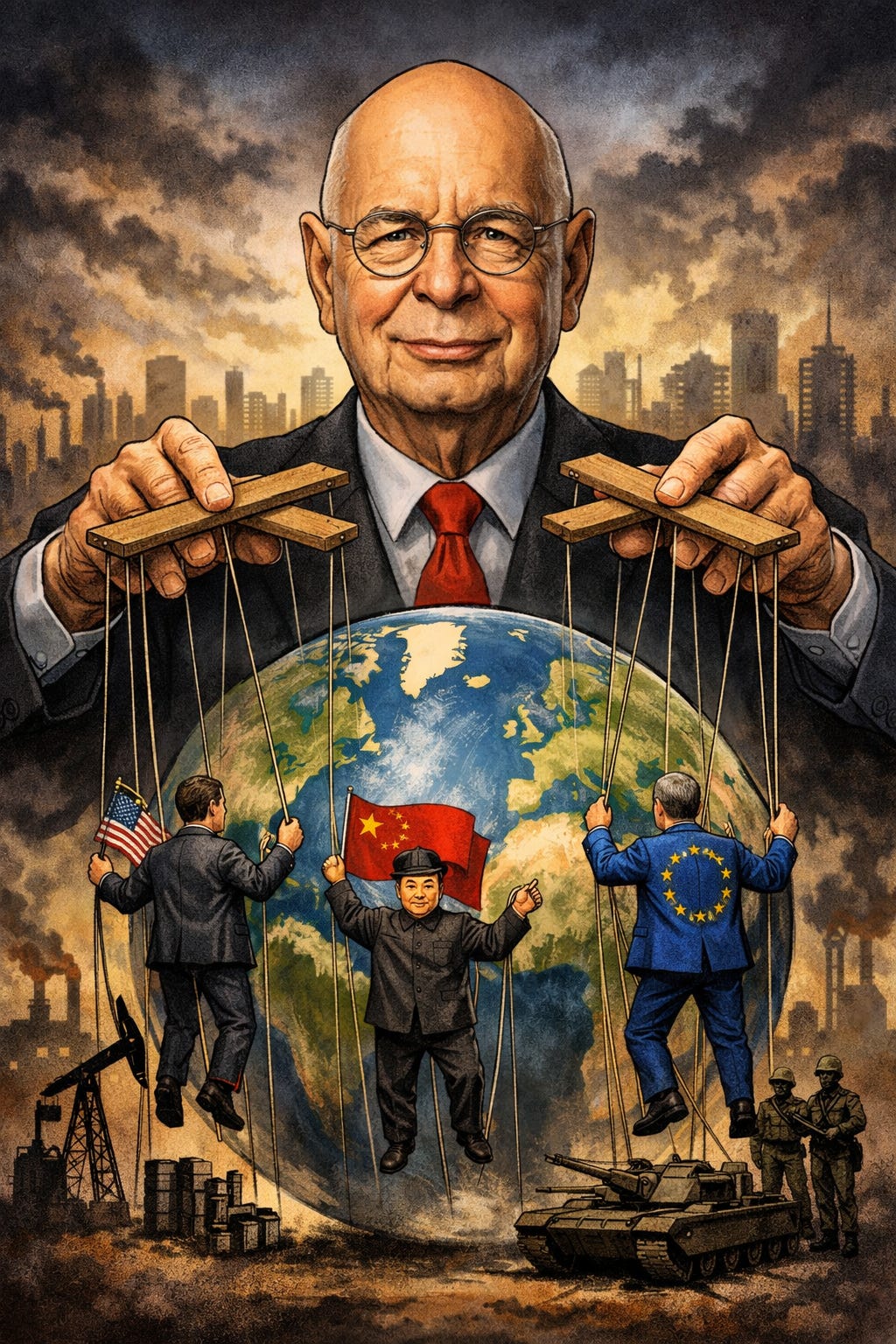
The Globalization Riddle
Why Davos’ Model Always Favored Europe — and Why It Finally Broke
By Jim Reynolds | www.reynolds.com
The most revealing moments in politics rarely begin with answers.
They begin with the right question.
Here’s the one Davos never wanted asked:
If globalization was such a brilliant, inevitable deal — who was it actually a better deal for?
The answer explains almost everything.
⸻
The Asymmetry No One Talked About
Globalization was sold as a universal win: lower prices, higher efficiency, shared prosperity. But from the beginning, it was structurally asymmetric.
The United States entered globalization with:
Energy
Land
Capital
Innovation
A reserve currency
A manufacturing base
A security umbrella it already paid for
Europe entered globalization with:
Limited energy
Aging populations
Rigid labor laws
Expensive welfare states
Declining industrial capacity
Those are not equivalent starting positions.
Globalization didn’t “level the playing field.”
It solved Europe’s problem.
⸻
Europe’s Quiet Bargain
Europe’s postwar social model is expensive by design. Generous benefits, high labor protections, and regulatory density all require one thing to remain politically viable:
Cheap inputs.
Globalization delivered them:
Manufacturing outsourced to Asia
Energy imported from Russia
Goods shipped cheaply from China
Environmental and labor costs externalized
National security costs transferred to the American taxpayer
This allowed European elites to preserve a high-cost domestic model while offloading production pain elsewhere. Consumers enjoyed lower prices. Governments avoided unrest. The bill was simply routed outward.
From Europe’s governing class perspective, globalization wasn’t ideology.
It was life support.
⸻
The American Role: Shock Absorber
For the United States, the deal was different.
Globalization enriched:
Multinationals
Financial institutions
Asset holders
Urban professional classes
But it hollowed out:
Domestic manufacturing
Working-class wages
Regional economies
Social cohesion
For years, this was masked by cheap imports, easy credit, and asset inflation. But structurally, America was subsidizing the system — absorbing trade deficits, underwriting global security, and financing consumption with its own industrial decline.
Europe consumed stability.
America absorbed volatility.
That imbalance could persist only as long as voters didn’t notice.
Eventually, they did.
⸻
China Was the Keystone — and the Trap
China completed the model.
It offered:
Cheap labor
Authoritarian discipline
Environmental indifference
Political patience
China absorbed the mess.
Europe consumed cheaply.
America financed it all via dollar dominance.
This wasn’t “comparative advantage.”
It was comparative sacrifice — and the sacrifice flowed one way.
Once supply chains snapped and geopolitical risk returned, the illusion collapsed.
⸻
The Energy Paradox (That Isn’t a Paradox at All)
Europe’s energy self-stripping looks insane — until you understand who bears the cost.
Net Zero was never designed to:
Make energy cheap
Preserve industry
Secure sovereignty
It was designed to:
Signal moral leadership
Justify regulatory control
Shift costs downward
Increase external dependence
Energy scarcity is tolerable if:
You don’t run factories
You don’t pay retail prices
You can subsidize consequences
You govern narratives instead of outcomes
Elites don’t freeze.
Industries do.
This is why Howard Lutnick’s question at Davos landed like a hammer:
“Why would Europe agree to be net zero by 2030 when they don’t make a battery?”
That wasn’t an insult.
It was a diagnosis.
Climate policy without industrial capacity is not virtue.
It’s dependency.
⸻
What Davos Could Never Admit
Here’s the truth Davos cannot say without indicting itself:
Globalization worked exactly as designed — for capital, not for countries.
It optimized for:
Labor arbitrage
Regulatory escape
Cost minimization
Profit without responsibility
It was never meant to preserve:
National resilience
Industrial depth
Worker stability
Democratic accountability
Those weren’t bugs.
They were tradeoffs.
And the moment governments accept that they owe primary allegiance to their own citizens — not to global capital flows — the Davos ethic collapses.
⸻
Why the Spell Finally Broke
Three things changed:
1. Supply chains failed.
2. Energy reality returned.
3. Voters noticed.
When voters notice, inevitability dies.
That’s why Lutnick’s speech mattered. Not because it was radical, but because it was obvious — and spoken out loud, in the room where obvious things were never supposed to be said.
Globalism didn’t fall at Davos.
It was audited.
And the numbers didn’t add up.