


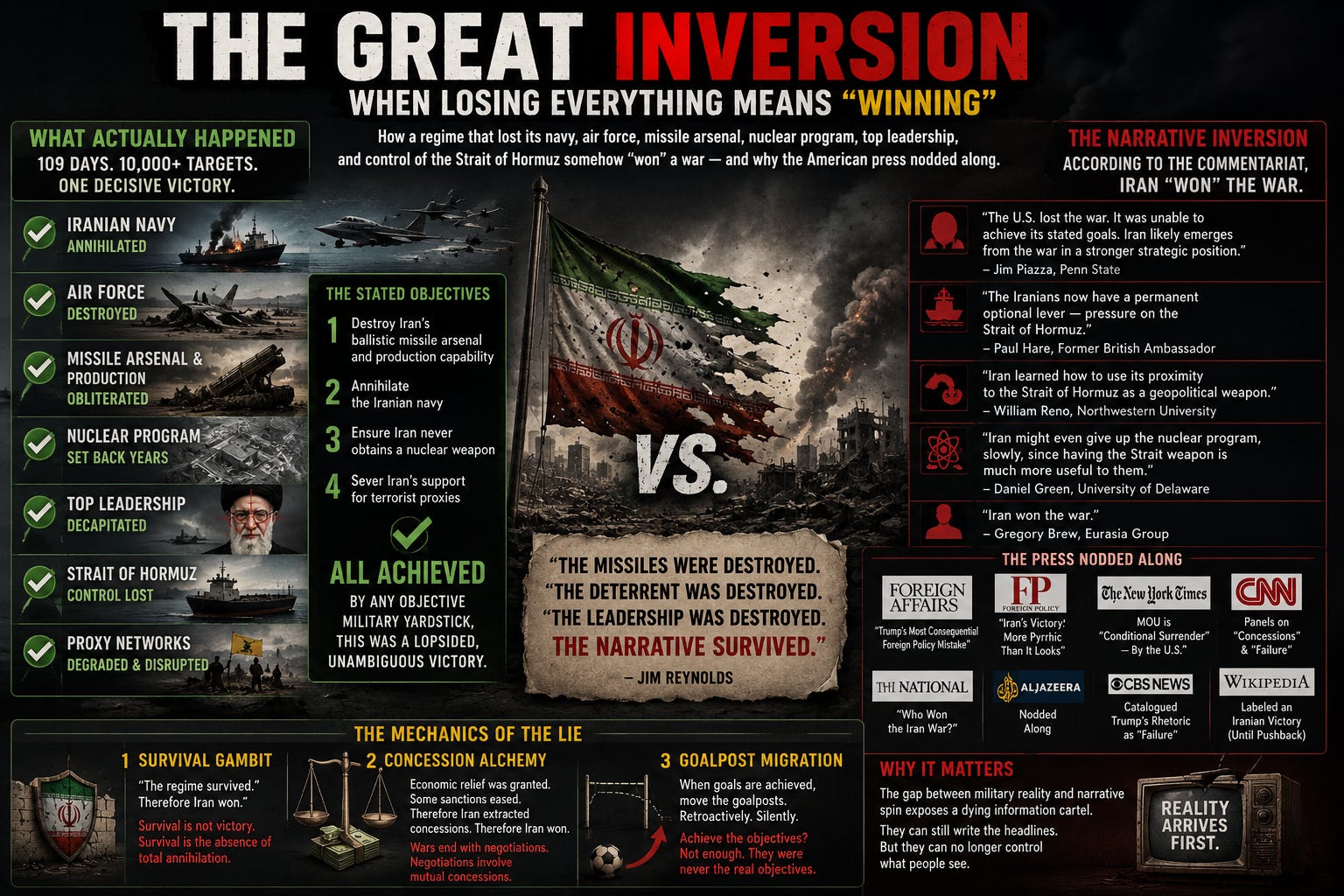
🔥 The Great Inversion: When Losing Everything Means “Winning”
How a regime that lost its navy, air force, missile arsenal, nuclear program, top leadership, and control of the Strait of Hormuz somehow “won” a war — and why the American press nodded along
By Jim Reynolds | www.reynolds.com
June 20, 2026
I. The Corpse That Declared Victory
Let’s start with what actually happened. Not what you read in the New York Times editorial section. Not what Mohammad-Bagher Ghalibaf announced through a megaphone in Tehran. Not what Foreign Affairs dressed up in think-tank jargon. What happened.
On February 28, 2026, at approximately 7:00 AM local time, the United States and Israel commenced the most intense American air campaign in a generation. Operation Epic Fury — paired with Israel’s parallel Operation Roaring Lion — struck more than 1,000 targets in the opening salvo alone. Over 10,000 combat flights followed in the first month. B-2 stealth bombers flew nonstop from the continental United States to hit hardened ballistic missile facilities. F-35s and F-16s specialized in suppression of enemy air defenses cleared the skies. By the time the dust settled, CENTCOM had struck more than 10,000 Iranian targets.
What got destroyed? The Iranian navy — most of it sunk. The air force — gone. Air defenses — degraded to irrelevance. Ballistic missile launchers, production facilities, and stockpiles — cratered. The IRGC command structure — decapitated. The Supreme Leader himself — killed in a strike on Tehran. Iran’s nuclear enrichment facilities at Fordow and Natanz, already devastated by Operation Midnight Hammer in June 2025, were hit again, along with the Isfahan nuclear complex, the Iran Atomic Energy Agency headquarters, and the explosive research testing facility at Parchin.
The Strait of Hormuz — Iran’s one geopolitical trump card, the chokepoint through which roughly one-fifth of global oil shipments pass — fell temporarily from its grasp. Proxy networks across the Middle East were disrupted and degraded.
And the objectives? They weren’t hidden. They weren’t ambiguous. They weren’t retroactively discovered by historians decades later. President Trump laid them out explicitly in his February 28 address, and the administration repeated them relentlessly — from the White House podium, from the Pentagon briefing room, from every venue available:
1. Destroy Iran’s ballistic missile arsenal and production capability
2. Annihilate the Iranian navy
3. Ensure Iran never obtains a nuclear weapon
4. Sever Iran’s support for terrorist proxies
White House Press Secretary Karoline Leavitt recited them verbatim on March 4, March 30, and again in April. Secretary of Defense Hegseth repeated them on March 19, March 26, and March 31. The President himself reaffirmed them on March 2. These were not vague aspirations. They were specific, measurable military objectives — the kind you can check against satellite imagery and after-action reports.
By any objective military yardstick — territory held, matériel destroyed, leadership eliminated, stated aims met — this was a lopsided, unambiguous victory.
And yet.
Open your browser. Turn on cable news. Scroll through the discourse. You will find, in all apparent seriousness, the claim that Iran won the war.
Not “Iran survived.” Not “Iran extracted concessions.” Iran won.
II. The Rogues’ Gallery of Reality-Deniers
The list is not fringe. It is not confined to Iranian state media. It spans the Western commentariat, the think-tank circuit, the halls of what used to be called “respectable” foreign policy analysis, and the editorial boards of the most prestigious publications in the English-speaking world.
Mohammad-Bagher Ghalibaf, Speaker of Iran’s Parliament, declared: “Iran won the war against the United States and Israel. The agreement is a record of US failure. People will see it and judge.” Fine. The man works for the regime that just got its teeth kicked in. His predecessor got vaporized. Propaganda from a theocracy fighting for narrative survival is not surprising. It’s expected. It’s what you say when you’re standing in the rubble of your own military and need to convince your population that the rubble was the plan all along.
But then the Western choir joined in.
Jim Piazza, political scientist at Pennsylvania State University: “The U.S. lost the war. It was unable to achieve its stated goals. Iran likely emerges from the war in a stronger strategic position.”
Read that again. Iran emerges stronger. The country that lost its navy, air force, missiles, nuclear infrastructure, air defenses, and supreme leader is now somehow stronger. This is not analysis. This is alchemy — the transmutation of catastrophic military defeat into strategic gold through the magic of redefined terms.
Paul Hare, former British ambassador: “The Iranians now have a permanent optional lever — pressure on the Strait of Hormuz.” Permanent optional lever. The chokepoint they lost control of is now somehow a permanent asset. The waterway the U.S. military forced open is now proof of Iranian leverage.
William Reno, Northwestern University political scientist: “Iran learned how to use its proximity to the Strait of Hormuz as a geopolitical weapon.” Learned? Iran has been threatening to close the Strait of Hormuz since the 1980s. The only thing it learned in 2026 is that attempting to do so gets your navy sunk and your ports blockaded.
Daniel Green, University of Delaware: “Iran might even give up the nuclear program, slowly, since having the Strait weapon is much more useful to them.” The Strait weapon. The one they don’t control. The one that’s being reopened under a negotiated framework. That weapon.
Gregory Brew of the Eurasia Group — the kind of analyst whose quotes move markets and shape boardroom strategy — flatly stated: “Iran won the war.”
Foreign Affairs ran a piece titled “The Long Shadow of the Iran War: Trump’s Most Consequential Foreign Policy Mistake,” describing the outcome as “the greatest foreign policy failure of both of Trump’s terms.” The magazine that once published George Kennan’s “X Article” now publishes the argument that destroying your enemy’s entire conventional military capability constitutes a failure.
Foreign Policy hedged slightly — calling Iran’s victory “more Pyrrhic than it looks” — but still framed the entire analysis around the premise of an Iranian win.
Al Jazeera segments nodded along. The National ran the headline “Who won the Iran war?” and concluded that Tehran “was badly weakened on the battlefield” but that the framework deal “may be handing it strategic gains.”
Wikipedia’s entry on the conflict was labeled an Iranian victory until the edit wars grew too embarrassing.
And the American press? The New York Times editorial page described the MOU as “conditional surrender” — by the United States. Representative Adam Smith, ranking member of the House Armed Services Committee, insisted American goals went unachieved. CNN panels gravely discussed the deal’s concessions, the regime’s survival, Israel’s supposed unhappiness with the outcome. CBS News ran a piece cataloguing every shift in Trump’s rhetoric as evidence of mission failure.
The framing was consistent and relentless: muddled failure, strategic capitulation, an embarrassing quagmire that left Iran stronger.
The country that just lost its navy, air force, missiles, nuclear infrastructure, and supreme leader is now somehow stronger. This is not analysis. This is not even spin. This is an act of mass suspended belief that would embarrass a flat-earth convention.
III. The Mechanics of the Lie
How do you pull this off? How do you convince millions of reasonably intelligent people that the side that lost everything actually won?
The method is not mysterious. It has three components, and once you see them, you will never unsee them.
The Survival Gambit
The logic, such as it is, runs: Iran’s regime survived. Therefore Iran won.
Foreign Policy articulated this with a straight face: “Survival against a combined US-Israeli assault is itself being read across the region as a win.” The National echoed: “Strategically, survival against a combined US-Israeli assault is itself being read across the region as a win.”
This is the rhetorical equivalent of a boxer getting knocked unconscious, hospitalized for three weeks, and then declaring victory because his heart never technically stopped beating. Survival is not victory. Survival is the absence of total annihilation. If the standard for “winning” a war is that your government still exists afterward, then Germany won World War I and World War II. Japan won the Pacific theater. The Confederacy — well, okay, bad example. But you see the absurdity.
Regime survival was never a stated American military objective. The administration explicitly declined to make regime change a core goal — despite Trump’s rhetorical flourish about Iranians taking over their government. The four objectives were about capabilities, not governance. The fact that the Islamic Republic still technically exists proves nothing except that the United States showed more restraint than its critics would ever acknowledge.
And what kind of “survival” are we talking about? The Supreme Leader is dead. His son Mojtaba was hastily installed as successor. The IRGC command structure was decapitated. The security apparatus is operating from “a distributed spider-hole defensive posture.” The regime that “survived” is not the regime that started the war. It’s a wounded, scrambling remnant — surviving the way a man who’s lost both legs “survived” the car crash.
Bob:🅱️ “Does anybody remember Baghdad Bob?”
Bob:🅱️ “Apparently victory now means getting your teeth kicked in and keeping your mailing address.”
The Concession Alchemy
The second argument points to the Memorandum of Understanding. Economic relief was granted. Some sanctions were eased. Frozen assets were released. A $300 billion reconstruction fund was floated. Therefore, Iran extracted concessions. Therefore, Iran won.
Foreign Affairs framed it darkly: Iran “may now be set to receive economic relief in exchange for restoring free passage in a strait that was open before the war began.” The implication: the U.S. paid Iran to reopen a waterway Iran itself had disrupted. The U.S. was the sucker at the table.
This ignores the obvious reality that negotiated settlements routinely include incentives designed to lock in battlefield outcomes. The alternative to the MOU was not “Iran surrenders unconditionally and pays reparations.” The alternative was indefinite military operations, occupation of Iranian territory, and the slow bleed of a forever war — exactly the outcome the same critics would have denounced as Bush-era adventurism.
If economic concessions secure the permanent destruction of military capabilities that took decades and billions of dollars to build, the concessions are part of the settlement — not proof that the settlement failed. The critics treat every diplomatic compromise as evidence of defeat while ignoring the capabilities that were surrendered in exchange.
Iran gave up: its nuclear breakout capacity, its conventional deterrence, its navy, its missile production infrastructure, its air defenses, its ability to project power beyond its borders. The United States gave up: some sanctions, some frozen assets, and a promise to negotiate further.
That is not a sucker’s deal. That is a trade of economic relief for permanent military degradation. The fact that Iran got anything does not mean Iran won. It means wars end with negotiations, and negotiations involve mutual concessions.
Bob:🅱️ “Looks like they haven’t read Trump’s book about making deals.”
The Goalpost Migration
This is the masterstroke. When the actual stated goals are met, you simply change the goals. Retroactively. Without acknowledging you’ve done it.
CBS News ran an entire piece cataloguing Trump’s shifting rhetoric — from “destroy their missiles” to “it’s OK for Iran to keep some” — as evidence of failure. Foreign Affairs complained that “concerns over Iran’s nuclear program, ballistic missile arsenal, and support for proxies across the Middle East remain largely unresolved.” Jim Piazza declared flatly that the U.S. “was unable to achieve its stated goals.”
But the stated goals were never “eliminate every last missile from Iranian territory.” They were “destroy Iran’s ballistic missile arsenal and production capability” — meaning the industrial capacity to manufacture and deploy them at scale. The stated goals were never “end all proxy activity forever.” They were “sever Iran’s support for terrorist proxies” — meaning degrade the funding, arming, and directing of those networks. The stated goals were never “regime change.” They were “ensure Iran never obtains a nuclear weapon.”
On the actual, documented, repeatedly articulated objectives, the U.S. and Israel delivered decisively. The goalpost shift is the mechanism by which success becomes failure: take the original objectives, achieve them, then insist the real objectives were always something more maximalist — regime change, total disarmament, the permanent elimination of every IRGC officer, the establishment of a Jeffersonian democracy in downtown Tehran by the Fourth of July.
Since these unstated maximalist goals were not achieved, the operation was a failure. QED.
This is not argument. It is intellectual fraud. It is the foreign policy equivalent of your contractor building you exactly the house you specified in the blueprints, then you refusing to pay because it doesn’t have the indoor pool you never asked for.
Bob:🅱️ “This may be the way they run elections in California, but maybe not so effective in the Middle East.”
IV. The Media Is Not Stupid. It’s Worse.
Many people ask why so much of the press seems incapable of acknowledging obvious outcomes. The answer is not stupidity. Stupidity would be an upgrade. Stupidity implies honest confusion. What we’re dealing with is motivated cognition at institutional scale.
The legacy press — the Times, the Post, CNN, MSNBC, the polite center-left organs of respectable opinion — operates under a set of incentives that make honest assessment of this war structurally impossible.
First, there is the Trump factor. Any military success under this president must be diminished, contextualized, reframed, or outright denied. The institutional hatred is so consuming that it has devoured basic empirical judgment. If Trump ordered the sun to rise in the east, the Times editorial board would publish “Daybreak: A Reckless Escalation of Illumination” by 9 a.m.
The evidence for this is not subtle. The same publications that spent years insisting the 2015 JCPOA was a diplomatic masterpiece now describe the 2026 MOU — which achieved far more in terms of actual capability degradation — as a catastrophic failure. The same analysts who praised Obama’s “strategic patience” with Iran now condemn Trump’s decisive military action as reckless adventurism. The standard shifts because the name on the policy shifted.
Second, there is audience capture. The subscribers and viewers of these outlets expect a certain narrative. They pay for confirmation, not information. A headline reading “US Achieves Decisive Military Objectives in Iran” would provoke cancellation rage. “Trump’s Iran Debacle: How Strategic Overreach Strengthened Tehran” keeps the checks clearing. The business model depends on telling the audience what it wants to hear — and what it wants to hear is that Trump failed.
Third, there is the professional-class pathology of conflating diplomatic messiness with strategic failure. Wars are ugly. Endings are uglier. The MOU is imperfect. Proxies still exist. Iran’s government still exists. In the seminar-room worldview of the foreign policy commentariat, any outcome short of the pristine theoretical ideal is a “quagmire” or a “fiasco.” These people have never built anything, never managed anything, never had to make a consequential decision under uncertainty. They grade papers for a living. And they grade military operations on the same curve — deducting points for messiness while ignoring whether the assignment was actually completed.
The result is a media environment where empirically falsifiable claims — “Iran won the war” — circulate without challenge, while the observable reality of 10,000+ targets destroyed, a navy at the bottom of the Persian Gulf, decapitated leadership, and diluted nuclear stockpiles is treated as somehow beside the point.
Bob:🅱️ “The missiles were destroyed. The deterrent was destroyed. The leadership was destroyed. The narrative survived. That’s what they’re really defending.”
Bob:🅱️ “They didn’t redefine victory because Iran won. They redefined victory because Trump did.”
V. The Information War and Why It Matters
This is not merely an academic dispute about how to score a conflict. The gap between military reality and narrative spin has consequences — and the most important one is the exposure of a dying information cartel.
For decades, major media institutions enjoyed near-monopoly control over public interpretation. They could define success. Define failure. Define reality itself. If the New York Times said a war was lost, it was lost. If Foreign Affairs said a strategy was failing, it was failing. There was no competing source of authority, no alternative lens through which the public could evaluate events.
That power is fading. And this war is accelerating its collapse.
People can see satellite imagery. They can watch combat footage. They can compare statements made before a conflict with statements made afterward. They can pull up the White House transcript from February 28, read the four objectives, and check them against observable outcomes. The gap between the approved narrative and empirical reality has become too wide to bridge.
When Foreign Affairs can publish “The Long Shadow of the Iran War: Trump’s Most Consequential Foreign Policy Mistake” while Iran’s navy sits at the bottom of the Persian Gulf and its nuclear facilities are smoking craters, something has broken in the information ecosystem. When a Penn State political scientist can claim the U.S. “lost the war” with a straight face while the stated objectives were achieved, the concept of expertise has been drained of all meaning. When a former British ambassador can describe a waterway Iran lost control of as a “permanent optional lever,” the language of foreign policy analysis has become untethered from reality.
This is the last gasp of a dying information cartel. They can still write the headlines. They can still book the cable news panels. They can still publish the think-tank white papers and the prestigious journal essays. But they can no longer control what people see. The empirical world pushes back. And credibility, once lost on this scale, does not return.
The old media once told people what reality was. Now reality arrives first. The headlines have to chase it.
And that may be the biggest defeat in this entire story.
VI. The Simple Truth
Here is what happened. Strip away the spin, the partisan incentives, the goalpost migration, and the survival-as-victory sophistry:
The United States and Israel identified four specific, measurable military objectives regarding Iran’s conventional capabilities and nuclear program. They articulated those objectives publicly, repeatedly, and unambiguously. They then executed a 109-day military campaign that struck more than 10,000 targets, flew over 10,000 combat sorties, employed every operational fighter, bomber, and aerial tanker in the U.S. inventory, and systematically destroyed Iran’s ability to threaten its neighbors and the world.
The navy was annihilated. The missile arsenal and production infrastructure were obliterated. The nuclear program was set back years, with enrichment stockpiles diluted under a signed agreement. Proxy networks were degraded and disrupted. The Supreme Leader was killed. The IRGC command structure was decapitated.
The MOU locked in those gains at acceptable diplomatic cost. Iran’s ability to project power has been set back by a generation. Its nuclear ambitions are, for now, contained.
This is called winning.
The fact that this statement is controversial — that it must be defended at length against a united front of Iranian propagandists, anti-Trump partisans, captured think-tank analysts, and prestige media editorial boards — tells you everything you need to know about the state of our institutions.
A regime that lost its navy, air force, missiles, nuclear program, supreme leader, and control of its most strategic waterway did not win a war. It survived one. There is a difference. And the difference is visible to anyone still willing to open their eyes.
The question is not whether Iran won. It plainly did not.
The question is why so many people with impressive titles and prestigious bylines felt compelled to say it did.
And the answer to that question is the real story — the story of an information cartel that can still write the headlines but can no longer control what people see, still publish the analyses but can no longer define the terms, still claim authority but can no longer command belief.
The missiles were destroyed. The deterrent was destroyed. The leadership was destroyed. The narrative survived.
But not for long. Not when reality arrives first.
AFTERWORD: A SIMPLE TEST
There is an easy way to test whether this debate was ever really about military outcomes.
Ask a simple question:
What result would have caused these same critics to conclude that the United States and Israel had won?
Iran’s navy destroyed?
Not enough.
Missile infrastructure destroyed?
Not enough.
Nuclear facilities crippled?
Not enough.
Proxy networks degraded?
Not enough.
The Supreme Leader killed?
Apparently not enough.
So what would have been enough?
The question matters because if the answer is “nothing,” then the debate was never about military success or failure in the first place.
It was about narrative protection.
The strongest evidence for goalpost migration is not that the goalposts moved after the war.
It is that there appears to have been no imaginable outcome under which many of the war’s critics would have acknowledged victory.
If every possible outcome leads to the same conclusion, then the conclusion did not come from the evidence.
The evidence arrived later.
The conclusion was already waiting for it.
That is why this argument matters far beyond Iran.
It tells us something about our institutions, our media, and our political culture.
When reality becomes negotiable, victory becomes defeat, survival becomes triumph, and words lose their connection to the things they describe.
Eventually, however, reality gets a vote.
And reality is notoriously difficult to fact-check away.
Best summary I've seen of actual results of the events, versus fake media's falsification of same. Seems our culture is in midst of a massive shift from print & TV media to internet media postings as the main trusted source of reliable info.
To me, the bottom line as described by Jim is that:
“The strongest evidence for goalpost migration is not that the goalposts moved after the war.
It is that there appears to have been no imaginable outcome under which many of the war’s critics would have acknowledged victory.
If every possible outcome leads to the same conclusion, then the conclusion did not come from the evidence.
The evidence arrived later.
The conclusion was already waiting for it.”