


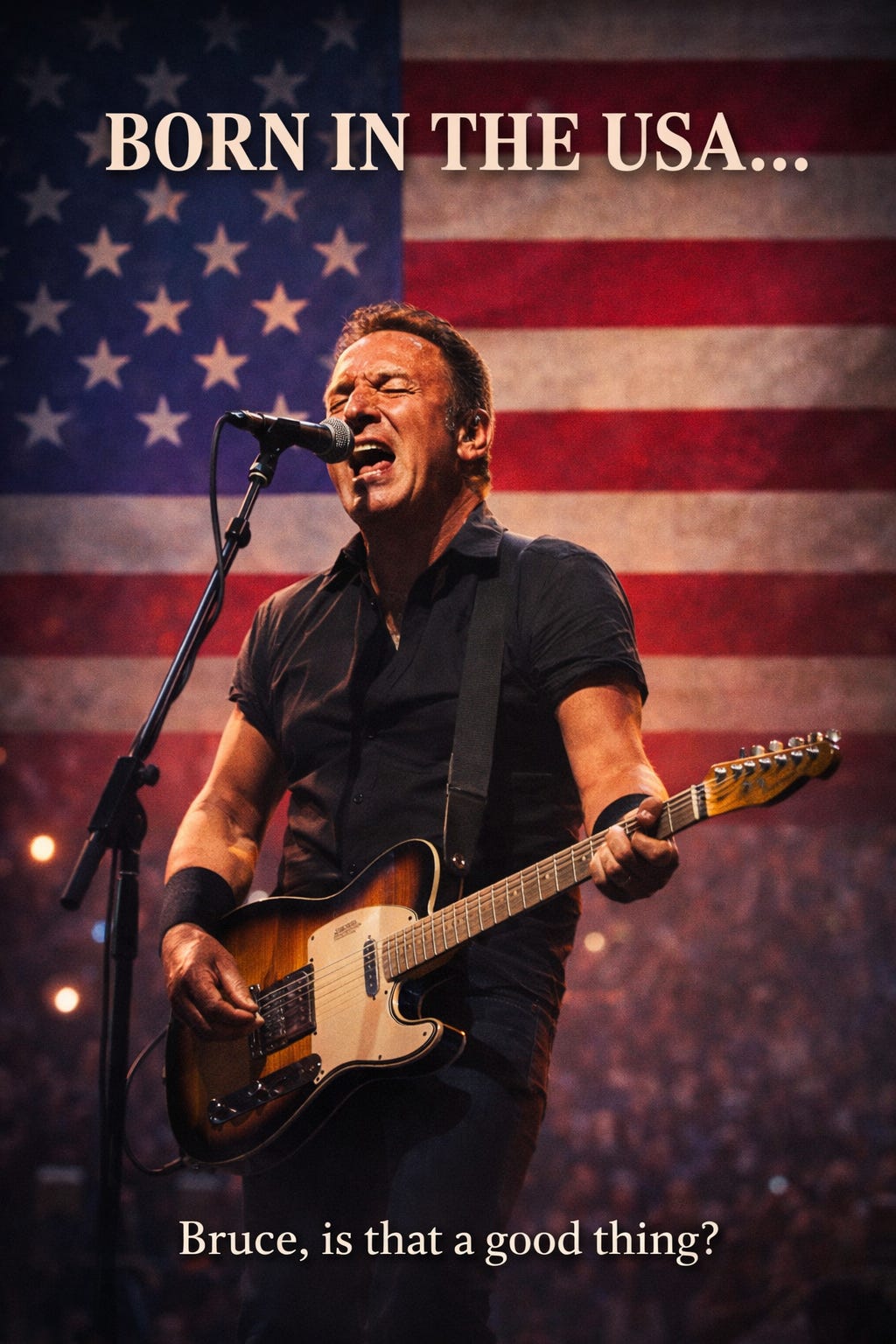
The Hard-Working Man
How Bruce Springsteen’s Most Famous Character Outlived Its Author
By Jim Reynolds | www.reynolds.com
Bruce Springsteen built one of the most durable characters in American popular culture:
the hard-working man.
Not a specific person—more an archetype. A guy with grease under his nails, bills on the table, pride bruised but intact. Someone who worked, endured, and didn’t ask to be rescued. The music didn’t preach politics; it narrated constraint. Dignity under pressure. Limits, choices, consequences.
That character carried a generation.
But characters can calcify. And sometimes the performer forgets which parts were costume.
Today, Springsteen’s public posture collides hard with the myth that made him. Not because he became wealthy—success isn’t a crime—but because he now speaks against the very premise that animated the work: individual agency, self-direction, earned dignity.
A man whose fortune sits comfortably in the hundreds of millions of dollars now scolds the country that enabled that ascent—while continuing to perform as if he still stands inside the story.
That’s the fracture.
⸻
Class Without Consequence
Springsteen’s persona was never really about poverty. It was about responsibility. About people who didn’t outsource meaning or blame. About lives shaped by choices rather than explanations.
Which makes the pivot so jarring.
Over time, the hard-working man was replaced by the lecturing man—moralizing from the safety of cultural elevation, denouncing voters who no longer behaved as expected, sneering at the country that once supplied his raw material.
You can hear the tension in the rhetoric: America is something to endure, not belong to. Citizenship becomes embarrassment. Disagreement becomes pathology. The working class becomes a prop—useful when singing, disposable when voting.
There’s an unspoken irony here: the hard-working man Springsteen made famous would not recognize himself in Springsteen’s politics. That man believed effort preceded reward. That agency mattered. That dignity didn’t come from institutions but from standing up straight when no one was watching.
When artists abandon the values that gave them voice, the songs don’t vanish—but they hollow.
⸻
A Real Moment — And Why It Matters
To be fair, Springsteen did help create something real once.
There was a moment—rare, genuine, and worth preserving—when he stood alongside Roy Orbison and others, not as a spokesman or scold, but as a participant in something larger than himself. That collaboration worked precisely because it wasn’t about posture or politics or instruction. It was about craft, lineage, and shared musical respect.
Orbison didn’t need a narrative.
He didn’t need a constituency.
He didn’t need to be explained.
And Springsteen, in that setting, didn’t try to dominate or correct. He listened. He blended. He showed restraint. For a brief window, the costume came off and the musician showed up.
That matters—because it proves the talent was real.
And that the myth wasn’t always hollow.
Which makes what came later more revealing, not less.
The problem was never that Springsteen lacked ability.
It’s that he eventually stopped trusting it.
⸻
The Museum Effect
At some point, the act stops evolving and starts curating itself.
Springsteen’s work has slowly migrated from lived experience to exhibit—a carefully preserved representation of rebellion, piped through stadium speakers. The character remains frozen in amber while the author climbs ever further from the conditions that gave it meaning.
The Boss gradually became a museum exhibit with a sound system.
And that’s fine—until the exhibit starts lecturing the visitors about how backward they are.
The hard-working man doesn’t need permission to exist. He doesn’t need to be softened, managed, or corrected. He doesn’t ask to be re-educated by people who long ago left the imagined factory floor and never looked back.
⸻
Why This Lands Now
Springsteen’s recent lashing out isn’t just political—it’s existential. The audience he once claimed as kin no longer takes instruction. They’ve moved on. Not because they became cruel or ignorant, but because they recognized the performance had flipped.
The voice that once narrated constraint now demands compliance.
The storyteller became an administrator.
There’s nothing wrong with becoming an institution.
There’s something wrong with pretending you’re still the rebel.
⸻
Closing Note
Springsteen may be Born in the U.S.A., but pride in that fact has always sat awkwardly with him. Disdain is easier to express than gratitude. Condemnation travels faster than reflection.
And that’s the final irony.
The hard-working man he made famous never asked to be saved. He asked to be left alone to build something—slowly, imperfectly, honestly. When that character is dismissed as outdated, cold, or morally suspect, people notice.
They don’t boo.
They don’t riot.
They simply stop listening.
And once that happens, all that remains is the exhibit—
lights on, speakers loud, meaning quietly gone.
————————————-
Here are the full lyrics to his “Streets of Minneapolis” song. This is the raw material the Boss dropped yesterday—passionate, memorializing, accusatory. Some might say — brimming with stupidity and and a severe case of TDS.
Through the winter’s ice and cold, down Nicollet Avenue, a city of flame fought fire and ice ‘neath an occupier’s boots.
King Trump’s private army from the DHS, guns belted to their coats, came to Minneapolis to enforce the law, or so their story goes.
Against smoke and rubber bullets, in dawn’s early light, citizens stood for justice, their voices ringing through the night.
And there were bloody footprints where mercy should have stood. And two dead left to die on snow-filled streets, Alex Pretti and Renee Good.
Minneapolis, I hear your voice singing through the bloody mist. We’ll take our stand for this land and the stranger in our midst.
In our home, they killed and roamed in the winter of ‘26. We’ll remember the names of those who died on the streets of Minneapolis.
Trump’s federal thugs beat up on his face and his chest. Then we heard the gunshots and Alex Pretti lay in the snow dead.
Their claim was self-defense, sir, just don’t believe your eyes. It’s our blood and bones and these whistles and phones against Miller and Noem’s dirty lies.
Minneapolis, I hear your voice, crying through the bloody mist. We’ll remember the names of those who died on the streets of Minneapolis
Now they say they’re here to uphold the law, but they trample on our rights. If your skin is black or brown, my friend, you can be questioned or deported on sight.
In chants of “ICE out now,” our city’s heart and soul persists, through broken glass and bloody tears on the streets of Minneapolis.
Minneapolis, I hear your voice, singing through the bloody mist. Here in our home, they killed and roamed in the winter of ‘26.
We’ll take our stand for this land and the stranger in our midst. We’ll remember the names of those who died on the streets of Minneapolis.
We’ll remember the names of those who died on the streets of Minneapolis.
Bob Comments (Translation from Lefty Rant to English):
“Occupier’s boots” — Federal agents enforcing federal law are now a foreign army. Words mean whatever they need to mean this week. ICE enforces laws passed by Congress, under administrations of both parties; if enforcement is ‘occupation,’ then the entire federal code is occupation.
“King Trump’s private army” — DHS is not private, not Trump’s, and not an army. It’s a federal agency doing its job.
“Citizens stood for justice” — Many were organized, paid protesters, coordinating in real time. That’s not a civil rights march; it’s logistics.
“Voices ringing through the night” — They banged pots, blew whistles, and deliberately prevented sleep. That’s not singing; that’s harassment.
“Mercy should have stood” — Apparently mercy applies to everyone except law enforcement officers trying not to freeze or get overrun.
“Bloody mist” — Curious how there’s no “bloody mist” in the other 49 states where ICE enforces the same laws every day.
“Take our stand for this land” — The criminals being removed are not from this land. That is literally the issue.
Miller and Noem’s “dirty lies” — They’re not lying; they’re enforcing statutes passed by Congress. Calling that “lies” is just narrative maintenance.
“Black or brown… deported on sight” — ICE targets known violent criminals who are illegal aliens. If they’re disproportionately non-white, that’s math, not racism.
Broken glass — ICE didn’t break it. Your people did. Own your mess.
Moral urgency — If you feel this strongly, Bruce, you’re welcome to join your friends on sub-zero streets in the winter of ’26 instead of mythologizing it from a warm studio.
Stylistic note — This reads like a bargain-bin Gordon Lightfoot impression, minus the restraint, insight, or accuracy.
Bottom line:
This isn’t a protest song. It’s a grievance cosplay — emotionally overheated, fact-free, and proudly incurious. A tragedy rewritten as propaganda, with accountability carefully edited out.
==================
Here’s Bob’s version of Springsteen’s pathetic tune, which the Boss delivers in a thin, exhausted whine, heavy on accusation and light on truth.
“MINNEAPOLIS: A WINTER OF VERY NICE CRIMES AND 19 BILLION DOLLARS OF WELFARE FRAUD”
Well gosh, it was awful cold that winter
Down Nicollet, slick as a rink
Law enforcement tried not to fall down
While democracy went down the sink
The Feds came in, doing their jobs
Enforcing federal law — how rude
With their parkas zipped and their boots on ice
Just trying not to fracture a dude
They weren’t stormtroopers, no sirree
Just agents with warrants and names
But in Minnesota that’s extremism
If it interferes with the grift and the games
Now the locals were told, real gentle-like:
“Why don’t you folks just stand right down?”
So city cops watched from warm squad cars
While the Feds got swallowed by a waiting crowd
And oh my goodness, what a crowd it was
Organized, paid, and queued
Signal pings lighting up every phone:
“Unit Bravo moved.”
“ICE van turning left.”
“Block the street.”
“Who’s got bail?”
“Good job, comrades — very good.”
Signal communiqués echoing citywide
Sneaky as church bells, only faster
Every federal move mapped in real time
By activists employed by… well… someone with cash
(Oh, that’d be Singham, wouldn’t it?)
Funny how that works out neat
Global money, local chaos
All coordinated from a very warm seat
Meanwhile it was twenty below
The kind of cold that hurts your thoughts
Fingers numb, radios freezing
Boots sliding where the law was taught
Try crowd control on black ice, friend
Try restraint when you can’t feel your face
Try enforcing law while the mayor says
“Gosh, this really isn’t our place.”
And speaking of leaders — bless their hearts —
Governor Walz and the mayor smiled
They could’ve shut it down in an instant
For the safety of every child
One order. One call. One press conference.
“Stand down, this is dangerous.”
But they didn’t.
They watched.
They nodded.
They preened.
They let it burn — very neighborly and treacherous.
Complicit as snow in January
Complicit as mittens on hands
They chose the chaos, chose the crowd
Chose the money, chose the plan
And hey — quick question, real polite:
Where are the Somalis tonight, then?
Not freezing in streets, not chanting on ice
Not dodging rubber bullets or cameras or lights
Curious, that.
Almost like the folks being “defended”
Aren’t the ones being spent.
Then came the violence, real unfortunate
Real tragic, don’tcha know
Blood on snow — that stains something fierce
Even when the wind tries to blow
And somewhere nearby, humming patiently
Like it’s been here before
The wood chipper waited, metaphorical
For truth, for law, for norms, for order, for more
Minnesota nice fed feet-first
Into a machine of lies and fraud
While everyone swore they were shocked — shocked!
That ignoring law might have a cost
Minneapolis, I hear your voice
Soft, trembling, rehearsed
Saying “This isn’t who we are”
While proving it verse by verse
You could’ve stopped it any time
That’s the part that sticks like ice
This wasn’t chaos — it was policy
Done Minnesota nice
And when they ask how it all went wrong
Just smile, shrug, and say:
“Well gosh… it’s complicated, you see.
Now please step aside — you’re in the way.”
One thing we all know
One thing we can confess:
Only a fool brings a gun
To an ICE fest.
You nailed it Jim. I was feeling and thinking the same thing just not as eloquently. I was a Springsteen fan in his early days but he lost me when it became political.
Amen! Mailing a copy to BS.