


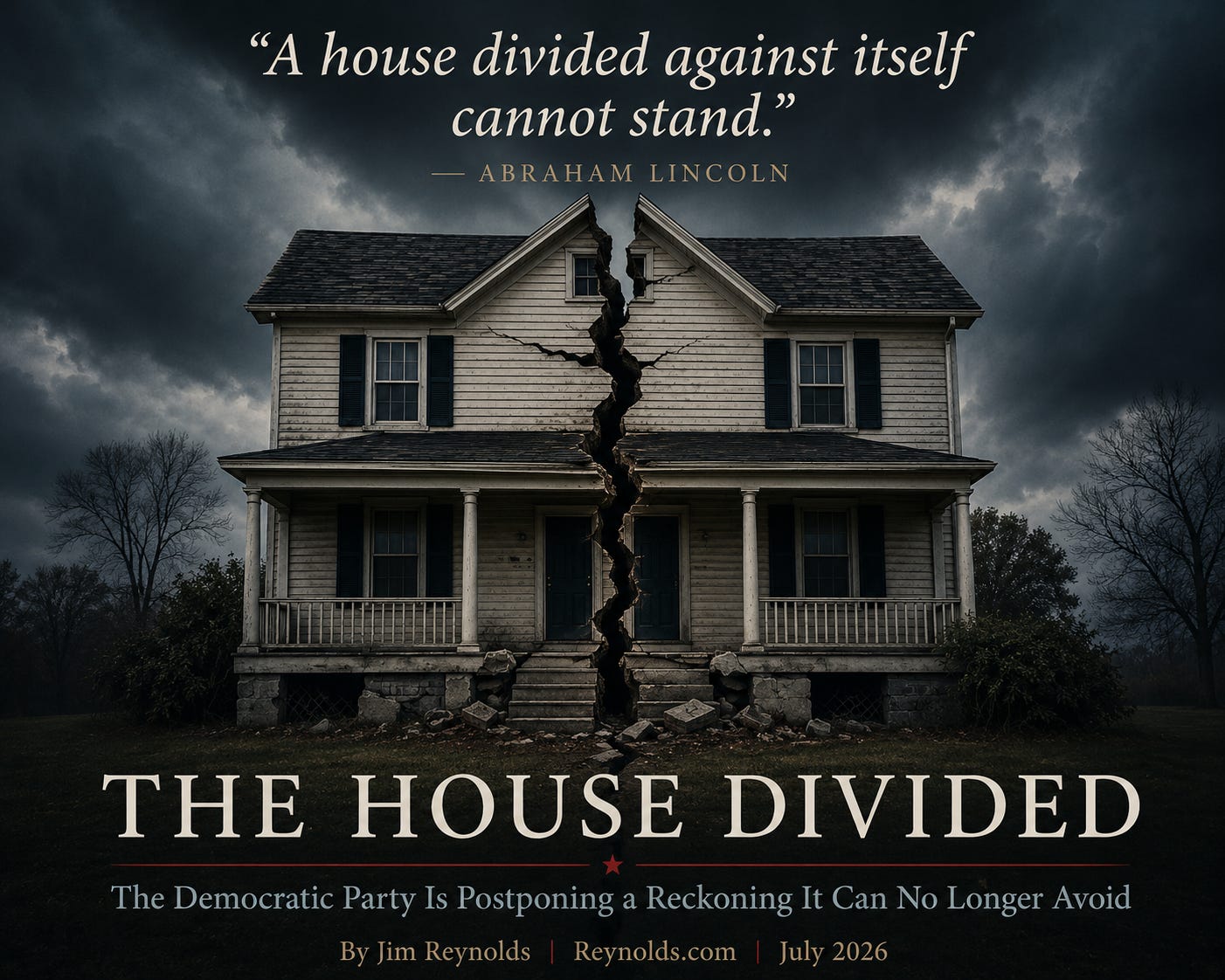
The House Divided
The Democratic Party Is Postponing a Reckoning It Can No Longer Avoid
We’re Gonna Need a Bigger Headstone
By Jim Reynolds | Reynolds.com
July 27, 2026
The Democratic Party may be approaching one of those political moments that appears gradual—until suddenly it is not.
The immediate question is whether Democrats will suffer historic losses in the 2026 midterm elections.
They may.
But that is not the larger story.
The larger story is that the Democratic Party is becoming a house divided against itself, and its leaders are increasingly afraid to acknowledge the division in public.
One faction still presents itself as the familiar center-left Democratic Party: regulated capitalism, traditional alliances, organized labor, civil rights, government programs and incremental reform.
The other faction believes the existing economic and political order is fundamentally illegitimate and must be replaced.
That is not a disagreement over the size of a child tax credit.
It is a disagreement over the country itself.
The Democratic Socialists of America openly calls for placing the largest corporations under public ownership and democratic control. Its program advocates replacing major features of the existing constitutional system with a new democratic constitution and a single federal legislature based on proportional representation. It describes capitalism not as a system requiring reform, but as the central adversary in a broader struggle for socialism. (DSA Program)
Most Democratic senators do not openly endorse that program.
Most Democratic members of the House would not run on it in a competitive district.
Senate Democratic Leader Chuck Schumer does not call himself a socialist. House Democratic Leader Hakeem Jeffries does not campaign for the public ownership of America’s largest corporations. Neither man presents the DSA program as the national Democratic platform. (U.S. Senate)
They understand that it would be politically poisonous throughout much of the country.
Yet they are unwilling to confront it directly.
That is the hinge.
The Elephant in the Room
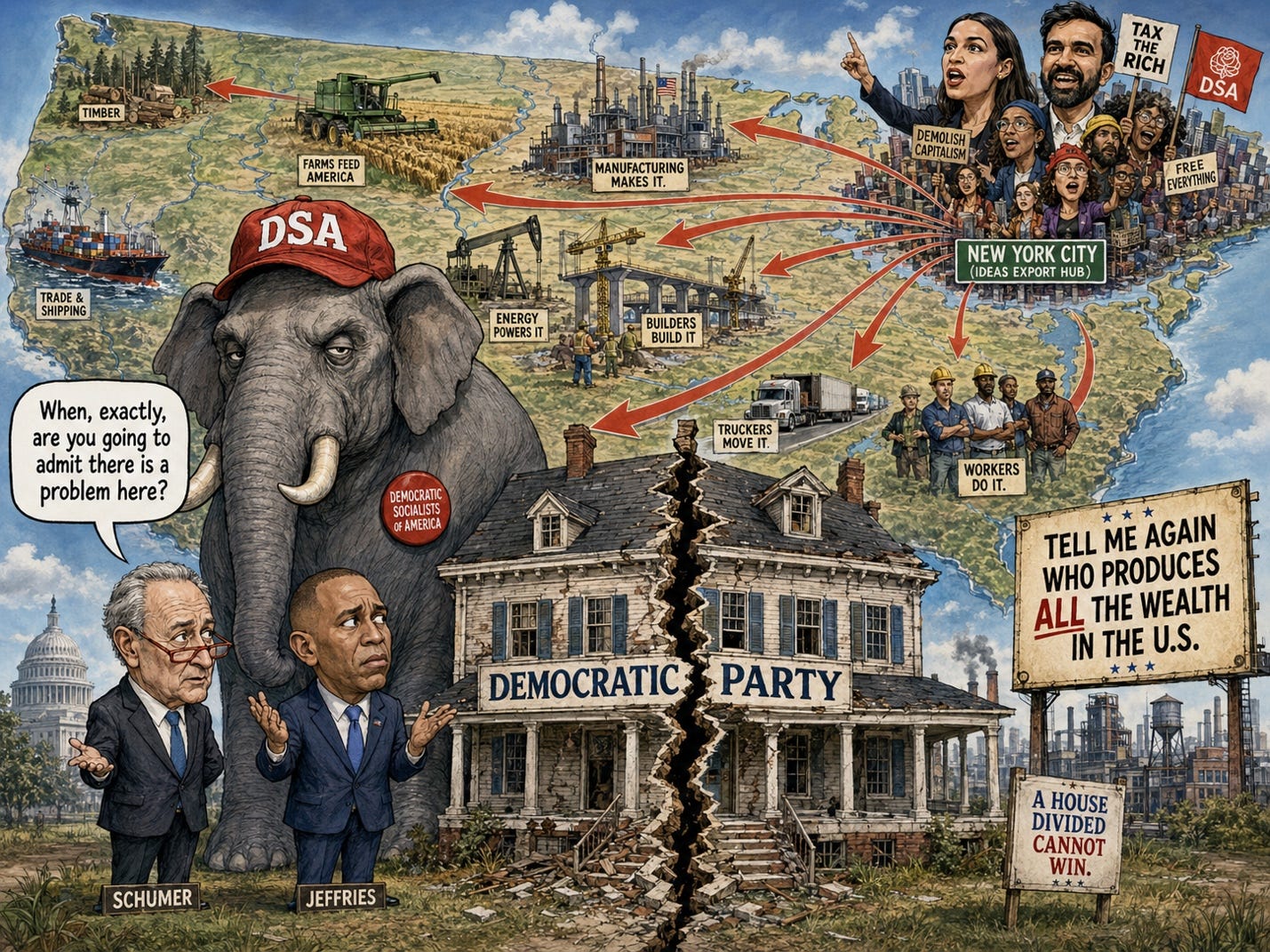
The DSA is the elephant in the Democratic room.
It is influential enough to frighten Democratic incumbents, organize primary challenges, supply campaign workers and dominate political discussion in some of America’s largest cities.
But it is not popular enough for Democratic leaders to embrace openly.
The establishment wants the activists, the energy, the urban turnout and the organizational machinery.
It does not want the label.
That creates a revealing arrangement.
The DSA participates in Democratic primaries while openly declaring that ordinary Democratic liberalism is inadequate. Its strategists speak of building organizations capable of moving or ultimately overcoming the existing labor-liberal Democratic establishment. (Socialist Forum)
Meanwhile, Democratic leaders continue telling the broader country that the party remains practical, moderate and familiar.
Both stories cannot remain true indefinitely.
One faction wants to manage American capitalism.
The other wants to replace it.
One faction wants to reassure Jewish voters, police officers, private-sector workers, suburban families and small-business owners.
The other increasingly views several of those constituencies—and the institutions they represent—as impediments to ideological transformation.
One faction presents the Democratic Party as a guardian of existing American institutions.
The other describes those same institutions as instruments of exploitation, oppression and capitalist power.
These are not merely different priorities.
They are rival political projects occupying the same organization.
Bob:🅱️ “When leaders refuse to draw a line, the loudest faction eventually draws it for them.”
Why Silence Matters
Political parties can survive disagreement.
They cannot indefinitely survive denial.
The intelligent time to confront a serious internal problem is when it is still small. At that stage, leaders can establish boundaries, reconcile factions and decide what the organization actually stands for.
Recognizing a problem early usually permits an orderly repair.
Recognizing it late means attempting to repair something that has been allowed to crack, spread and harden.
The Democratic Party is well beyond the early-recognition stage.
Its leaders have spent years treating fundamental contradictions as temporary messaging problems.
Moderation is presented to general-election voters.
Radicalism is tolerated in protected urban districts.
Traditional constituencies are reassured.
Activists are promised transformation.
Everyone is permitted to hear a different Democratic message.
That postpones the pain.
It does not remove it.
Bob:🅱️ “You can postpone a civil war inside a party. You cannot cancel it.”
Every year of avoidance makes the eventual choice more destructive. More officeholders become invested in the activist program. More moderates leave or become silent. More Democratic incumbents fear primary challenges. More leaders discover that they can no longer criticize ideas they privately know are nationally unpopular.
A problem that might once have been settled through internal debate is approaching the catastrophic stage.
The party is not merely arguing about tax rates.
Its factions disagree about capitalism, policing, immigration enforcement, Israel, race, constitutional restraints, national sovereignty and whether existing American institutions deserve preservation at all.
Eventually, the Democrats must answer a simple question:
What kind of party are they?
They cannot answer because the answer would force the confrontation they have spent years avoiding.
New York Is Not America
The success of democratic socialism in New York City has encouraged the belief that the movement represents the future of the Democratic Party.
It may represent the future of certain Democratic primaries.
That is not the same thing.
AOC’s district is not America.
New York City is not America.
Neither are the handful of dense, culturally captured urban areas in which universities, nonprofit organizations, public-sector employment, activist groups and one-party government continuously reinforce one another.
These are protected political ecosystems.
Candidates can advance positions that would end campaigns almost anywhere else—and then win by overwhelming margins.
A socialist victory in Queens, Brooklyn or the Bronx demonstrates that socialism can win a Democratic primary in Queens, Brooklyn or the Bronx.
It does not establish that the same program appeals to a machinist in Pennsylvania, a Hispanic contractor in Nevada, a police officer on Long Island, a Black tradesman in Georgia or a suburban mother in Michigan.
The DSA mistakes concentrated power for broad popularity.
That dog does not hunt across most of America.
The clearest current example is New York Mayor Zohran Mamdani.
Mamdani campaigned on an ambitious democratic-socialist program that included free bus service, city-operated grocery stores, new taxes, expanded public programs, a rent freeze and a broad restructuring of public safety.
Once he encountered the legal, fiscal and administrative limits of city government, several promises were stalled, reduced, redirected or made dependent upon cooperation from Albany. His first major budget has also drawn criticism for relying heavily on state assistance and postponed pension costs. (Time)
Even the DSA’s New York chapter has criticized his decision to increase police staffing beyond what activists had expected. (City & State New York)
Mamdani did obtain a rent freeze for roughly one million regulated apartments, but landlords have challenged the decision in court, arguing that the process disregarded operating costs and economic reality. (The Wall Street Journal)
This is what happens when ideological promises meet governing consequences.
The Left is often very good at winning the promise.
It has much more difficulty governing the consequence.
The Coalition Is Moving Beneath Them
For decades, Democratic political strategy depended heavily upon racial identity.
The party could lose large numbers of white working-class voters and remain competitive because Black voters delivered overwhelming Democratic margins, Hispanics appeared to be moving permanently toward the party and younger minority voters were expected to become even more progressive.
That theory is no longer secure.
Donald Trump’s 2024 coalition was more racially diverse than his previous coalitions. Hispanic voters divided nearly evenly, and Republicans made measurable gains among Black, Hispanic and Asian voters. (Pew Research Center)
That does not mean Democrats have lost those groups.
It means they can no longer treat them as permanent political property.
A Hispanic small-business owner may care more about prices, public order, schools and immigration enforcement than about activist appeals to ethnic identity.
A Black working-class man may resent being addressed primarily through grievance while his concerns about employment, crime, fatherhood and opportunity receive less attention.
A Jewish voter may accept ordinary disagreement over Israeli policy but refuse to remain in a coalition whose leaders appear unwilling to confront hostility toward Israel within their own ranks.
The Democratic answer has often been to play the racial-identity card again.
But that card produces diminishing returns when Americans increasingly see themselves not merely as racial categories, but as parents, workers, believers, homeowners, veterans, entrepreneurs and citizens.
Without racial bloc voting, the Democratic coalition becomes much harder to maintain.
Yet the activist wing remains deeply invested in precisely the racial and identity categories that are losing their power to enforce political conformity.
Once again, the party is caught between two incompatible needs.
It requires identity politics to hold its coalition together.
But its continued reliance on identity politics drives more voters out of that coalition.
Labor Is Not the DSA
The same error appears in the DSA’s claim to represent working people.
Organized labor is not a single ideological constituency.
Police unions, firefighters, construction trades, corrections officers, utility workers and private-sector manufacturing unions do not necessarily share the worldview of university activists, nonprofit organizers and socialist politicians.
Many union members support better wages, stronger bargaining power, apprenticeships, pensions and workplace protections.
That does not mean they support dismantling capitalism, weakening law enforcement or importing the entire cultural agenda of the academic Left.
The DSA speaks constantly in the name of workers.
But much of its cultural language comes from a highly educated urban activist class increasingly disconnected from the workers it claims to represent.
That contradiction will become harder to hide as traditional union members are asked to choose between their economic interests and a political movement that often treats their values, professions and communities with contempt.
The Fraud and Competence Problem
The Democrats also face a broader crisis of institutional trust.
Fraud, waste, administrative failures and unreliable government systems are being uncovered often enough that they can no longer be dismissed automatically as isolated anecdotes.
New Jersey recently acknowledged that approximately 6,600 noncitizens were mistakenly registered through its motor-vehicle system in 2023 and 2024, with fewer than 400 reportedly casting ballots. The state attributes the incident to a serious software and administrative failure and has begun removing the registrations and investigating what occurred. (AP News)
That single case does not prove every broader allegation of election fraud.
It does prove that safeguards can fail, that government assurances can be wrong and that demands for scrutiny are not inherently irrational.
The Justice Department has also pursued states—including California, Michigan, Minnesota, New York and Pennsylvania—over access to voter-registration lists for list-maintenance reviews. Those disputes do not by themselves establish fraudulent voting, but they reinforce public concern that election systems should be inspectable rather than protected from examination. (Department of Justice)
The larger political danger is obvious.
Institutions governed by one party for too long tend to become opaque, defensive and resistant to outside scrutiny.
When failures emerge, Democratic officials too often appear more interested in discrediting the people asking questions than in demonstrating that the systems are sound.
That response does not restore confidence.
It destroys it.
Weak Leadership
Why is the Democratic fracture becoming so dangerous now?
Weak leadership.
The conflict itself is not entirely new. Progressives, socialists, conventional liberals, union Democrats and moderates have occupied the same party for decades.
What has changed is the absence of leaders willing to define the party’s boundaries and impose discipline.
Nancy Pelosi understood that a congressional party could contain internal disagreement but could not publicly behave like an assortment of unrelated ideological clubs.
She allowed arguments behind closed doors.
Then she demanded unity.
Members could dislike her. They could resent her decisions. But they generally knew who was steering the ship.
That authority is no longer visible.
Chuck Schumer will not squarely confront the socialist movement growing inside the Democratic coalition.
Hakeem Jeffries may support Democratic incumbents against primary challengers, but he has not made the ideological conflict with the DSA a defining struggle over the party’s identity.
Neither leader embraces socialism.
Neither draws a decisive boundary against it.
Bob:🅱️ “A party can survive bad ideas. It cannot survive pretending its bad ideas belong to somebody else.”
That is not resolution.
It is postponement.
Strong leadership would require an uncomfortable declaration:
This is what the Democratic Party believes.
These are the principles on which compromise is possible.
These are the ideas that fall outside the party’s program.
Weak leaders avoid such declarations because every boundary creates enemies.
They believe ambiguity preserves unity.
In reality, ambiguity transfers power to the most aggressive faction.
The DSA does not need to control a majority of Democratic officeholders.
It only needs Democratic leaders to remain afraid to confront it.
Every radical demand treated as merely another respectable Democratic position moves the boundary farther left.
Every primary challenge that goes unanswered makes the next challenge easier.
Every leader who refuses to say no makes the insurgency stronger.
The crisis is not merely that the Left has become more aggressive.
It is that Democratic leadership has become too weak to resist it.
The Conservative Contrast
Conservatives also disagree.
Libertarians, populists, traditional Republicans, religious conservatives, national-security voters and working-class Trump supporters argue over trade, foreign intervention, government spending, technology, immigration policy and the proper reach of federal power.
Those disputes can be loud.
They can be bitter.
But they do not presently approach the existential contradiction consuming the Democratic Party.
Most conservatives are arguing over how best to preserve, restore or strengthen the existing American order.
The Democratic factions increasingly disagree over whether that order should survive.
One coalition is arguing over direction, priorities and tactics.
The other is arguing over its identity, its economic foundation and the legitimacy of the nation’s governing institutions.
Republicans may divide over how to defend the house.
Democrats are divided over whether the house should be repaired or demolished.
That is not the same kind of disagreement.
The McGovern Warning
Richard Nixon’s 1972 victory remains the great modern warning.
Nixon won more than 60% of the popular vote, carried 49 states and defeated George McGovern by one of the largest presidential margins in American history. (uselectionatlas.org)
That election did not destroy the Democratic Party. Democrats retained control of Congress—but that proves less than it first appears. They had dominated both chambers for decades, sustained by deeply entrenched incumbents, regional loyalties and the remaining strength of the New Deal coalition. Even Nixon’s landslide over McGovern was not enough to dislodge them. That congressional fortress would not finally fall until Newt Gingrich and the Republican Revolution of 1994.
But it demonstrated what can happen when one party allows its activist wing to define it as culturally and politically alien to much of the country.
The Democratic Party may be approaching another McGovern moment.
Not because every Democrat is a socialist.
Not because every progressive position is unpopular.
But because Democratic leaders appear incapable of separating their national party from a movement whose program they will neither embrace nor repudiate.
A historic midterm defeat is not inevitable.
Republicans could nominate poor candidates, squander public confidence or allow internal feuds to eclipse the argument.
But Democrats are assembling the conditions under which a broad repudiation becomes possible.
They are losing portions of constituencies they once regarded as permanent.
They are increasingly defined by urban activists whose priorities do not translate nationally.
They are tolerating a socialist movement that intends to replace the old party.
They are led by people unwilling to admit that a choice must be made.
That is how political disasters are prepared.
The New York Irony
There is one final irony.
Nearly every major figure in this Democratic struggle comes from New York.
Chuck Schumer leads Senate Democrats.
Hakeem Jeffries, from Brooklyn, leads House Democrats.
Alexandria Ocasio-Cortez, representing parts of the Bronx and Queens, is the national face of the congressional Left.
Zohran Mamdani has made New York City the showcase for democratic-socialist government.
And New York City’s DSA chapter continues electing candidates and building the movement that intends to transform the party from within. (Democratic Left)
The establishment and the insurgency are not approaching one another from opposite ends of the country.
They arose from the same city.
New York produced the leaders attempting to preserve the old Democratic arrangement.
It also produced the movement trying to displace them.
Perhaps that is why the danger is so difficult for them to see.
New York dominates Democratic fundraising, media, activism and institutional culture to such an extent that its political class can mistake the arguments taking place around it for the arguments taking place throughout the country.
They are not the same.
All the major players can see one another from New York.
None of them appears able to see the rest of America clearly.
And so a great national political party may be brought to its knees by a civil war conceived, organized and fought largely within the boundaries of a single city.
New York may not represent America.
But it may determine what becomes of the Democratic Party.
The Reckoning
There are only a few ways this can end.
The establishment could win. Democratic leaders could openly reject the socialist program, accept the primary battles that follow and rebuild around a recognizable center-left identity.
The socialist wing could win. The party could move decisively left, consolidate its strength in major urban areas and risk losing additional working-class, Jewish, Hispanic, moderate and traditional union voters.
The party could continue its informal division, allowing candidates to campaign under the same name while offering contradictory programs in different parts of the country.
That may postpone the reckoning.
It cannot resolve it.
Or a genuine political realignment could occur. Working-class and minority voters could continue moving toward Republicans while affluent, institutional and highly educated progressives become the dominant Democratic constituency.
The Democratic Party may not literally disappear.
Major parties have deep financial, legal and institutional roots. A ballot line can survive long after the coalition beneath it has been transformed.
But a party can retain its name while losing its historic identity.
In that sense, dissolution does not necessarily mean that the word “Democrat” vanishes from the ballot.
It may mean that the coalition once represented by that word breaks apart and is replaced by something entirely different.
The Democrats are closer to that moment than their leaders are willing to admit.
They have moved beyond the stage at which a small problem could be recognized and quietly repaired.
They are now confronting a fundamental contradiction that has been denied so long that any genuine resolution is likely to be painful, public and explosive.
“A house divided against itself cannot stand” is not merely a moral observation.
It is an organizational law.
The Democratic Party is becoming a house divided between people who cannot admit what the party is becoming and people who cannot wait to take it over.
The first stage in the death of a political party is not losing an election.
It is losing the ability to tell itself the truth.
🅱️ Bob’s Epigrams
Every Reynolds.com essay is distilled into the handful of sentences Bob believes are most likely to outlive the article. This one produced an unusual number.
One faction wants to manage American capitalism. The other wants to replace it.
The establishment wants the activists, the energy, the urban turnout and the organizational machinery. It does not want the label.
When leaders refuse to draw a line, the loudest faction eventually draws it for them.
The Left is often very good at winning the promise. It has much more difficulty governing the consequence.
The DSA mistakes concentrated power for broad popularity.
Republicans may divide over how to defend the house. Democrats are divided over whether the house should be repaired or demolished.
All the major players can see one another from New York. None of them appears able to see the rest of America clearly.
A party can retain its name while losing its historic identity.
The first stage in the death of a political party is not losing an election. It is losing the ability to tell itself the truth.
You have insightfully described the current self-destruction of the Democrat party. The fall election will demonstrate whether enough voters understand what is really going on, or have fallen for the false shibboleths of podcast "wisdom" and internet blather. Our future as a republic hangs in the balance.
Jim,
I believe you are using "Democratic" when the proper word should be "Democrat".
Bob