


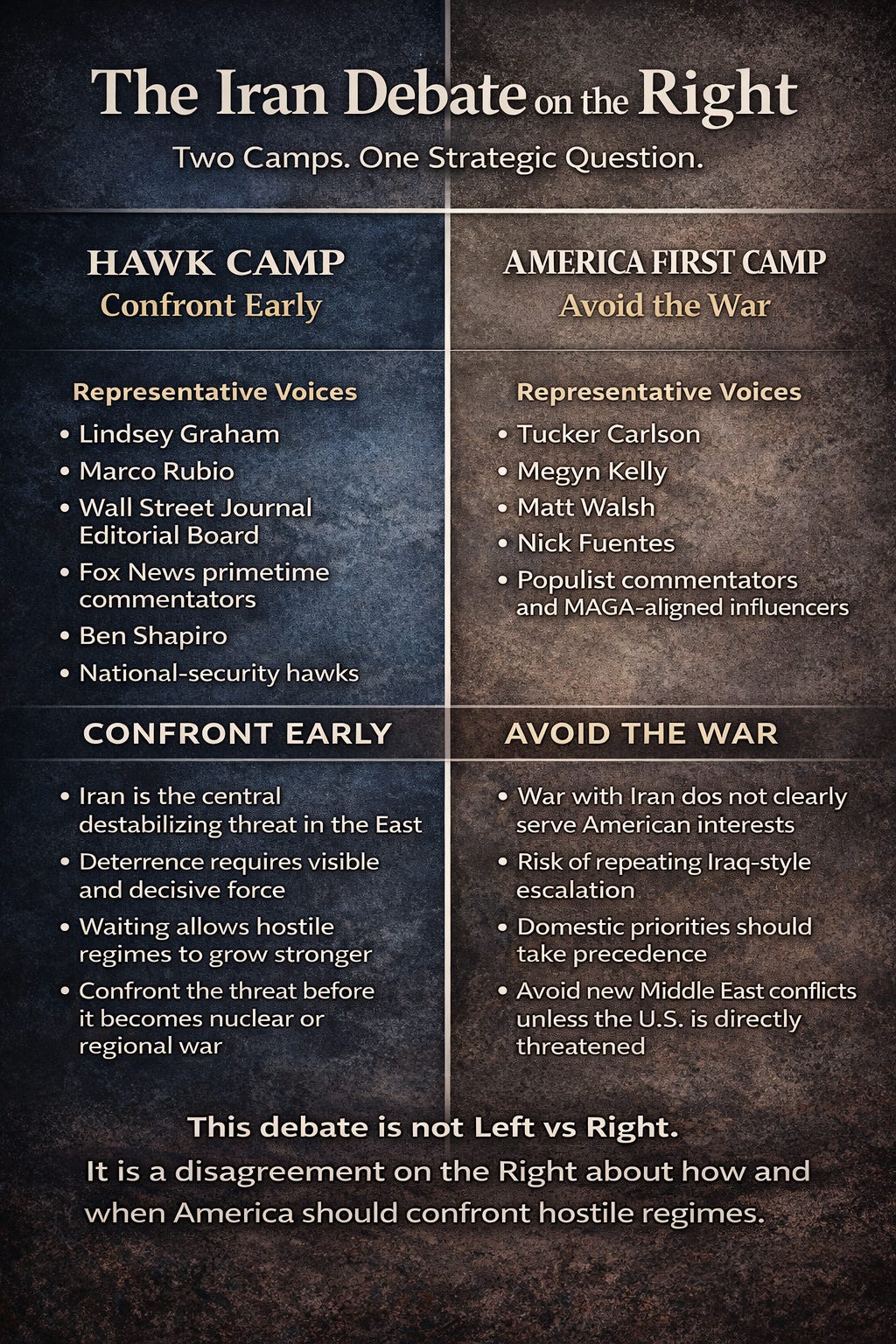
The Iran Debate on the Right
Churchill, Chamberlain, and the Choice in Front of Us
By Jim Reynolds | www.reynolds.com
Something unusual is happening on the American Right.
For most of the last half-century, Republican foreign policy arguments followed a familiar pattern: disagreements over tactics, but broad agreement on the underlying premise that American power must deter hostile regimes.
Now that consensus is fractured.
Trump’s Iran war has exposed a real divide inside the conservative coalition. One camp views the strikes as necessary and strategically overdue. Another camp sees them as a dangerous departure from the “America First” promise to avoid new Middle East wars.
This is not just a policy disagreement.
It is a clash between two different theories of risk.
And it echoes a much older argument.
⸻
The Hawk Camp
The traditional national-security wing of the Right strongly supports the campaign against Iran.
You see it in figures such as:
• Sen. Lindsey Graham
• Sen. Marco Rubio
• much of the Republican congressional leadership
• the Wall Street Journal editorial board
• most of Fox News’ current primetime commentary
Their reasoning is familiar and straightforward.
Iran is widely viewed as:
• the leading state sponsor of terrorism
• the patron of Hezbollah and Hamas
• the most aggressive anti-American regime in the Middle East
• a state pursuing nuclear capability
• the primary destabilizing force in the region
From this perspective, allowing Iran to attack U.S. forces or allies without decisive retaliation would signal weakness.
And weakness invites escalation.
The hawkish argument follows the classic deterrence model: hostile regimes expand until they encounter real resistance.
Hit them hard enough early, and you may prevent a much larger war later.
Some voices in this camp go further.
Editorial writers at the Wall Street Journal and several national-security commentators openly argue that weakening the Iranian regime—or eventually replacing it—may be the only durable solution to the threat.
In that view, today’s conflict is not reckless escalation.
It is overdue strategic correction.
⸻
The Pro-Israel Conservative Lane
A second group of supporters overlaps with the hawks but frames the issue primarily through Israel’s security.
This includes voices such as:
• Ben Shapiro
• commentators at The Daily Wire
• pro-Israel policy analysts and columnists
• some Fox News contributors
Their argument centers on Iran’s long-standing hostility toward Israel and its sponsorship of regional militias.
Iran funds and arms Hamas.
Iran funds and arms Hezbollah.
Iran’s leadership repeatedly calls for Israel’s destruction.
For this camp, allowing Iran to continue expanding its missile network and nuclear capability would eventually produce a far larger war.
From their perspective, confronting the regime now may prevent a catastrophic regional conflict later.
⸻
The Trump-Strength Camp
Another pro-war lane focuses less on ideology and more on leadership psychology.
This group includes several pro-Trump media personalities and talk-radio voices who emphasize Trump’s willingness to retaliate forcefully when Americans are attacked.
Their argument is simple:
Trump projects strength.
Strength deters enemies.
And if Americans are killed, a president who does not respond decisively invites more attacks.
Implicit in much of this commentary is an assumption: the conflict will be short and contained.
Weeks, perhaps months—not decades.
⸻
The America First Revolt
Opposition on the Right is coming from a very different corner of the coalition.
You see it in voices such as:
• Tucker Carlson
• Megyn Kelly
• Matt Walsh
• Nick Fuentes
• a growing number of MAGA-aligned podcasts and independent commentators
Their argument is blunt.
A war with Iran does not obviously serve the everyday American citizen.
They see risks instead:
• American troops drawn into another Middle East conflict
• higher oil prices and economic disruption
• escalation that could spread across the region
• the possibility of another long and expensive intervention
Their question is direct:
How does this improve life for Americans at home?
⸻
The Israel Question
Here the debate becomes even more sensitive.
Many America First commentators argue that the Iran conflict primarily serves Israel’s security interests, not America’s.
They do not necessarily oppose Israel.
But they challenge the idea that American foreign policy should automatically align with Israeli strategic priorities.
That view breaks with decades of Republican foreign-policy consensus.
And it is part of why the debate has become so heated.
⸻
The Iraq Shadow
Hovering over the entire discussion is memory.
The Iraq War was also presented as:
• necessary
• strategic
• limited in duration
Instead, it became a multi-decade conflict that reshaped American politics.
For the nationalist camp, that experience still looms large.
They see the early rhetoric surrounding Iran and worry about repeating the same cycle.
The hawks respond that Iran is a different adversary, under different circumstances, with different strategic tools available today.
⸻
The Deeper Divide
Strip away the personalities and the debate comes down to one fundamental question.
What is American power for?
The hawkish camp believes American strength must actively confront hostile regimes before they grow stronger.
The nationalist camp believes American strength should focus primarily on defending America itself.
Both camps claim realism.
Both claim patriotism.
But they assess risk differently.
⸻
Bob Steps Back
Bob has been listening to the whole argument.
Hawks on one side.
Nationalists on the other.
He finally leans back and explains what he thinks everyone is really watching.
“This isn’t a new argument,” Bob says.
“It’s a very old one.”
He reaches back to the 1930s.
Before World War II, Europe faced the same kind of division.
On one side stood Neville Chamberlain and the appeasers.
Their belief was simple: Germany could be managed. Negotiations and restraint would prevent a catastrophic war. Fighting early seemed reckless, unnecessary, even provocative.
Better to wait until the threat became unmistakable.
Better to avoid escalation.
Better to preserve peace as long as possible.
On the other side stood Winston Churchill.
Churchill saw something different.
He believed hostile regimes rarely become less dangerous with time.
They become more dangerous.
They build strength, accumulate resources, and expand their ambitions until they are finally strong enough to challenge the world directly.
Churchill’s warning was blunt: if you wait until the danger is undeniable, you are waiting until the enemy is far harder to defeat.
Bob pauses.
“Every generation eventually runs into the same argument,” he says.
One side believes confrontation is reckless.
The other believes delay is the greater danger.
One side worries about fighting too soon.
The other worries about fighting too late.
Bob shrugs and finishes his thought.
“History remembers Chamberlain for delaying the fight.”
“And Churchill for recognizing that the fight was coming whether anyone wanted it or not.”
Then he adds one final observation.
“The real risk in geopolitics isn’t confronting enemies early.”
“The real risk is pretending they won’t become bigger problems tomorrow.”
“And history has a pretty clear record on which mistake is more expensive.”
Bob told me he wanted to make this crystal clear: we have been here before and the path is not easy. And as always, we are confronted with “the big gray area” in terms of decision-making. At least we have a leader who is willing to make the hard decisions — a rarity.
From AI:
China built a strategy around buying discounted oil from sanctioned states (Iran, Venezuela, and Russia) to keep refinery costs low. 
If Iranian and Venezuelan flows are disrupted simultaneously:
• roughly 1/5 of China’s crude supply chain becomes vulnerable
• the loss mainly hits independent Chinese refineries (“teapots”) that rely on cheap sanctioned crude
• China would likely replace barrels from Russia, Saudi Arabia, Brazil, or West Africa, but at higher prices.