


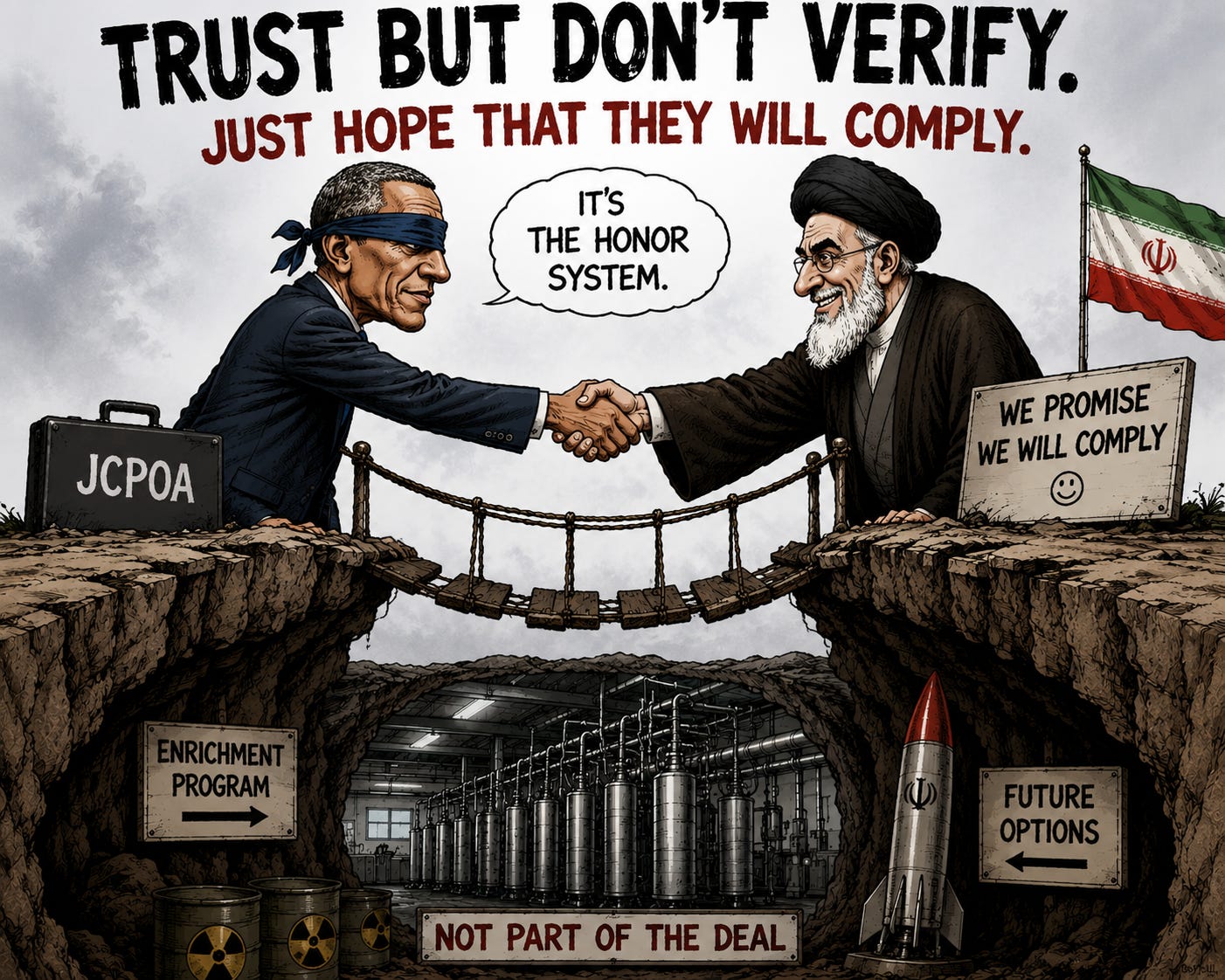
The JCPOA Was a Uranium Enrichment Program With a UN Stamp
By Jim Reynolds | www.reynolds.com
June 25, 2026
The Joint Comprehensive Plan of Action had exactly one job: stop Iran from getting a nuclear weapon. It failed at that job, and the people responsible have spent the years since pretending otherwise — aided by a press corps that needs the narrative to hold.
The Deal’s Architecture Was a Stall, Not a Solution
The Obama administration’s own talking point was that the JCPOA extended Iran’s nuclear breakout time from 2-3 months to roughly one year. That’s not disarmament. That’s not prevention. That’s a timer set to expire. The sunset clauses were the whole design — restrictions on enrichment and centrifuge development would phase out after 10-15 years, at which point Iran would be a “normal” nuclear threshold state with international blessing.
What kind of arms control agreement has a built-in expiration date on the arms control?
Bob:🅱️ “That’s like buying a burglar alarm that politely turns itself off after ten years because the burglar promised to retire.”
The Verification Was Theater
The IAEA inspection regime was the deal’s crown jewel, sold as “anytime, anywhere” access. It was nothing of the sort. Military sites—the places where weaponization work would most likely occur—were subject to a process that could take up to 24 days before inspectors gained access.
Twenty-four days is enough time to remove equipment, sanitize a site, and dramatically alter what inspectors might find. Former IAEA Deputy Director Olli Heinonen famously called the inspection terms “a joke.”
Iran also refused to fully account for its past weaponization work. Rather than resolving the IAEA’s “possible military dimensions” investigation, negotiators effectively closed the file and moved on. The agreement rested on a foundation of unanswered questions rather than verified answers.
Bob:🅱️ “Twenty-four days? That’s not an inspection. That’s an RSVP.”
The Enrichment Never Stopped
Here’s what actually happened under the JCPOA:
Iran kept its entire enrichment infrastructure intact. No centrifuges were destroyed. No facilities were dismantled. The deal limited the number of operating centrifuges and the enrichment level, but the knowledge, the equipment, and the supply chain all remained.
Iran continued developing advanced centrifuges — the IR-6, IR-8, IR-9 — that could enrich uranium far faster than the first-generation models. The JCPOA restricted their deployment but not their development. By the time Trump pulled out, Iran had tested centrifuges that could cut breakout time to weeks.
Iran’s ballistic missile program was explicitly excluded from the deal. The delivery system for a nuclear warhead was treated as a separate issue that the international community would address... never.
And Then They Just Opened the Floodgates
When Trump withdrew in 2018 and reimposed sanctions, Iran’s response was revealing: they immediately began breaching every enrichment limit in the deal. By 2019 they’d blown past the 3.67% cap. By 2021 they were enriching at 60% — a stone’s throw from weapons-grade. By the time the 2025 war started, the IAEA estimated Iran had enough highly enriched uranium for up to 10 nuclear weapons.
If the JCPOA had actually worked — if it had genuinely constrained Iran’s program rather than temporarily capping it — this wouldn’t have been possible. The rapid ramp-up proves the infrastructure was always there, waiting. The deal didn’t dismantle anything. It put a lid on a boiling pot and called it dinner.
Bob:🅱️ “And when the lid blew off, everyone blamed the stove.”
The Media’s Memory Hole
The same outlets now calling Trump’s MOU a “defeat” spent years calling the JCPOA a triumph of diplomacy. The New York Times editorial board said it was “the strongest nonproliferation agreement ever negotiated.” The Atlantic ran cover stories about Obama’s diplomatic genius. When Trump pulled out, the entire foreign policy establishment predicted catastrophe — Iran would immediately sprint to a bomb, the international coalition would collapse, war would become inevitable.
None of that happened immediately. But here’s the thing: the JCPOA’s failure did eventually lead to war. It just took longer than the press corps’s attention span.
Bob:🅱️ “We didn’t dismantle the factory. We put a ‘Closed Until Further Notice’ sign on the front door.”
A deal that allows a regime to maintain its nuclear infrastructure, develop advanced centrifuges, continue ballistic missile testing, and enrich to weapons-grade the moment it faces pressure is not a nonproliferation agreement. It’s a nonproliferation performance. And the audience gave it a standing ovation while Iran was backstage assembling the real thing.
“Removal” is an interesting option.
Some adversaries will never change. The more you attempt to moderate their behavior, the more they resist. Eventually you find yourself trapped in an endless cycle of escalation.
Let me use an example from my own life. For ten years I taught public school. One thing quickly became obvious: good classrooms required discipline. Poorly managed classrooms descended into chaos.
I rarely had behavioral problems, but every so often a student would become chronically disruptive. My approach was always the same. I refused to reward bad behavior with attention. I calmly explained the consequences. The student received three warnings. If the behavior continued, the student was removed from the classroom and sent to the vice principal. The administration backed me because they knew I acted deliberately, not emotionally.
Most students corrected their behavior. A very small number did not. If the disruptions became chronic, they eventually became former students.
Why? Because my primary responsibility was not to the problem child. It was to the twenty-five students who came to learn.
Society operates the same way. We imprison violent criminals not simply to punish them, but to protect everyone else. Rights belong to the public as well as the individual.
The same principle applies internationally. Some regimes repeatedly demonstrate that they have no intention of honoring agreements or changing their conduct. At some point, continuing to negotiate with an uncooperative and recalcitrant actor merely prolongs the problem.
Sometimes the only effective solution is removal—not because it is the preferred option, but because every other option has failed. Protecting the larger community occasionally requires eliminating the source of the disruption.
We seem to have forgotten that uncomfortable truth.
We're using the tools of the Western world (negotiations, signed agreements) to deal with a medieval culture that does not recognize them. One key to the success of Western Civilization is the ability to at least somewhat control and constrain future actions through agreed-upon processes. This allows planning and investment in a reasonably predictable future that would otherwise be impossible, resulting in a net advancement of the society over time.
Conversely, the current leadership in Iran reflects a different culture— one where today I do what I agreed today, and tomorrow I'll do what I agree tomorrow. There is no future in this process; there is no pathway to peace through the Western process of negotiating agreements with these people. The only way to control and constrain what these people do is to force them, continuously and consistently, to do it— or to remove them from the picture altogether.