


The Last Great Mystery of the Analog Age
TWA Flight 800 and the End of Official Narratives
By Jim Reynolds | www.reynolds.com
July 13, 2026
Note:
This isn’t really a story about TWA Flight 800.
It’s a story about something much larger.
Nearly thirty years have passed since that July evening in 1996, yet the questions surrounding Flight 800 have never completely disappeared. The reason isn’t simply disagreement over the investigation. America itself has changed.
In 1996, we lived in the final years of the analog age. Today, we live in a digital world where major events are often documented simultaneously from dozens—even hundreds—of independent viewpoints.
That technological revolution has fundamentally changed the relationship between governments and the governed.
TWA Flight 800 sits almost exactly on that dividing line.
This essay is not an attempt to prove what happened that night over the Atlantic. Rather, it is an opportunity to revisit one of America’s most enduring controversies through the lens of thirty years of experience and ask a broader question:
How differently would this story unfold if it happened today?
Some Stories Never Really End
On the warm evening of July 17, 1996, Trans World Airlines Flight 800 lifted off from New York’s JFK Airport bound for Paris.
Twelve minutes later, it exploded over the Atlantic Ocean.
All 230 people aboard were killed.
For a few terrifying hours, America feared the obvious.
A terrorist attack.
The first World Trade Center bombing had already occurred. The Oklahoma City bombing was fresh in the nation’s memory. The Atlanta Olympics were only days away.
Something catastrophic had happened.
The question was what.
An Investigation Unlike Most Others
Normally, an airline disaster belongs to the National Transportation Safety Board.
The NTSB reconstructs wreckage.
It analyzes mechanical failures.
It determines probable cause.
Its mission is technical, not political.
TWA Flight 800 began differently.
Because terrorism was immediately suspected, the FBI assumed an unusually prominent role. What began as an aviation accident quickly became one of the largest criminal investigations in FBI history before investigators ultimately concluded there was no evidence of terrorism.
Years later, the NTSB reached its conclusion.
An electrical short had most likely ignited fuel vapors inside the aircraft’s center wing tank.
Case closed.
Officially.
But Not For Everyone
For many Americans, the story never really ended.
The Internet was still in its infancy.
There was no Facebook.
No YouTube.
No X.
No smartphones.
The questions persisted because a number of respected investigators, pilots, engineers, journalists and former government officials argued that important pieces of the story never fit comfortably within the official explanation.
Among the most comprehensive challenges came from investigative journalist Jack Cashill in his book TWA 800: The Crash, the Cover-Up, and the Conspiracy.
Cashill’s argument is not simply that investigators reached the wrong conclusion.
It is that the investigation itself deserves another look.
The Witnesses
Cashill believes the heart of the controversy isn’t found in the wreckage.
It is found in the people who watched the tragedy unfold.
Hundreds of eyewitnesses were interviewed, including fishermen, police officers, commercial and private pilots, military veterans, and residents who had spent years watching aircraft over Long Island Sound.
Many reported seeing what appeared to be a bright object rapidly ascending before the explosion.
The official investigation reached a different conclusion, determining that many witnesses were observing the crippled aircraft after an internal explosion rather than a missile rising from the surface.
That disagreement remains the central divide.
Cashill asks a question that still resonates.
If eyewitness testimony became such a significant issue, why didn’t representative eyewitnesses testify publicly during the investigation?
The NTSB has explained that its hearings are designed around technical issues and are not public forums for every witness. Critics argue that hearing directly from representative eyewitnesses might have strengthened public confidence in the process.
Reasonable people continue to disagree.
The Incentives
Every investigation unfolds inside a human environment.
Investigators are not robots.
Neither are politicians.
Neither are government agencies.
They operate under pressure.
That raises another set of questions.
It was July 1996.
President Bill Clinton was in the middle of a reelection campaign.
The Atlanta Olympics were only days away.
The nation still carried fresh memories of terrorism.
Now imagine, for a moment, that investigators had concluded the aircraft was destroyed by an external missile.
What questions would immediately have followed?
Was it terrorism?
Was it a military accident?
Had an American military exercise gone horribly wrong?
Were commercial airliners vulnerable?
Could another attack occur tomorrow?
The consequences would have extended far beyond one airplane.
Public confidence would have been shaken.
International travel could have been disrupted.
Political leaders would have faced enormous pressure to answer questions they may not yet have been able to answer.
None of this proves anyone intentionally steered the investigation.
But it illustrates something important.
Large institutions often have powerful incentives to reduce uncertainty, calm public fears and restore confidence as quickly as possible.
Sometimes those conclusions prove entirely correct.
Sometimes history revises them.
The important point is not that institutions always deceive.
It is that institutions, like all human organizations, operate under incentives.
A Pattern Worth Considering
Forget TWA Flight 800 for a moment.
Imagine any large institution—government, corporation, military, university, or media organization—trying to explain a confusing national event.
How might that process naturally unfold?
Information becomes centralized.
One explanation gains early momentum.
Conflicting evidence is interpreted through that explanation.
Experts reinforce the emerging consensus.
Alternative explanations receive less attention.
Time passes.
Public attention moves on.
None of that necessarily reflects bad faith.
It may simply reflect human nature.
Confirmation bias.
Organizational self-protection.
The desire to restore public confidence.
The question is not whether these patterns exist.
They do.
The question is whether they influenced this investigation.
That is precisely where thoughtful people continue to disagree.
The Last Great Mystery of the Analog Age
Perhaps the biggest difference between 1996 and today isn’t the investigation.
It’s us.
When TWA Flight 800 exploded, almost nobody carried a camera.
No smartphones.
No dashcams.
No Ring cameras.
No livestreams.
No instant uploads.
Hundreds of people looked toward the sky that evening.
The only recording device most of them possessed was their memory.
Today, the same event would unfold in an entirely different world.
Boaters would reach for their phones.
People on the shoreline would begin recording.
Security cameras might capture distant flashes.
Within minutes, investigators—and the public—would have dozens, perhaps hundreds, of independent recordings from different locations and different angles.
Would every question be answered?
Probably not.
Videos can mislead.
Memories can fail.
Evidence still requires interpretation.
But something fundamental has changed.
Official investigations no longer stand alone.
They are increasingly examined alongside an expanding body of independent evidence gathered by ordinary citizens.
Sometimes that evidence confirms the official explanation.
Sometimes it challenges it.
Either way, the search for truth has become more transparent than it was a generation ago.
Thirty years ago, history gave us hundreds of eyewitnesses.
Today, history would likely give us hundreds of videos.
That single technological change has altered the relationship between citizens and institutions more profoundly than almost anything else in modern public life.
TWA Flight 800 may have been one of the last great American tragedies to occur just before ordinary citizens began carrying high-definition cameras in their pockets.
If the same tragedy happened today, the first investigators might still be the FBI and the NTSB.
But the first witnesses would also be millions of citizens.
That is not a small difference.
It is the difference between the analog age and the digital age.
And perhaps that is the real legacy of TWA Flight 800.
Not simply the enduring mystery of what happened over the Atlantic that July evening.
But the realization that it occurred just before technology permanently changed how democracies discover, test, and debate the truth.
Your points about our collective ability to record almost anything is well taken. This is not only because today virtually everyone has a camera with them at all times, but we have security cameras on many of our buildings, and many of our automobiles are recording everything that's happening around them as well. I remember the events as they were dribbled out back in '96 (I lived on the south shore of LI at the time), and reports of the Navy having been conducting live fire exercise at the time were being bandied about. I was also friends with the photo lab manager of the Suffolk County Police who had to photograph the assembled wreckage. Most of us didn't believe the official "fuel tank" theory as the aircraft was on its way to Europe from JFK and wouldn't have had an empty tank.
A point of geographic correction, though. The Long Island Sound is on the north side of the island. TWA went down over the Atlantic Ocean, which is on the south side of the island.
Jim, interesting that you chose this event and framed it as a watershed of technological culture.
As a former Naval Aviator, TWA800 was of great interest and while we have never been (and likely never will be) privy to the truth, there is a large body of evidence that counters the official version of the event. As you note, the investigation was heavily politicized and much of the investigation seemed to deliberately ignore evidence and testimony that pointed toward a contrary finding. At thirty years on, many of the key witnesses and investigators have gone to their rewards, yet traces remain.
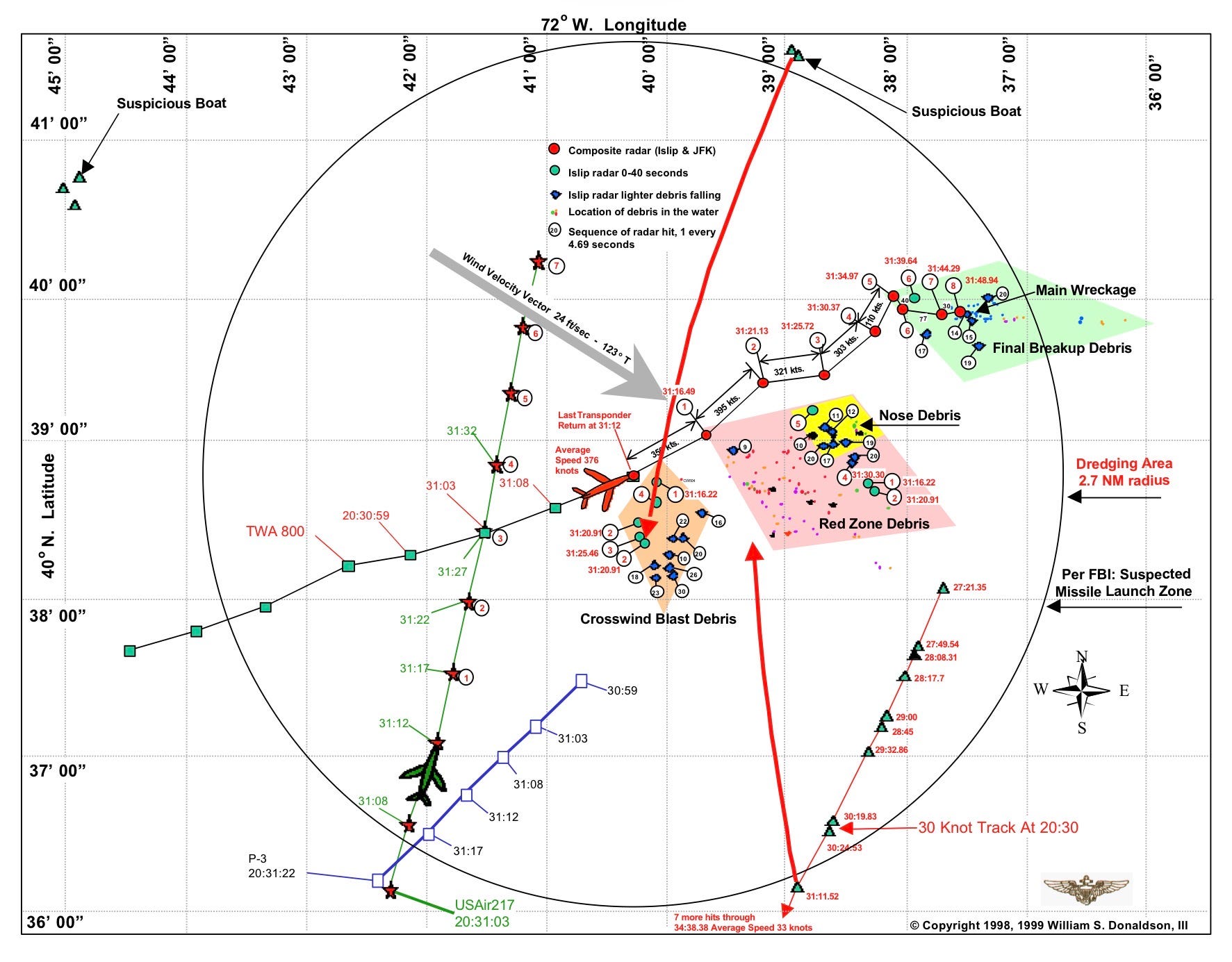
One of the most determined was the late CDR (USN Ret) Bob Donaldson. His work is documented at https://www.twa800.com. Note that Donaldson was trained as an aircraft accident investigator. Relatively unknown in the civilian community, a USN accident investigation has two parallel but isolated components: the Safety Investigation (what happened and how do we prevent future occurrences; designed to avoid "political" shenanigans) and the legal investigation (who's at fault or liable). I won't say it's a fool-proof system, but it is mighty effective. CDR Donaldson was on the Safety Investigation side. The fact that the site is still up and accessible twenty-five years after his passing is testimony to the supporters that truly believe that the truth has not been told. It's worth a bit of time perusing. The scope and depth of CDR Donaldson's investigation and evidence is remarkable.
Two items of physical evidence that I've always found noteworthy were: 1) the bulkhead of the fuel tank that supposedly exploded from internal causes was buckled inward, contrary to the advertised direction of force; and 2) the residuals of explosives consistent with missile warheads found in interior fabric recovered from the wreckage.
Then, there is the reality of many hundreds of unaccounted for Stinger missiles supplied to Afghan Mujahideen by the CIA during the Soviet-Afghan war, despite the efforts of Operation MIAS (roundly viewed as an abject failure).
So color me a non-believer of the official version. I don't know what happened, but I don't think the government's tale is accurate.
JC