



The Midterm Reckoning
When you suffer a defeat, it’s often the best time to step back and put things in perspective.
By Jim Reynolds | www.reynolds.com
November 4, 2026
And there are few better places to find perspective than in history.
Seventy-six years of American elections reveal a recurring pattern: voters use Congress to register their dissatisfaction with the president.
Every two years, Americans elect a new House of Representatives and approximately one-third of the Senate. Every four years, that congressional election takes place halfway through a president’s term.
The president’s name isn’t on the ballot, but his administration certainly is.
And something remarkable happens with extraordinary regularity.
The president’s party loses seats.
Let’s examine every midterm election in my lifetime, beginning in 1950. For our purposes, we’ll call that the postwar modern era.
🅱️ Bob: “Jim, it appears your perspective is somewhat influenced by your personal participation.”
Since 1950, there have been 19 completed midterm elections. In 17 of them, the president’s party lost seats in the House of Representatives. Only twice did it gain seats.
The Senate is less predictable, partly because only about a third of its seats are contested in each cycle. But the overall pattern is unmistakable: midterm elections frequently become referendums on the administration in Washington.
The 2026 election fits into that history. To understand its significance, we need to look beyond which party won Congress and examine how many seats changed hands, what voters were dissatisfied with, and how the result compares with previous midterms.
The scorecard: 1950–2026
The table measures net gains or losses by the party occupying the White House. All historical figures use the same source and convention, so the comparisons are consistent.
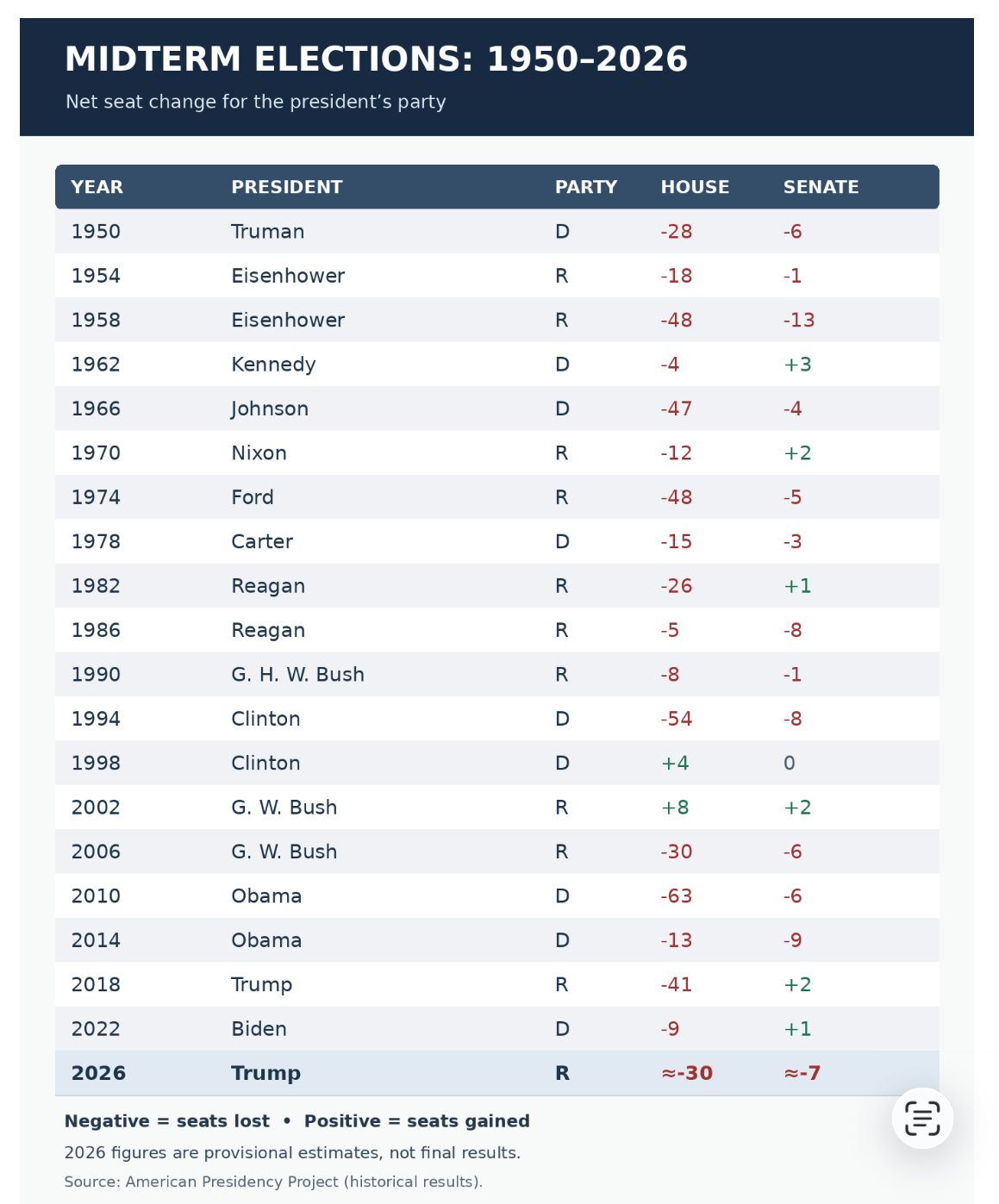
The historical average from 1950 through 2022 was a loss of approximately 24 House seats and three Senate seats per midterm.
Against that benchmark, an estimated 30-seat House loss in 2026 would be worse than average but hardly unprecedented. A seven-seat Senate loss would be more unusual.
What the opposition campaigned against
The numbers tell us what happened. The campaigns tell us what the opposition wanted voters to blame.
What follows identifies the principal grievances emphasized by the party opposing the president. These are summaries of campaign messages, not claims that every voter shared those grievances or that a single issue determined each outcome.
The 1950s: Communism, Korea, and economic anxiety
1950 — Harry Truman (D): House −28, Senate −6
Republicans attacked Truman over the Korean War, inflation, Communist expansion, and allegations that his administration had been insufficiently vigilant about Soviet influence. The opposition portrayed Democrats as weak abroad and increasingly committed to an oversized federal government.
1954 — Dwight Eisenhower (R): House −18, Senate −1
Democrats criticized Republican economic policies, declining farm income, and the handling of unemployment. They also challenged the excesses of Senator Joseph McCarthy’s anti-Communist investigations, although Eisenhower himself remained relatively popular.
1958 — Eisenhower (R): House −48, Senate −13
A severe recession gave Democrats a powerful economic argument. They emphasized unemployment, falling farm income, concerns about Soviet technological advances after Sputnik, and allegations of influence-peddling within the administration.
The 1960s: Civil rights, Vietnam, and social upheaval
1962 — John Kennedy (D): House −4, Senate +3
Republicans criticized Kennedy’s domestic spending, federal activism, and economic policies. But the Cuban Missile Crisis had strengthened Kennedy’s standing, and Democrats gained Senate seats despite their small House losses.
1966 — Lyndon Johnson (D): House −47, Senate −4
Republicans attacked the costs of the Great Society and Vietnam War, rising inflation, urban unrest, and crime. Vietnam’s mounting economic burden was especially prominent, even as public debate over the military campaign intensified.
The 1970s: Vietnam, Watergate, and inflation
1970 — Richard Nixon (R): House −12, Senate +2
Democrats emphasized the continuing Vietnam War, inflation, unemployment, and the administration’s handling of the economy. Nixon and Republican candidates countered with law-and-order appeals that helped produce Republican Senate gains.
1974 — Gerald Ford (R): House −48, Senate −5
Watergate dominated. Democrats emphasized corruption, secrecy, abuse of presidential power, and Ford’s pardon of Nixon. Inflation and recession fears reinforced the dissatisfaction.
1978 — Jimmy Carter (D): House −15, Senate −3
Republicans emphasized inflation, taxes, growing government, and doubts about Carter’s economic management. The emerging conservative movement also criticized federal regulation and the administration’s energy policies.
The 1980s: Reaganomics and the federal budget
1982 — Ronald Reagan (R): House −26, Senate +1
Democrats focused on the deep recession, high unemployment, and the effects of Reagan’s economic program. They argued that budget cuts and tax policies favored wealthier Americans while imposing economic hardship on working families.
1986 — Reagan (R): House −5, Senate −8
Democrats emphasized federal deficits, agricultural problems, and concerns about the consequences of Reagan’s policies. The economy had improved substantially, limiting House losses, but Democrats successfully targeted vulnerable Republican Senate seats.
The 1990s: Taxes, government, and impeachment
1990 — George H. W. Bush (R): House −8, Senate −1
Democrats emphasized the weakening economy, budget deficits, and the controversy surrounding Bush’s reversal of his no-new-taxes pledge. The election produced relatively modest Republican losses.
1994 — Bill Clinton (D): House −54, Senate −8
Republicans attacked Clinton’s health-care proposal, taxes, federal spending, and what they described as excessive government intervention. Newt Gingrich’s Contract with America gave Republicans a coordinated alternative built around tax cuts, welfare reform, congressional reform, and fiscal restraint.
1998 — Clinton (D): House +4, Senate 0
Republicans emphasized Clinton’s personal misconduct and the Monica Lewinsky scandal. Democrats argued that Republicans were excessively preoccupied with impeachment rather than governing during a strong economy. The result was an unusual midterm gain for the president’s party.
The 2000s: Terrorism and the Iraq War
2002 — George W. Bush (R): House +8, Senate +2
Democrats challenged Republican domestic priorities and expressed concerns about the economy and corporate scandals. But following September 11, national security and terrorism dominated the political climate, and Bush’s high approval ratings helped Republicans gain seats in both chambers.
2006 — Bush (R): House −30, Senate −6
Democrats centered their campaign on the increasingly unpopular Iraq War. They also criticized the administration’s handling of Hurricane Katrina, allegations of Republican corruption, and the direction of the country.
The 2010s: Obamacare, Washington, and Trump
2010 — Barack Obama (D): House −63, Senate −6
Republicans emphasized Obamacare, government spending, federal deficits, and the sluggish economic recovery after the financial crisis. The Tea Party movement helped turn those grievances into a nationwide campaign against expanding federal power.
2014 — Obama (D): House −13, Senate −9
Republicans criticized Obamacare’s implementation, the slow recovery, immigration policy, and what they characterized as ineffective presidential leadership. Unlike 2010, the campaign had no single dominant issue, but dissatisfaction with Washington remained widespread.
2018 — Donald Trump (R): House −41, Senate +2
Democrats emphasized protecting health coverage for people with preexisting conditions, opposing Republican efforts to repeal the Affordable Care Act, and challenging Trump’s conduct and governing style. The opposition gained substantial ground in suburban House districts, while Republicans gained Senate seats in a favorable electoral map.
The 2020s: Inflation, abortion, and the cost of living
2022 — Joe Biden (D): House −9, Senate +1
Republicans campaigned against inflation, rising living costs, immigration policy, and crime. Democrats countered by emphasizing abortion rights following the Supreme Court’s Dobbs decision, along with health care and concerns about Republican candidates’ positions on democracy. The expected large Republican House gains did not materialize.
2026 — Donald Trump (R): House approximately −30, Senate approximately −7 (provisional)
Democrats emphasized high living costs, inflation, government corruption, the Iran war, and the consequences of Republican health-care and spending policies. Republicans countered with messages about taxes, immigration, and crime. Early reporting points to economic dissatisfaction and concern about the administration’s conduct as important elements of the Democratic campaign.
The 2026 figures should remain explicitly provisional until counting is complete. They represent changes in party seats, not simply the number of Republican incumbents personally defeated.
What changes — and what doesn’t
Looking across these elections, the opposition’s complaints change with the circumstances. But they tend to fit into a small number of recurring categories.
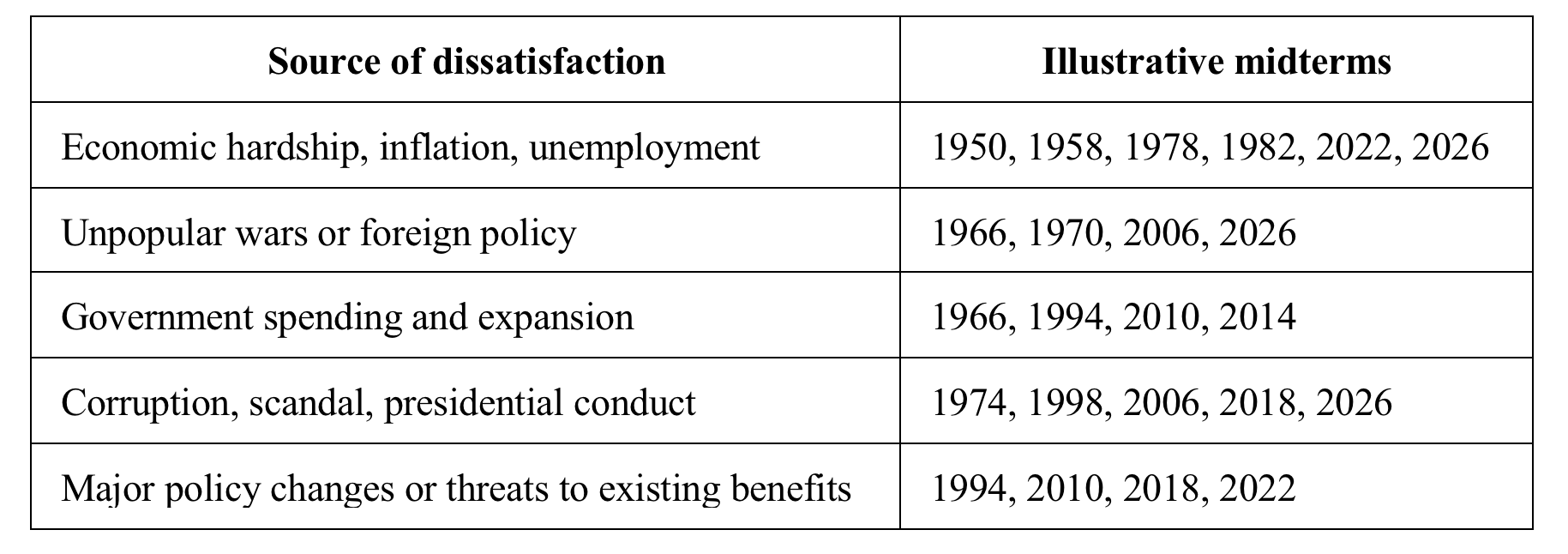
The categories overlap. A voter can be angry about inflation, dissatisfied with a war, and concerned about the president’s behavior at the same time.
🅱️ Bob: “Okay, I get it. Find something to complain about, blame it on the guy in the chair, and pound it into the ground. Works almost every time.”
And the political effects are not always symmetrical. Democrats gained four House seats during Clinton’s impeachment controversy in 1998. Republicans gained eight in 2002 during the post-September 11 national-security environment. Both elections interrupted the usual midterm pattern.
Where 2026 fits
The House average during this period was a loss of 24.1 seats. The working estimate for 2026 is about -30.
The Senate average was a loss of 3.2 seats. Our working estimate for 2026 is negative 7.
As of the morning of November 4, Democrats have secured control of both houses, according to AP reporting. The Guardian’s live count shows a net Republican loss of 25 House seats, with 68 House races not yet called, and a seven-seat Senate loss with two Senate races outstanding.
Those numbers suggest three distinct conclusions.
First, Republican House losses are consistent with a long-established historical pattern. On their own, they do not distinguish 2026 from several earlier midterms.
Second, the Senate result is more consequential. A seven-seat loss is substantially larger than the historical average and illustrates how the composition of the Senate electoral map can amplify dissatisfaction with the incumbent party.
Third, losing congressional control is not the same thing as suffering a historically unprecedented electoral defeat. A narrow majority can disappear with relatively few lost seats, while a party holding a large majority can absorb a substantially greater loss and remain in power.
The larger historical lesson
Midterm elections are often described as verdicts on presidents. That is a useful shorthand, but it conceals something important.
There is an enduring disadvantage to holding the presidency. The president gets credit when things go well and blame when they don’t, even for circumstances largely beyond his control.
The opposition has the luxury of pointing out problems without having to solve them. At least until it wins.
But criticism alone isn’t enough. The opposition must identify something voters dislike about the party in power, organize that dissatisfaction, and offer a reason to transfer political authority.
Sometimes the grievance is war. Sometimes it is inflation, corruption, taxes, or an ambitious domestic policy. Sometimes it is the president personally.
The electorate has been doing this for generations, under Democratic and Republican presidents alike.
The 2026 election is another chapter in that history. Its eventual significance will depend not only on how many seats Republicans lose, but on what the new Democratic congressional majorities do with the authority voters have given them.
An election tells us who gained power. What follows tells us what that change actually meant.
🅱️ Bob: “Knowing that others before me have had a toothache is reassuring, but it does not particularly ease my pain.”
"voters use Congress to register their dissatisfaction with the president." Totally true. How to explain the Blue wave in what were strong Red States? In Texas the entire executive branch plus Texas Supreme Court Justice went Blue. Iowa, Ohio, Kansas, and Georgia all turned Blue. This is a bigger story than Trump.
Thanks for all the history. But I’m with Bob.