


THE MOST PREDICTABLE PEOPLE IN THE WORLD
By Jim Reynolds | www.reynolds.com
June 18, 2026
The ceasefire is signed.
The shooting has stopped.
The Strait of Hormuz is open.
Oil is moving.
Negotiators are talking.
And before the ink was dry, you could almost hear the voices warming up.
Trump gave away too much.
Trump got played.
Iran won.
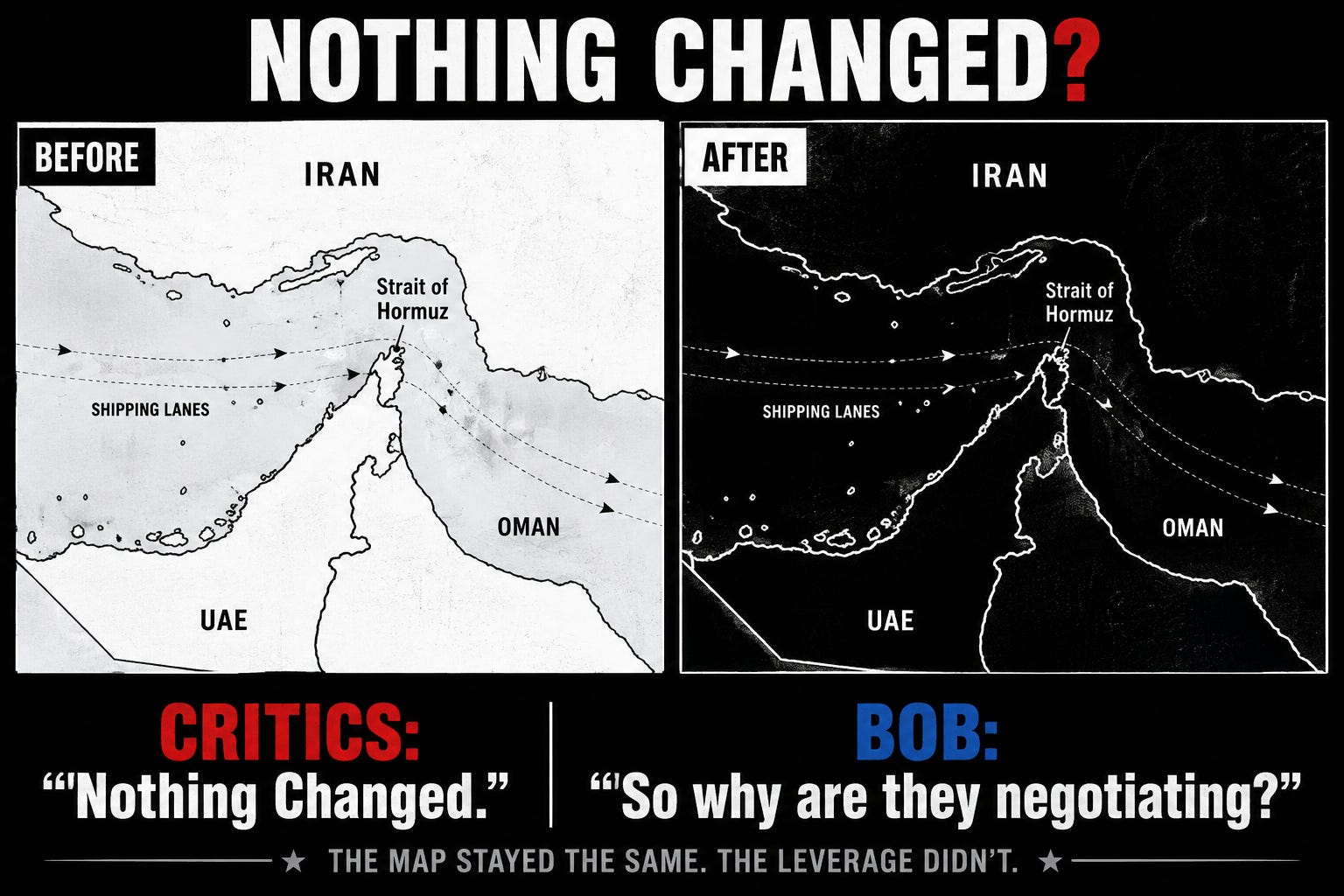
Nothing changed.
The fascinating thing wasn’t what they said.
The fascinating thing was how predictable it all was.
You could have written most of the headlines before the agreement was signed.
That’s because many commentators no longer analyze events. They analyze Trump.
Their conclusions are fixed in advance. Events merely provide supporting material.
If Trump attacks Iran, he’s reckless.
If Trump avoids war, he’s weak.
If Iran refuses negotiations, Trump failed.
If Iran signs negotiations, Trump failed.
If Iran’s government collapses, Trump got lucky.
If Iran’s government survives, Trump accomplished nothing.
The answer is always the same. Only the wording changes.
Bob has a rule for people like this.
🅱️ “If your answer never changes, you’re not analyzing. You’re coloring by numbers.”
Which brings us to one of the strangest arguments now making the rounds.
The Strait of Hormuz was open before the conflict.
The Strait of Hormuz is open now.
Therefore nothing was accomplished.
Several commentators have made variations of this claim, and House Minority Leader Hakeem Jeffries offered perhaps the purest version of the mindset when he argued that Iran is now “stronger, not weaker.”
Stronger.
After their leadership was eliminated.
After four months of war.
After military facilities were hit.
After proxy forces were battered.
After economic damage mounted.
After Iran found itself negotiating directly with the United States.
Stronger.
At some point, language loses contact with reality.
Think about what this argument actually requires us to believe.
Iran entered this conflict with a functioning nuclear program, regional proxies stretching from Lebanon to Yemen, influence over one of the world’s most important oil chokepoints, and a leadership openly threatening both Israel and the United States.
Four months later, the surviving leaders are sitting across the table signing agreements they would have rejected outright a year ago.
Their proxies have been hammered.
Their economy has taken a beating.
Their military infrastructure has suffered significant damage.
Their patrons in Moscow and Beijing were largely spectators while Washington and Tehran conducted the negotiations.
And somehow we’re told Iran emerged stronger.
By that standard, no conflict in history has ever changed anything.
France existed before D-Day.
France existed after D-Day.
Nothing changed.
Japan existed before surrender.
Japan existed after surrender.
Nothing changed.
The homeowner still owns the lot after the house burned down.
Nothing changed.
The condition of a thing is not the same as the leverage behind it.
The purpose of conflict is not always to create a different map.
The purpose is to create a different reality beneath the map.
The Strait of Hormuz being open today is not the same Strait of Hormuz that existed before the war.
Before the conflict, Iran possessed the ability to threaten closure on its own terms.
Today it is negotiating those terms while attempting to regain economic normalcy and international legitimacy.
Those are not identical circumstances.
They are radically different circumstances that happen to produce the same photograph.
Bob squinted at the television.
🅱️ “So let me get this straight.”
He grabbed a pencil and started making notes.
🅱️ “If Mike Tyson knocks me down six times, breaks my nose, takes my lunch money, and I sign a paper promising not to hit him back…”
He paused.
🅱️ “…I’m stronger?”
Even the television looked uncomfortable.
And that’s the larger lesson here.
Many people don’t judge outcomes by what happened.
They judge outcomes by who benefited.
If Trump had signed this exact agreement under a different administration, half the critics would be nominating the negotiators for a Nobel Prize.
Instead, we’re told that reopening the world’s most important shipping lane, halting a war, damaging Iran’s military capabilities, weakening its proxies, restarting nuclear inspections, and bringing Tehran to the negotiating table somehow amounts to failure.
Perhaps the deal will ultimately fail.
Iran has earned every ounce of skepticism directed its way.
Perhaps the ceasefire will collapse.
Perhaps the negotiations will break down.
Perhaps the mullahs will once again choose confrontation over survival.
Those are legitimate concerns.
But claiming that “nothing changed” requires ignoring almost everything that happened.
The bombs stopped.
The ships moved.
The proxies bled.
The leverage shifted.
The negotiations began.
And the people who spent years insisting Iran was an existential threat are suddenly explaining why forcing Iran to negotiate isn’t an achievement.
That’s not analysis.
That’s muscle memory.
Bob folded the newspaper and stood up.
🅱️ “Funny thing about reality.”
🅱️ “It doesn’t care who gets credit.”
Then he pointed toward the television.
🅱️ “And eventually, even the scoreboard gets tired of listening to the announcers.”
Thanks Jim and Bob for shining truth and sanity on this.