


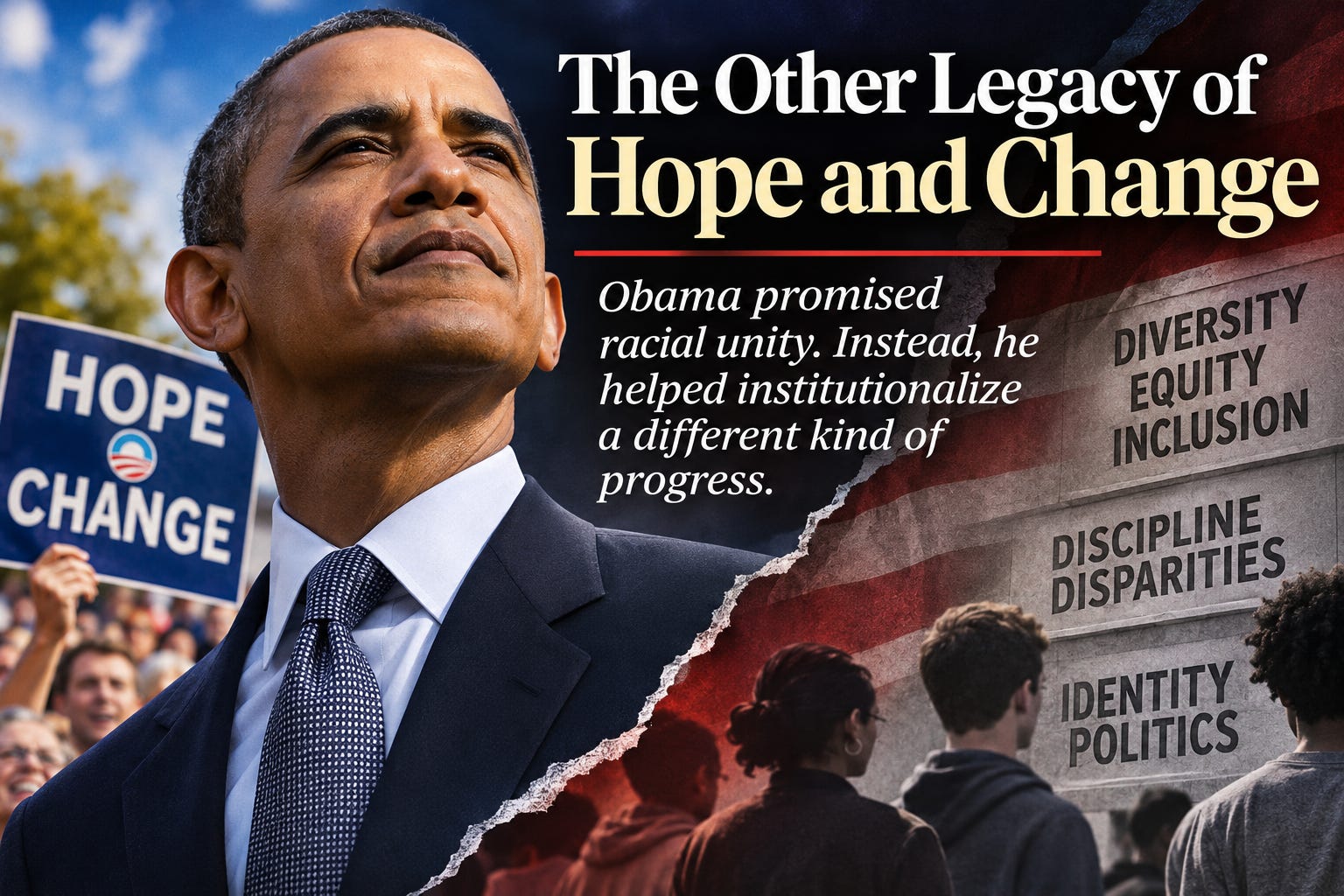
The Other Legacy of Hope and Change
What the Obama generation actually got was a rebranding of group identity politics — and a broken promise about what America could be.
By Jim Reynolds | www.reynolds.com
November 6, 2026
The Promise That Wasn’t
Evelyn Quartz’s recent essay on the disillusioned Obama generation is a fine elegy. Young Democratic staffers came of age believing in hope and change. They entered politics on the strength of a 2008 election that seemed to prove America could finally move past race and deliver progress through its institutions. They worked hard, and they expected the institutions they believed in to deliver.
Nearly two decades later, they’re broke, priced out, and confused about what happened.
Quartz reads this as a story about a promise that went unfulfilled. She’s half right. The real story is about a promise that was replaced — and about a president who dismantled the very ideal his generation thought he embodied.
The Racial Unity That Never Came
In 2004, Obama stood before the Democratic convention and declared there was no Black America, no white America, no Latino America, no Asian America — only the United States of America.
In 2008, 70% of Americans believed race relations would improve. By 2016, 46% believed his presidency had made them worse. Only 29% thought things had gotten better.
That’s quite a verdict. For eight years, America had a president who claimed to transcend race, yet racial divisions became a defining feature of national politics. Obama was at the helm the whole time. He owns it.
The man who promised to unite us presided over the great fragmentation.
From Merit to Identity
There are two ways to understand equality, and they pull in opposite directions.
One says: remove the barriers, judge people on their merits, and let individual ability decide the outcome.
The other says: group outcomes must be equalized, and institutions should intervene until they are.
Obama didn’t invent the second approach. But he supercharged it. In 2011 he ordered a federal diversity-and-inclusion apparatus across the government. In 2014 his Education and Justice Departments pushed schools to treat disciplinary policies — even race-neutral ones — as suspect if the outcomes looked skewed.
Think about what that meant. The federal government was instructing schools to question neutral rules based on demographic results. Individual accountability was becoming subordinate to group outcomes, with the federal government enforcing the new priorities.
What happens to a country’s common identity when its own institutions start sorting people by race? That’s a question Quartz never addresses.
“You Didn’t Build That”
In July 2012, Obama told entrepreneurs they didn’t build their own businesses.
His defenders explained that he was talking about government infrastructure. Roads, bridges, schools. Fine. Nobody disputes that these things contribute to economic success. But the words were revealing precisely because of the way he chose to make his point.
When discussing individual achievement, Obama’s instinct was to emphasize what the successful person owed to the collective. The individual’s accomplishment became secondary to the contributions of everyone else.
A successful society needs both individual initiative and shared investment. But when you start telling people their success isn’t really theirs, you’ve picked a side. Obama picked his.
The Meritocracy Myth Isn’t
Quartz quotes a young woman who worked two service jobs, couldn’t afford health care, and concluded that meritocracy was a myth. Ouch.
Here’s the part that never gets said: working hard is necessary, but it is not sufficient — and the direction of your effort matters. Working hard at skills the economy doesn’t value produces exactly what you’d expect. That’s not a failure of meritocracy; that’s how a market works. The lesson isn’t that merit is a lie. The lesson is that which merits you build matters.
There’s an enormous difference between saying “meritocracy didn’t deliver for me” and “meritocracy is a myth.” The first describes a disappointing experience. The second calls into question the entire principle of rewarding individual accomplishment. You can’t establish the second merely by demonstrating the first.
Two Kinds of Disillusionment
Quartz’s interviewees believe the system failed to deliver enough progress. They entered public service expecting their work to make America better, and they are disappointed by the results.
But there’s another interpretation worth considering. What if the problem wasn’t simply that progress fell short? What if the Obama years helped change the meaning of progress itself — from common citizenship and individual accomplishment to a permanent machinery of group accounting?
Both approaches claim to be fighting discrimination, but they have very different destinations. The original ideal was a country in which race would gradually become irrelevant to an individual’s opportunities and achievements. The newer approach requires institutions to keep measuring racial outcomes, identifying disparities, and intervening to correct them.
The first seeks to make race less important. The second builds a permanent industry around keeping it important.
Look at which one Obama’s administration built.
Progress Toward What?
Quartz ends by asking whether gradual progress can sustain a generation’s faith.
Better question: progress to where?
Is progress a society where your ancestry stops deciding your life? Or is it a society where your ancestry becomes the most important thing about you, audited and remediated by institutions forever?
Those are fundamentally different objectives. And when they conflict, institutions have to make choices. Obama’s administration made its choices, repeatedly, through policies that placed increasing emphasis on group identity and demographic outcomes.
He came in promising to end America’s racial divisions. He left America more divided than ever, and with a whole new vocabulary and bureaucracy for keeping it that way.
One man can’t bear all the blame. But you can’t write the story of his presidency — or of the generation that believed in him — without recognizing what happened to the original promise. The hope was real. The change was real, too. It just wasn’t the change so many Americans thought they were getting.
The generation that believed in Obama didn’t get betrayed by a system that failed to deliver racial unity.
It got a system that decided racial unity was no longer the goal.

Obama can only talk. He is a straw man Clinton (aka”the pant load”) Biden is a “No Load”, Schumer is a talker and is in great need of a “Wedgie”.
The mullahs would eat his lunch.