


The Persuasion Ladder in Modern Politics
By Jim Reynolds | www.reynolds.com
March 1, 2026
Author’s Note
This piece, The Persuasion Ladder in Modern Politics, began as an extension of a sharp micro-lesson from Scott Adams—his “persuasion ethics stack,” which he shared publicly in July 2024 (and made available beyond his Locals subscribers at the community’s request). In that lesson, Scott laid out a clear ethical gradient for persuasion techniques: how they range from relatively benign influence to methods that cross into deeper ethical territory by undermining the target’s independent judgment and autonomy.
I took that core insight—the idea that persuasion carries an ethical weight proportional to how much it overrides or steals agency—and built upon it. Scott’s original stack provided the foundational rungs and the moral framing (persuasion as ethical when it respects the audience’s ability to reason freely, problematic when it covertly manages perception). I extended the ladder with additional steps particularly relevant to today’s political and media environment: weaponized omission as the subtle starting point, repetition as a powerful accelerator (drawing on the illusory truth effect he often highlights), and identity framing as a side-car mechanism that supercharges several other rungs by short-circuiting debate through tribal loyalty and moral pressure.
The arc here shifts the lens from the persuader’s toolkit (Scott’s frequent focus: how masters win) to the citizen’s defense: how these techniques, when escalated in public narratives, gradually erode personal agency—the operational form of free will in civic life. By wiring the framework into contemporary politics and centering the preservation of agency, the goal is to offer a practical warning and set of countermeasures for readers who value individual sovereignty, evidence-based reasoning, and resistance to narrative enclosure.
A sincere nod to the late Scott Adams: his micro-lessons on persuasion psychology have sharpened how millions think about influence, filters, and reality itself. This is one grateful extension of that work—grateful for the seed, and for the reminder that understanding persuasion ethically is one of the best ways to stay free in an age of constant framing.
Jim Reynolds
March 1, 2026
How Narrative Escalates — and How to Stay in Control
Persuasion is unavoidable in public life. Every political movement frames, emphasizes, and argues. The ethical question is not whether persuasion exists — it is how far it goes.
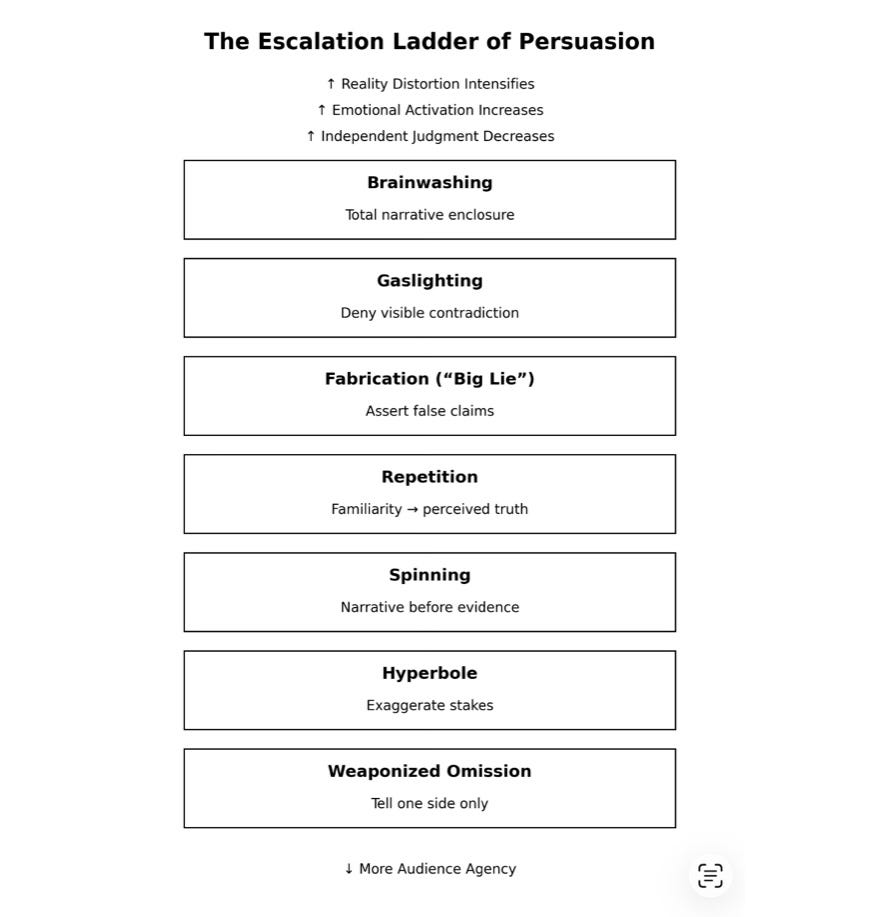
There is a ladder of escalation. At the bottom are rhetorical tools. At the top are psychological control tactics. The higher you climb, the more agency the audience loses.
Understanding this ladder allows citizens to recognize when argument becomes manipulation.
⸻
1. Weaponized Omission
Tell only one side of the story.
This is often where escalation begins. Facts presented may be technically accurate — but crucial context is excluded.
When media outlets ignore events that complicate their preferred narrative, they shape perception not by lying, but by narrowing the informational field.
Example pattern:
• Highlight incidents that reinforce a thesis.
• Downplay or omit events that challenge it.
• Avoid follow-ups that weaken emotional momentum.
The audience is not overtly deceived — but their field of vision is curated.
⸻
2. Hyperbole
Inflate the stakes.
Political language often escalates quickly:
• “This will destroy democracy.”
• “This is the end of the country as we know it.”
Hyperbole transforms disagreement into existential threat. Once everything is catastrophic, reason yields to fear.
⸻
3. Spinning
Narrative before evidence.
In controversial events — such as police shootings — coverage sometimes begins not with established facts but with emotionally powerful storytelling from one perspective. Narrative leads; investigation follows.
Spin is not fabrication. It is sequencing. It determines which emotional lens the audience adopts before facts stabilize.
⸻
4. Fabrication and the “Big Lie”
Fabrication introduces claims that lack evidentiary grounding. The “big lie” is not merely false — it is bold, sweeping, and emotionally loaded.
Large claims — whether about election interference, stolen elections, or apocalyptic threats — gain power from scale. The bigger the assertion, the harder it feels to fully disprove in casual conversation.
The ethical issue is not which party is involved. It is the substitution of assertion for verification.
⸻
5. Repetition — The Accelerator
Repetition deserves its own rung.
Psychology calls it the “illusory truth effect.” The more often a statement is heard, the more familiar it feels. Familiarity begins to register as truth.
Repetition gives fabrication wings.
• “Most secure election in history.”
• “Collusion.”
• “Systemic crisis.”
• “Authoritarian threat.”
When phrases are repeated without continual evidence, they harden into assumed premises. Debate then begins from conclusions rather than proof.
⸻
6. Gaslighting
Deny what people can see.
Gaslighting moves beyond argument and into perceptual control.
If protests are described as “mostly peaceful” while images show significant destruction, a psychological tension forms. The viewer is told to distrust their own observation.
Gaslighting does not merely argue. It attempts to redefine visible reality.
⸻
7. Identity Framing and Cognitive Short-Circuiting
Identity framing is a mechanism that accelerates several rungs.
Identity politics, broadly defined, shifts evaluation from ideas to group categories. The moral weight of identity can override analytical thinking.
When arguments are framed primarily in terms of race, gender, class, or historical grievance — without precise definitions or measurable criteria — disagreement becomes moral transgression.
This elevates social pressure and lowers open inquiry.
This does not mean all structural claims are illegitimate; it means that without agreed metrics, they become resistant to correction and thus more easily weaponized.
Ambiguously defined terms (for example, broad structural accusations without agreed-upon metrics) can become unfalsifiable. If something cannot be clearly defined or measured, it cannot be clearly debated.
Ambiguity increases susceptibility to narrative control.
⸻
8. Brainwashing
Narrative enclosure through repetition and isolation.
The highest rung is not a single statement — it is an environment.
When:
• One side of an issue is presented consistently across institutions,
• Counterarguments are socially penalized,
• Young or inexperienced audiences are repeatedly exposed to a single interpretive frame,
then persuasion can shift toward worldview formation before critical defenses are fully developed.
Brainwashing does not require chains. It requires narrative saturation.
The younger and less experienced the audience, the more durable early framing can become.
⸻
The Core Insight
As we climb the ladder:
• Context narrows.
• Emotion increases.
• Certainty hardens.
• Dissent feels immoral.
• Evidence becomes secondary.
At the bottom, persuasion still respects the listener’s autonomy.
At the top, persuasion attempts to manage perception itself.
⸻
How Citizens Reclaim Agency
1. Ask: What might be missing from this story?
2. Separate verified facts from interpretive language.
3. Notice repetition — especially slogan-level repetition.
4. Look for precise definitions of abstract claims.
5. Seek primary evidence, not only commentary.
6. Compare cross-ideological sources.
7. Slow down emotional reaction.
Agency begins with awareness.
⸻
Final Thought
The danger is not confined to one party, one ideology, or one institution. The ladder describes a human temptation: the desire to win the narrative at any cost.
When persuasion drifts toward enclosure, citizens become passengers.
When people recognize escalation early, they remain drivers.
The goal is not to eliminate rhetoric — it is to prevent rhetoric from replacing reality.
—-
Addendum
The Real Target: Your Agency
Every rung on the persuasion ladder points in the same direction.
Not toward policy.
Not toward ideology.
Not even toward winning an argument.
Toward you.
More precisely: toward your agency.
The ladder is not primarily about convincing you of something. It is about gradually reducing your ability to decide for yourself.
⸻
Agency and Free Will
Agency is the operational form of free will in public life.
It is your ability to:
• Observe reality.
• Compare competing claims.
• Evaluate evidence.
• Form conclusions.
• Revise those conclusions if better evidence appears.
• Act on your judgment.
Without agency, free will becomes ornamental. You still feel as though you are choosing — but the menu has been curated, the lighting adjusted, the exits quietly locked.
Democracy assumes agency.
Self-government only works if citizens govern themselves first.
⸻
What the Ladder Actually Does
Look at the escalation again:
• Weaponized omission narrows what you see.
• Hyperbole heightens emotional urgency.
• Spin pre-loads interpretation.
• Fabrication corrupts factual foundation.
• Repetition replaces evaluation with familiarity.
• Gaslighting attacks your perception.
• Brainwashing encloses your worldview.
Each step removes one layer of independent judgment.
At the bottom, you are persuaded.
At the top, you are managed.
The more managed you are, the less free you are — regardless of which political banner is waving overhead.
⸻
Why Free Will Is the Unspoken Issue
Most political debates argue over outcomes.
Very few argue over cognitive sovereignty.
But that is the deeper fight.
When repetition turns slogans into assumed truths…
When dissent is morally stigmatized…
When definitions remain vague but emotionally charged…
When inconvenient facts disappear from coverage…
When visible contradictions are denied…
The argument is no longer about policy.
It is about who gets to define reality.
If someone else defines reality for you — consistently, persistently, emotionally — your formal freedom remains intact, but your practical freedom diminishes.
That is how agency erodes without chains.
⸻
Democracy Requires Friction
A functioning republic depends on:
• Competing narratives.
• Open disagreement.
• Defined terms.
• Evidence that can be challenged.
• The ability to say, “Convince me.”
If information flows in one direction…
If only one moral vocabulary is permitted…
If certain conclusions are socially mandatory…
Then deliberation collapses into conformity.
Democracy cannot survive conformity masquerading as consensus.
⸻
The Responsibility of the Citizen
The ladder will always exist. Persuasion is human nature.
The question is whether citizens recognize escalation early.
You defend your agency when you:
Notice what is not being said.
Separate description from commentary.
Demand definitions for sweeping claims.
Resist emotional acceleration.
Compare multiple sources.
Allow yourself time to think.
Free will requires maintenance.
Agency requires vigilance.
⸻
The Heart of the Matter
This is not ultimately about left or right.
It is about whether citizens remain authors of their own judgments.
The ladder is a warning sign.
It reminds us that manipulation rarely begins with outright coercion. It begins with small distortions, repeated often, amplified emotionally, and socially reinforced.
If we recognize the pattern, we remain free.
If we fail to recognize it, we may still vote, speak, and argue — but we do so inside boundaries drawn by others.