


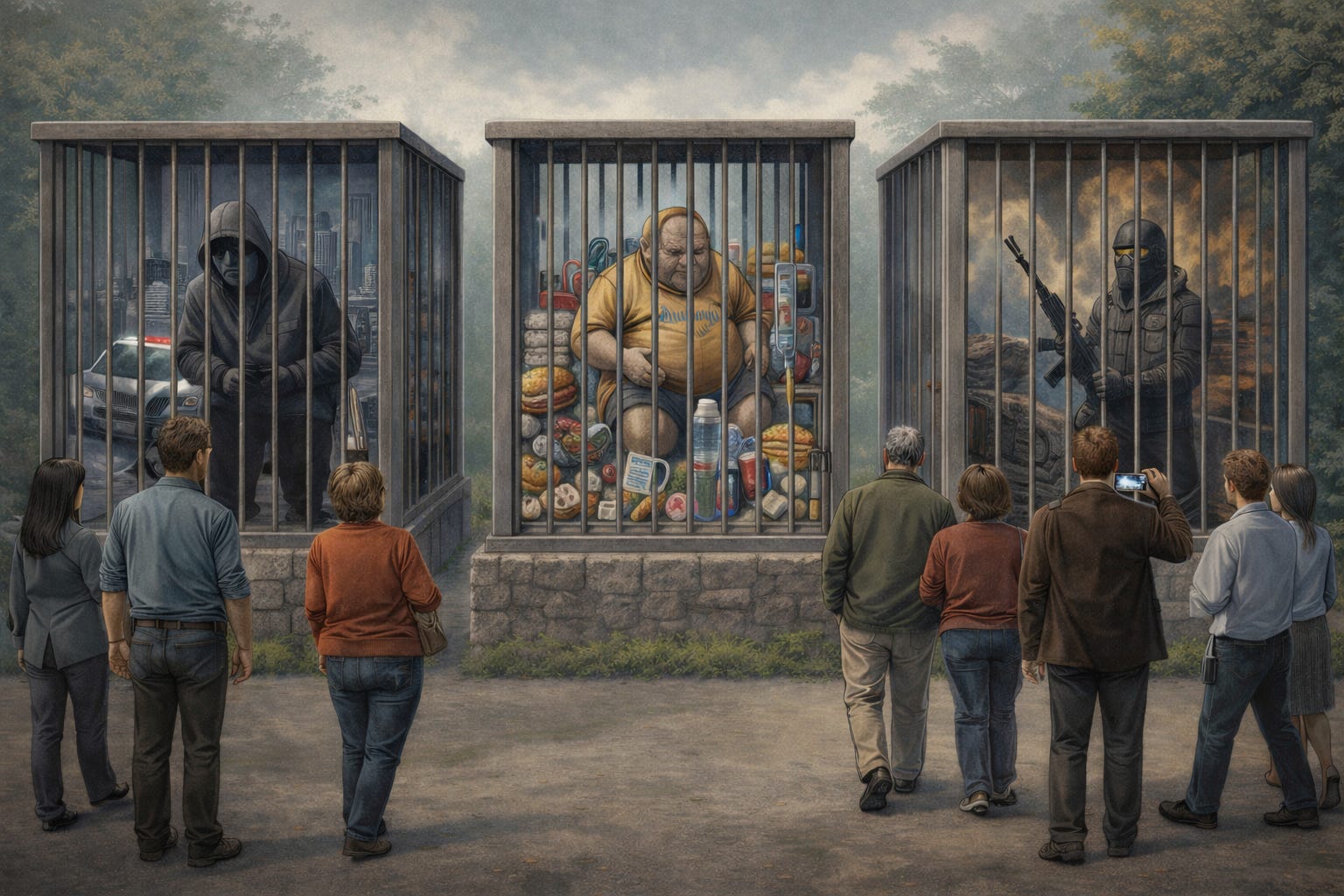
Who are these zoo visitors? NGOs, Consultants, Professors, Politicians, Activists, Journalists. Who are they not? Problem solvers.
The Problem Zoo
By Jim Reynolds | www.reynolds.com
March 8, 2026
“Someone told me it’s all happening at the zoo ..”
Every zoo begins with a simple idea.
Take something dangerous. Put bars around it. Build a safe walkway for visitors. Add explanatory signs.
Now people can observe the creature without being threatened by it.
Civilizations sometimes treat their problems the same way.
Instead of eliminating them, we build cages.
Once a problem is safely behind bars it becomes much easier to live with. Experts can observe it. Scholars can explain it. Conferences can debate it. Entire institutions can grow up around studying it.
The danger is no longer immediate.
It becomes an exhibit.
Visitors walk past the cage, point at the creature inside, and discuss its behavior. Phones come out. Pictures are taken. Observations are shared.
Then everyone moves along to the next enclosure.
Meanwhile the animal remains very much alive.
Nothing has actually been solved.
The cage simply creates the illusion of control.
The obvious question is why societies build cages for their problems instead of removing them.
The answer is incentives.
Once a problem becomes institutionalized, it begins generating ecosystems. Researchers study it. NGOs address it. Consultants advise on it. Government agencies fund it. Conferences debate it. Universities produce degrees in it.
An entire economy can arise around a single unresolved problem.
And economies do not like to disappear.
Solving the problem collapses the ecosystem built around it.
Managing the problem sustains it.
Over time the problem migrates from the category of dangerous reality into the category of permanent institution.
Crime becomes a research field.
Homelessness becomes a funding stream.
Educational failure becomes a bureaucracy.
International threats become panel discussions.
The talking class thrives in this environment. Their skill is interpretation. Their profession is explanation. Their currency is analysis.
Analysis requires the problem to remain.
Builders eliminate problems.
Talkers organize them.
And talkers gradually accumulate authority, because they are the ones writing reports, advising governments, appearing on panels, and explaining the creature inside the cage to everyone else.
The cage becomes their workplace.
Workplaces are rarely dismantled voluntarily.
You can see the pattern everywhere once you notice it.
Consider Type II diabetes.
This is one of the most studied health conditions on Earth. The causes are well known: poor diet, inactivity, and the metabolic consequences of sustained obesity.
And yet the disease continues to expand.
Why?
Because an enormous economic ecosystem now surrounds it.
Food companies profit from producing the products that contribute to metabolic disease. Pharmaceutical companies develop drugs that manage the symptoms after the fact. Government programs subsidize agricultural inputs and medical treatments alike.
Again, none of the participants necessarily intend harm.
But the incentives are unmistakable.
The system rewards treatment far more reliably than prevention.
The problem sits safely inside the cage.
We can measure it.
We can discuss it.
We can manage it.
Meanwhile the patient becomes the mule pulling the cart while the ecosystem surrounding the disease continues to grow.
The zoo remains open.
The same pattern appears in international politics.
“International law” has become another cage.
It allows comfortable societies to place dangerous realities behind glass where they can be examined without confronting them directly. Panels debate the creature. Experts interpret its behavior. Conferences discuss its implications.
Meanwhile the regime funding terrorism, the cartel trafficking drugs, or the dictatorship threatening its neighbors continues operating quite normally.
We observe the animal.
We photograph the animal.
We issue statements about the animal.
But the animal remains alive.
Cages are very good at creating the illusion of control.
They are much less effective at solving problems.
Which is why every so often someone arrives who does not see the cage as an exhibit.
He sees the creature.
Builders think differently from observers. Builders are measured by results. If the problem remains, the work is unfinished.
Talkers are measured by explanation. If the problem remains, there is always another conference.
When builders regain influence, cages start to disappear.
The creature is removed.
And the people who built careers explaining it suddenly discover that the zoo is closing.
Civilizations eventually face a choice.
They can keep expanding the zoo.
Or they can start removing the animals.
Because in the end, cages are not solutions.
They are simply a comfortable way to live with problems that someone, somewhere, is being paid not to solve.
Sometimes we just have to decide to close the zoo, and do it.