


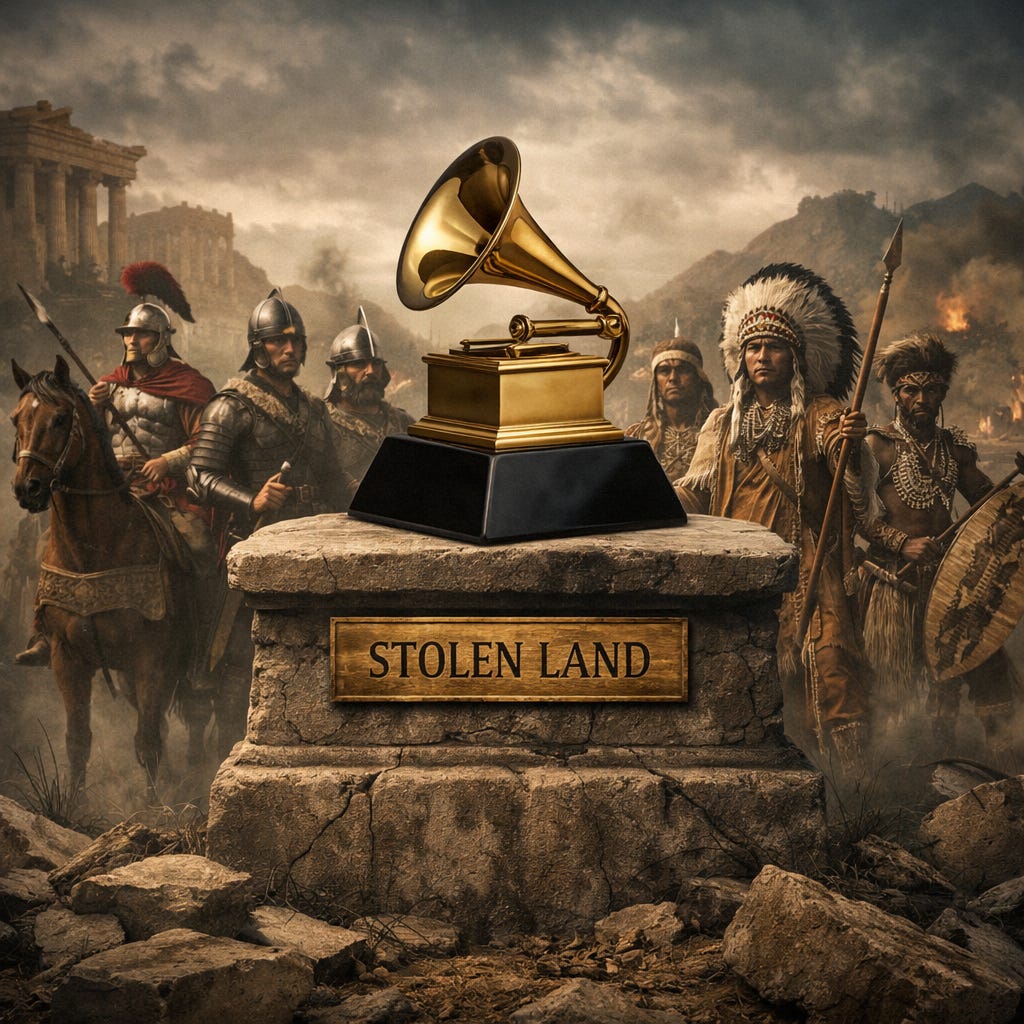
Every pedestal has a history.
The Question History Already Answered
by Jim Reynolds | www.reynolds.com
I was watching the Grammys the other night.
No — I wasn’t. I haven’t watched the Grammys since Fleetwood Mac was winning everything in the late 1970s. Back then it felt like a music awards show. Maybe there was some politics mixed in, but it wasn’t the point. Or at least it wasn’t the thing you were rewarded for noticing.
This is where a conservative writer is expected to do the familiar routine: complain about how ridiculous the show has become, how thin the music is, how thick the virtue signaling feels, how nobody watches anymore. All of that may be true. It’s also beside the point.
So let’s skip it.
What caught my attention instead was a sentence that drifted out of the ceremony and into the culture at large:
“No one is illegal on stolen land.”
It’s a neat sentence. Calm. Moral. Certain. The kind of sentence that sounds finished — as if nothing more needs to be said. And whenever a sentence sounds that finished, it deserves to be tested.
So let’s test it.
Strip away the emotion and reduce the claim to its core. It rests on an implied historical premise, whether the speaker realizes it or not. That premise can be framed as a simple question — one that history itself is well equipped to answer.
Has there ever been a time when all three of the following conditions were true?
1. A militarily dominant group needed more land.
2. That group was adjacent to a much weaker group occupying valuable, desirable territory.
3. The land was not ultimately taken by force, coercion, or one-sided arbitration.
If the slogan is meant to function as a serious moral principle — not a gesture, not a mood — then such an example should exist. Somewhere. At least once.
It doesn’t.
Not in Mesopotamia.
Not in ancient China.
Not on the Roman frontier.
Not in pre-Columbian North America.
Not in Africa.
Not in Europe.
Not in the Islamic expansions.
Not in the colonial era.
Not in the modern nation-state period.
Different cultures. Different religions. Different technologies. Same outcome.
When a powerful society needs land, and a weaker society sits next door on land worth having, the land changes hands. Sometimes brutally. Sometimes gradually. Sometimes under the cover of treaties that exist only because force stands behind them. But it always changes hands.
That observation is not a moral endorsement. It’s a historical description. Confusing the two is where most of the trouble begins.
Human history is not a tale of peaceful stewardship interrupted by a single uniquely evil chapter. It is a continuous record of migration, expansion, conflict, displacement, and replacement. North America is not an exception to this story. It is a case study within it.
Once you accept that, the slogan begins to unravel.
If no one is illegal on “stolen land,” then nearly everyone on earth lives on stolen land.
Borders everywhere become arbitrary. Property rights everywhere become provisional. Sovereignty everywhere becomes a temporary illusion. The principle cannot be selectively applied to one country, one century, or one political preference without collapsing under its own inconsistency.
And yet the inconsistency is the point.
These claims are rarely offered as rules meant to govern real societies. They are offered as signals — ways of announcing moral posture without assuming moral responsibility. They sound elevated precisely because they are never meant to be enforced.
Notice, too, how selectively the accusation travels. Some nations are endlessly asked to acknowledge the crimes embedded in their past. Others, built on conquest no less real, are spared the ritual. That selectivity tells you everything you need to know. This is not about historical honesty. It’s about leverage in the present.
History, taken seriously, does not grant moral exemptions. It grants humility. Every people has been both conquered and conqueror, victim and aggressor, depending on the century and the map. That doesn’t excuse brutality. But it does expose the fraud of pretending that one society alone stands outside the human story.
Which brings us back to the sentence.
A moral principle that has never once governed human behavior under identical conditions is not a principle. It’s a wish. And wishes, however well-intentioned, do not invalidate borders, erase nations, or substitute for law.
If an idea only works when no one asks how it would function in the real world — or whether it ever has — then the problem isn’t history.
The problem is the idea.
Bob would put it more bluntly: If your rule has never worked anywhere, at any time, with any people — it isn’t wisdom. It’s decoration.
And decoration, no matter how fashionable, is a flimsy foundation on which to dismantle a country.
Hooray. Well said, appropriate, a comment long deserved. If nobody is taught history, or if taught it remains unread...nobody will then understand reality.
Bill Schoettler
“Land cannot be stolen if no one is illegal.” —Matt Walsh