


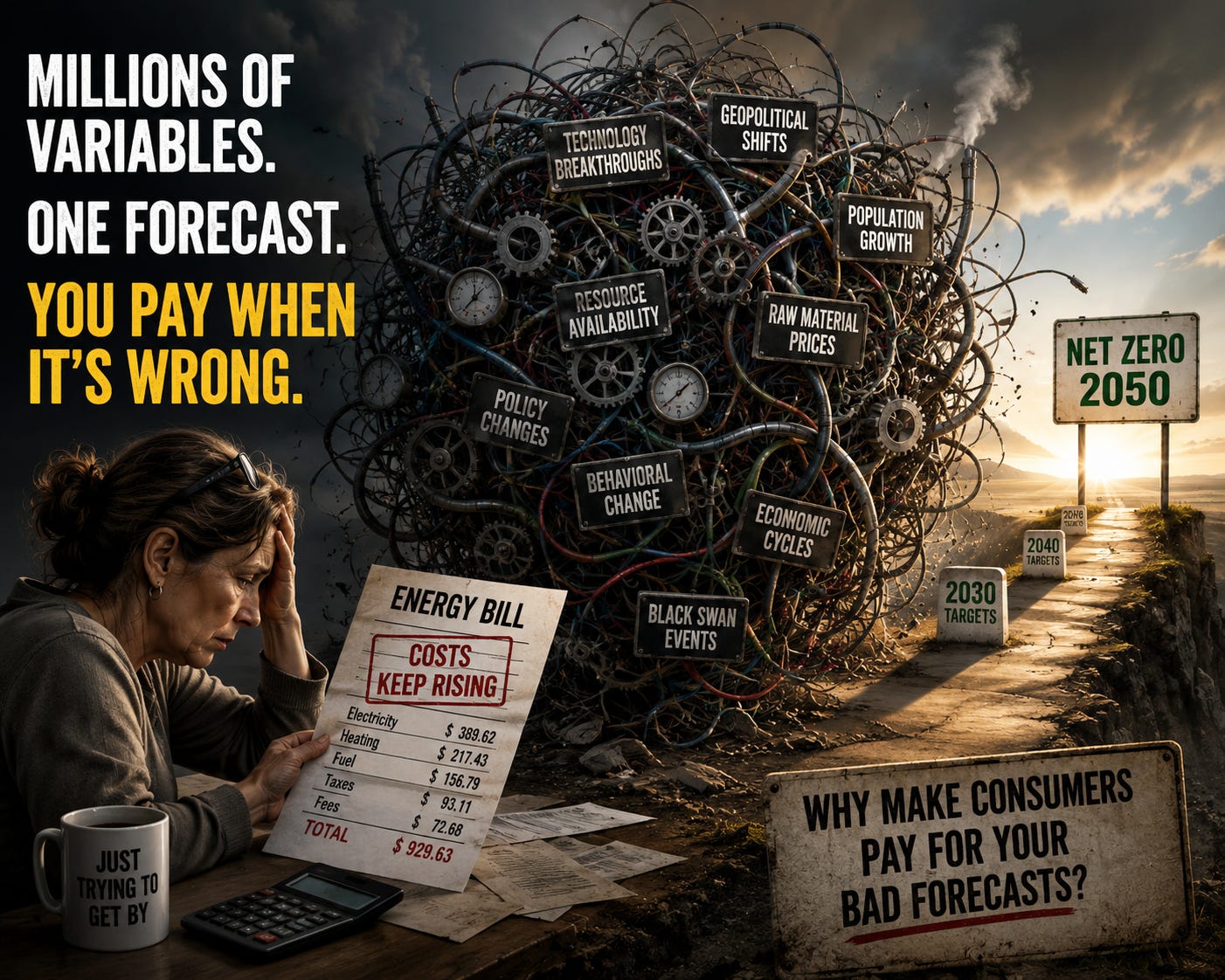
The Retreat From Net Zero, Part I
The promises were easy. Then the future arrived.
By Jim Reynolds | www.reynolds.com
September 1, 2026
There is a special kind of arrogance required to redesign the energy system of the industrialized world around predictions extending three decades into the future.
Think about what you have to know to pull that off. You have to know what technologies will exist in 2040 and 2050, what they will cost, how much electricity billions of people will require, what consumers will buy, where industries will locate, whether batteries can store enough power cheaply enough, whether carbon capture will finally work at scale, how quickly transmission lines can be permitted and built, and what China, India and several billion people in developing countries intend to do about all of this.
And then comes the part nobody can know: what hasn’t happened yet.
Wars, recessions, political upheavals, new industries, new inventions, commodity shortages, population changes, technological revolutions. Artificial intelligence is the obvious current example. Five years ago, how many climate plans had accurately estimated the electrical appetite of the AI industry now being built?
Nobody knows these things with any precision.
Yet politicians who couldn’t reliably tell us what gasoline would cost next summer decided they knew what the world’s energy system should look like in 2050—and then began turning those predictions into law.
That was the great conceit of Net Zero. It wasn’t merely an environmental objective.
It was one of the largest economic forecasts ever attempted, involving almost every important industrial system on earth, and governments began treating that forecast as though the uncertain parts had already been settled.
Now the future is beginning to arrive.
The forecast isn’t holding up very well.
When 2050 Started Sending Invoices
The great advantage of promising something for 2050 is that almost nobody making the promise expects to be standing at the podium when the bill arrives.
Back in the great climate-pledge years during the “Biden” years, everybody could play.Governments, banks, oil companies, automakers and food companies all announced their own versions of Net Zero. The dates were wonderfully distant. A CEO could promise what his company would accomplish long after he had retired, collect the ESG applause immediately, and leave some poor bastard in 2037 to figure out how to do it.
🅱️ Bob would call this buying virtue on layaway.
Then the installments started coming due.
The problem with an interim target is that it eventually becomes the present. Companies had to build things. Utilities had to generate enough electricity. Consumers had to purchase the preferred products. Mines had to produce the necessary materials. Transmission lines had to cross somebody’s property. Manufacturers had to compete against companies in countries that hadn’t volunteered for the same handicaps.
All of those pleasant abstractions began acquiring prices.
Net Zero was easy when it was a promise about 2050.
It became considerably harder when 2050 started sending invoices.
Look at the banks.
Royal Bank of Canada retired its previous 2030 financed-emissions targets while retaining a long-term 2050 “ambition.” Scotiabank went further and withdrew its interim targets and its 2050 financed-emissions net-zero goal, explaining that government policy, geopolitics, changing energy demand and insufficient progress in technologies such as carbon capture had altered the conditions under which the original targets were established.
There is an important word in there: conditions.
The promises depended on conditions. They always did.
They depended on technology developing roughly on schedule, governments remaining politically aligned, customers changing their behavior, competitors accepting comparable restrictions, and electricity somehow remaining abundant, dependable and affordable while the system producing it was being radically transformed.
Those were never facts. They were assumptions.
The mistake was pretending otherwise.
The Forecast Became a Command
This is where I part company with people who now want to describe the retreat from Net Zero as merely a sensible adjustment to changing circumstances.
Changing a forecast when the facts change is perfectly sensible. We call that adapting to the current reality.
What wasn’t sensible was forcing everybody else to live under the original forecast before anyone knew whether it was right.
There is nothing objectionable about wind power. Build windmills. Solar? Build it. Nuclear? Please build more. Better batteries? Wonderful. Electric cars? Make one people want at a price they want to pay and you’ll have trouble keeping it on the lot.
The trouble begins when politicians decide innovation isn’t happening quickly enough and therefore government must choose the timetable, choose the favored technologies, establish the incentives, impose the penalties and force capital in the desired direction until the economy produces the answer government wanted from the beginning.
Then they call what emerges “the market.”
🅱️ Bob has a technical term for that:
Bullshit.
A market is people choosing among alternatives while bearing the consequences of those choices. A system in which government pays you to buy Product A, subsidizes the factory making Product A, imposes additional costs on Product B, regulates Product B toward extinction and then announces that consumers have demonstrated a preference for Product A is something quite different.
We did a remarkable amount of this.
The Inflation Reduction Act, the title of which lives in the bizarro world, created or expanded incentives for clean electricity, electric vehicles, batteries, carbon capture, hydrogen, advanced manufacturing and other politically preferred technologies. Some projects could receive large investment credits. Manufacturers received production incentives. Buyers received vehicle incentives. Developers could qualify for additional advantages by satisfying domestic-content and labor requirements. More money was allocated through competitive programs for favored categories of manufacturing.
The Biden Treasury naturally celebrated the resulting wave of investment.
Of course there was a wave of investment.
If Washington puts a giant pile of money on one side of the table, intelligent businessmen have a way of discovering which side of the table it is on.
That doesn’t make the companies evil. Quite the opposite. They were responding rationally to the rules politicians created.
Which brings us to an important distinction.
Don’t Blame the Dog for Eating the Steak
Corporations are not monasteries. Their job is to survive, compete and make money.
If government tells General Motors, Ford, a battery manufacturer, a solar developer or a hydrogen company that billions of dollars are available if management invests in the preferred direction, what exactly do we expect those companies to do? Turn down the money on principle while the competitor across town takes it?
Of course not.
So everybody adjusts.
Money begins flowing toward politically approved industries. Investment flows toward whatever qualifies for the credit. Lobbyists learn the definitions. Lawyers learn the regulations. Consultants learn how to demonstrate compliance. Trade groups learn which phrases open doors in Washington.
At the same time, companies outside the favored categories don’t merely miss out on the subsidies. Often they face the other side of the policy: additional emissions requirements, compliance costs, permitting difficulties, reporting mandates or an explicit government strategy intended to reduce demand for what they sell.
One industry gets a carrot while another gets the stick, and government stands in the middle calling itself neutral.
Europe has done much the same through its own industrial and climate policies, including direct support for clean-energy projects, industrial decarbonization and favored manufacturing technologies.
And this is where the whole exercise starts chasing its own tail.
First energy policy contributes to a competitive problem.
Then government discovers that energy-intensive companies are struggling.
Then government creates another subsidy to compensate those companies for the competitive disadvantage created partly by the earlier policy.
🅱️ Bob again:
Eventually you have so many people fixing the government’s last fix that nobody remembers what the original problem was.
Germany Meets Reality
Germany is one of the clearest demonstrations of what happens when noble objectives encounter furnaces, chemical plants and payrolls.
The country spent years transforming its energy system, shut down its nuclear fleet and became heavily dependent on imported Russian natural gas. Then Russia invaded Ukraine and one of the central assumptions beneath the system disappeared almost overnight.
The gas shock was enormous, and it would be dishonest to blame everything that followed on climate policy. But that doesn’t absolve the preceding decisions. It illustrates the danger of deliberately reducing your options while assuming the future will remain cooperative.
Energy systems are infrastructure. Their great virtue is not ideological cleanliness. It is resilience.
You want redundancy. Coal, gas, nuclear, hydro, renewables, storage—whatever works economically and reliably. If one source becomes too expensive or suddenly disappears, another source keeps the lights on and the factories running.
Germany instead spent years narrowing the range of politically acceptable choices and then encountered exactly the sort of event long-range planners rarely put in the PowerPoint presentation.
The results have been ugly.
Germany’s Federal Statistical Office reports that from February 2022 through March 2026, production in its energy-intensive industries fell 15.2 percent, compared with 9.5 percent for industry overall. Those sectors lost approximately 53,200 jobs. Germany’s own statisticians specifically identify higher energy prices as hitting energy-intensive industry especially hard.
Those aren’t climate-model outputs. They are factories, payrolls and actual companies trying to sell products against competitors operating under very different cost structures.
The people working there don’t get paid in carbon credits.
The Other Team Doesn’t Have to Follow Your Rules
One of the weakest assumptions behind unilateral Net Zero policy was that everybody else would somehow participate in the same economic handicap.
Why would they?
China is not responsible for keeping German manufacturing competitive. India has no obligation to protect European industrial employment. A Chinese manufacturer confronting a Western competitor burdened by expensive electricity, elaborate carbon accounting and layer after layer of regulatory compliance does not stop production and announce that the arrangement seems terribly unfair.
He takes the order.
🅱️ Bob’s translation:
Thanks for the head start.
That doesn’t mean China ignores renewable energy. China has built staggering amounts of renewable capacity and continues expanding nuclear power as well. But that actually strengthens the point: China generally thinks about energy as national capacity.
Energy means factories. It means economic growth, military capacity, technological development and independence from foreign suppliers.
Western governments too often allowed energy policy to become a public morality play in which the source of a megawatt mattered almost as much as whether the megawatt actually existed when you needed it.
One system asks how much dependable energy it can produce at a competitive cost.
The other becomes preoccupied with which kinds of energy are sufficiently virtuous to permit.
Only one of those questions sounds clever in a conference room.
Then the future changed.
Part II: When the Future Refused to Cooperate
Zircon, interesting argument. 🅱️ Bob: “You mean I need a mini carbon capture device for my bottle of beer? Sounds excessive.”
You do a good job on highlighting the need for diverse energy sources and the fact that Germany is the poster boy for what happens to an economy by narrowing those options. Germany and their Green Party were absolutely stupid to shutter their thirteen nuclear generating plants.
But this whole net zero thing presupposes that man-caused greenhouse gasses (chiefly CO2) is the culprit. I’ll use your terminology…”bullshit”! It’s the Sun causing our global warming. CO2 is currently at 440 ppm. In past eons it’s been as high as 2,000 ppm. Examination of ice cores over hundreds of thousands of years shows that rises in CO2 always lag behind temperature increases. If CO2 is the culprit it has to lead temperature changes, not lag behind.
There is a simple explanation…oceanic waters contain orders of magnitude more CO2 than is in the atmosphere. As the Sun warms those waters the dissolved CO2 turns gaseous and is released…hence temperature increases first then CO2 is evolved into the atmosphere and increases. You can verify this with any carbonated beverage. Take it out of the refrigerator, open it and let it warm up. Within a short while the fizz (CO2) is gone…evaporated into the atmosphere.
We are still coming out of the Little Ice age and oceans are warming. The current El Niño in the Southern Pacific is partial evidence of this. Are we warming? Yes! But, it’s not CO2 driving it, it’s the Sun. Moreover clouds cover roughly 50% of the surface of Earth at any given time and they reflect solar radiation. Their effect swamps any tiny contribution from CO2. Plants require CO2 to grow and greenhouses artificially raise the level of CO2 within them to promote growth. Higher CO2 concentrations are healthy for the planet as plants convert that CO2 back to oxygen and grow stronger, healthier in the meantime.
Anthropogenic global warming? Bullshit! It’s the biggest scam perpetrated on mankind. Nothing more than a way to suck money out of your wallet for carbon credits and promote generally expensive ways to generate electricity.