


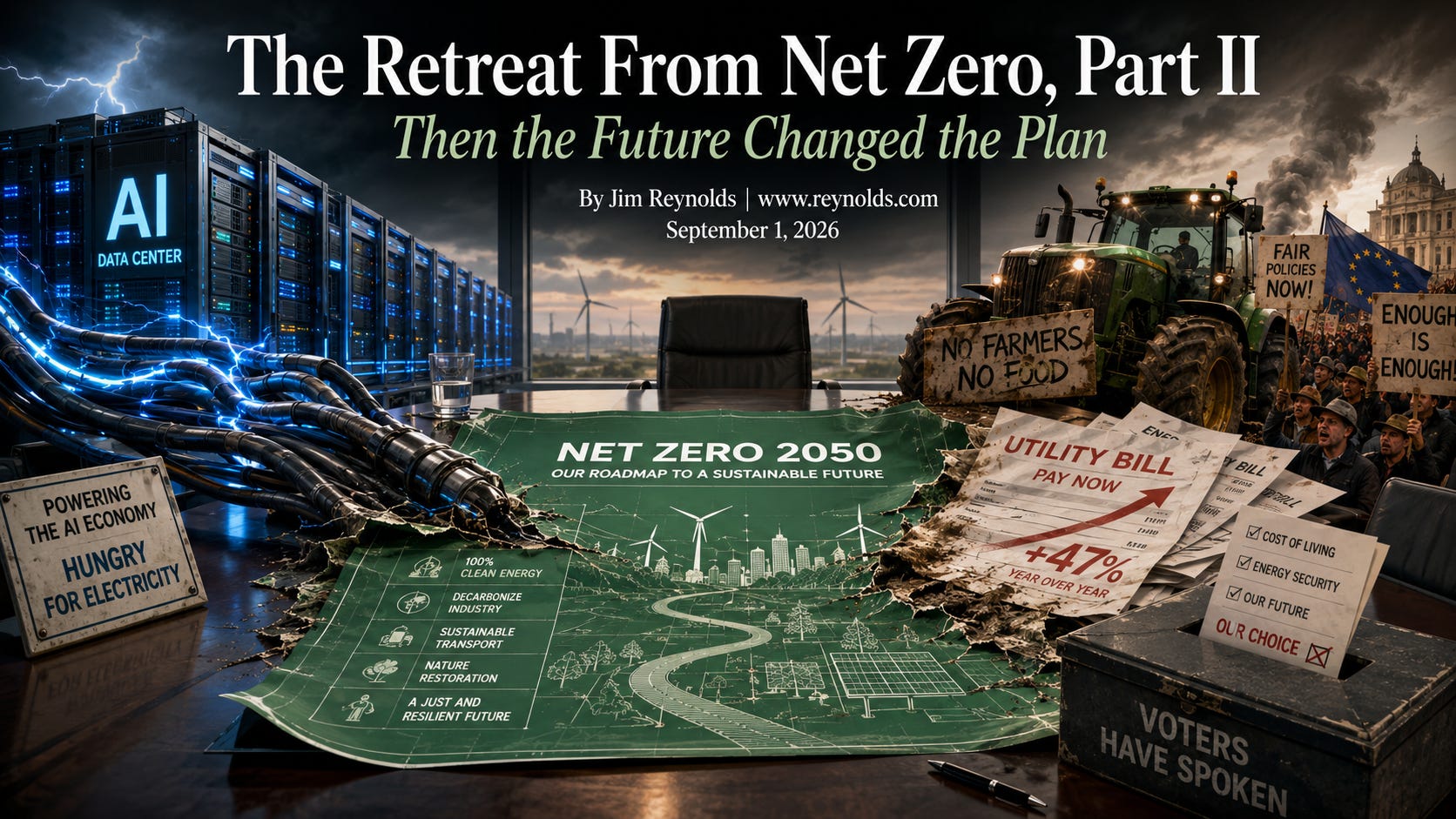
The Retreat From Net Zero, Part II
Then the Future Changed the Plan
By Jim Reynolds | www.reynolds.com
September 1, 2026
Then the Computer Ate the Climate Plan
Artificial intelligence may be my favorite exhibit in the futility of pretending to know what 2050 will look like.
AI requires gigantic data centers, and gigantic data centers require gigantic quantities of electricity. The International Energy Agency reported that data-center electricity use jumped sharply in 2025 and expects the sector’s consumption to continue rising dramatically through 2030. In the United States, data centers are expected to account for a large share of electricity-demand growth.
Suddenly many of the same political and corporate institutions that spent years planning how to constrain carbon-intensive energy are confronting perhaps the most important technological race of the decade.
And the race runs on electricity—lots of it.
Microsoft wants to be carbon negative. Microsoft also wants to win AI.
Good.
Now do both.
Where was this in the original assumptions? Where were millions of AI accelerators, enormous new data centers and an industry willing to spend extraordinary sums of money to obtain dependable power immediately rather than in 2040?
They weren’t there.
And neither is whatever comes next.
🅱️ Bob’s version:
The future has an irritating habit of not reading the plan.
That is precisely why governments should be exceedingly reluctant to destroy existing capacity on the strength of forecasts extending decades into the future.
Europe Discovers the Customer
Europe still intends officially to become climate neutral by 2050.
The slogans remain. The interesting part is what happens underneath them.
Its new emissions-trading system covering buildings and road transportation was pushed back. Safeguards have been added to restrain excessive prices, and the EU has created a large Social Climate Fund intended to help households and businesses cope with the cost of the transition.
Think about the loop.
Government introduces a policy intended partly to make certain forms of energy more expensive so people will use less of them. People discover that their energy has become more expensive. Government then becomes worried that those people may become angry and creates another program to help them afford the higher prices created by the first program.
🅱️ Bob: That may require a diagram.
Farmers understood the problem rather quickly.
Across Europe, tractors began appearing in capitals as farmers protested environmental regulations, fuel costs and agricultural restrictions they believed had been designed by distant officials with little appreciation for what happens on an actual farm.
This is where abstractions die.
A bureaucracy sees methane, nitrogen and an emissions curve. A farmer sees cattle, fertilizer, diesel fuel, acreage and next year’s income. Both may technically be describing the same policy, but only one has to live with it after the meeting ends.
Every regulation eventually leaves the conference room.
It lands on somebody.
Quite often, that person wasn’t invited to the conference.
Then People Vote
Voters were another variable missing from the great Net Zero spreadsheet.
People will tolerate abstract plans for quite a while when the costs remain abstract too. A target for 2050 sounds painless because 2050 is practically science fiction. But electricity bills arrive every month. So do car payments, heating bills, taxes and payrolls.
Once those costs become tangible, ideology becomes tangible too.
Opposition parties notice. Politicians discover that today’s existential moral imperative can become tomorrow’s electoral liability. Businesses notice the same shift and start recalculating what government is likely to require five or ten years from now.
That is why corporate retreat can occur so quickly once political permission appears.
For years, many companies had every incentive to nod along. Why pick a fight with the government? Why antagonize regulators? Why alienate officials controlling subsidies and tax credits? Why volunteer to become the corporation singled out for insufficient enthusiasm?
Put Net Zero in the annual report. Hire a sustainability officer. Set a target 25 years away. Promise Scope 3 reductions. Issue another glossy PDF filled with leaves.
Then the politics change.
And suddenly the lawyers rediscover the word ambition.
A commitment becomes an ambition. A mandate becomes a pathway. A deadline becomes a goal. A requirement becomes something to be achieved “where market conditions permit.”
Nobody holds a press conference announcing surrender.
The verbs simply become less expensive.
Trump Said No
Donald Trump’s return mattered beyond the particular regulations his administration reversed.
On his first day back in office he again ordered the United States out of the Paris climate agreement and began undoing large parts of Biden-era climate policy.
The larger effect, however, was psychological.
Trump demonstrated that a Western government could simply reject the premise that yesterday’s climate consensus was permanently binding. An international agreement was not sacred merely because previous leaders had signed it. A regulation was not beyond reconsideration merely because somebody attached the word “climate” to it. And the government did not necessarily possess superior wisdom about which automobile Americans should purchase ten years from now.
You can believe Trump is right or wrong about any individual policy and still recognize what changed.
He broke the spell of inevitability.
Once the world’s largest Western economy says no, incentives change everywhere. Banks notice. Automakers notice. Energy companies notice. Governments notice. And voters notice that a choice they had repeatedly been told no longer existed apparently existed after all.
Now Let’s Talk About the Damage
This is where my sympathy runs out.
I have no objection to people making bad forecasts. We all do it. What I object to is people making bad forecasts with my money, enforcing those forecasts with government power, damaging functioning industries along the way, and then quietly revising the forecast when reality refuses to cooperate.
That isn’t merely a forecasting error.
That is arrogance with subpoena power.
If I make a foolish investment, I lose my money. When Washington or Brussels makes one effectively mandatory, the losses are distributed across everyone else.
Consumers pay more. Taxpayers finance subsidies. Utilities retire equipment. Companies redesign products to satisfy regulations that may disappear after the next election. Engineers solve compliance problems instead of product problems, while small businesses absorb burdens that multinationals can hand to departments full of lawyers.
This is the opportunity cost Milton Friedman warned about: capital flows toward whatever governments temporarily designate as “the future,” diverting money from investments that might have created real value. The damage rarely appears in official reports. The factory that wasn’t built, the employee never hired, and the product made unaffordable by regulation leave no paper trail.
Nobody totals that column. But all of us pay for it.
That is the part the architects of these policies would very much like us to forget while they migrate gracefully from “commitments” to “ambitions.”
No.
You don’t get to do that without an audit.
The Sin Was Certainty
The great error was not caring about climate.
It was not building solar panels, developing EVs, improving batteries or even setting ambitious environmental goals.
The error was pretending to possess knowledge nobody actually possessed.
Politicians and activists took enormously complicated questions involving climate science, economics, electrical engineering, industrial policy, national security, consumer behavior and technological development and acted as though one side had already solved them all.
Maybe the grid couldn’t expand quickly enough.
Maybe batteries weren’t ready to do what the plan demanded.
Maybe carbon capture wouldn’t scale.
Maybe consumers wouldn’t buy exactly the vehicles government forecast.
Maybe shutting down dependable generating capacity before its replacement had been built was a bad idea.
Maybe Western manufacturers could not indefinitely compete with countries unwilling to accept the same costs.
Those were not crazy questions.
They were precisely the questions adults were supposed to ask before committing trillions of dollars and rearranging the energy infrastructure of nations.
Instead, too many people asking them were treated as obstacles to progress.
Now reality is asking the same questions.
Reality is considerably harder to censor.
Reality Gets the Last Vote
Central planning repeatedly crashes into the same wall because the planners don’t know the future.
Neither do I. Neither do you. Neither does Donald Trump. Neither does the European Commission, and neither does the smartest climate scientist at MIT.
Twenty-nine years is not a plan.
It is a guess wearing a necktie.
That doesn’t mean we do nothing. It means we stop pretending humility is cowardice.
Develop cleaner technology. Build more nuclear power. Improve batteries. Reduce pollution. Make solar better. Make natural gas cleaner. Build transmission where it makes economic sense. Experiment with carbon capture.
Do all of it.
But keep the energy system working while you do it.
Don’t blow up the bridge until you have finished the new bridge beside it.
And for God’s sake stop confusing government preference with technological inevitability.
Count the carbon, certainly. But count everything else too: reliability, electricity prices, manufacturing, competitiveness, subsidies, jobs, taxpayers, small businesses and the consequences for ordinary people who spend a much larger portion of their income heating a home, filling a tank or paying an electric bill.
Count all of it.
That is what sane policy looks like.
Net Zero too often worked backward. The morally approved destination was selected first, while engineering, cost, competition and human behavior were treated as details that would somehow resolve themselves on the journey.
Later has arrived.
The banners will remain. The conferences will continue. The 2050 targets will survive on government websites long after many of the policies underneath them have been rewritten.
But look underneath the banners and the movement is obvious. Deadlines are moving, targets are disappearing, exceptions are multiplying, subsidies are being redesigned, corporations are rewriting promises and governments are installing escape valves into policies that only a few years ago were described as inevitable.
The people who told us there was no alternative are gradually discovering alternatives everywhere.
They will call this pragmatic adaptation.
Fine.
I call it reality collecting a debt.
And unlike the people who wrote the original forecast, reality doesn’t accept carbon credits.
2050 is still on schedule.
Everything required to get there isn’t.
Rip’s Newsletter is a reader-supported publication. To receive new posts and support my work, consider becoming a free or paid subscriber.
Climate has been changing for 500 million years before humans even existed. CO2 was not causal; temperature was, and that was driven by variations in solar output and Milankovitch Cycles. At present, we are at the end of an ice age, so temperatures are rising naturally, whether humans exist or not. We are still significantly below historical norms.
People need to accept that Earth is warming naturally, that crops will grow better with warmer temperatures and more atmospheric CO2. But, it won't be significant for 10,000 years or more, so grab a beer and cheer.
This second contribution to your position on Net Zero is welcome. What is being demonstrated is the government's attitude toward "progress". When Pearl Harbor was bombed in 1941 the government "forecast" a long war and directed, by legislation and fiat for the entire country to mobilize to meet the threat. What Japan hadn't counted on was the way the US was able to meet the threat. I mention this to show how it is possible for the government to announce a policy and get the entire country to move in a given direction. BUT, climate change wasn't introduced the way Pearl Harbor was presented. There were no deaths and destruction, only forecasts and predictions of disaster. Noteworthy was the failed predictions that preceded the announced plans to deal with climate change. The nation's response was less than enthusiastic, except for the way industry moved. Government incentives were focused on manufacturers in a way that the citizenry didn't feel the impact. At least not at first. Automobiles were the most obvious "face of climate change", then came smaller requirements like the requirement for newly constructed residential houses to have solar panels and then the proliferation of wind turbines. Reality in the form of "net zero" meeting AI requirements is something relatively new. And it raises the question of "what's next?"