


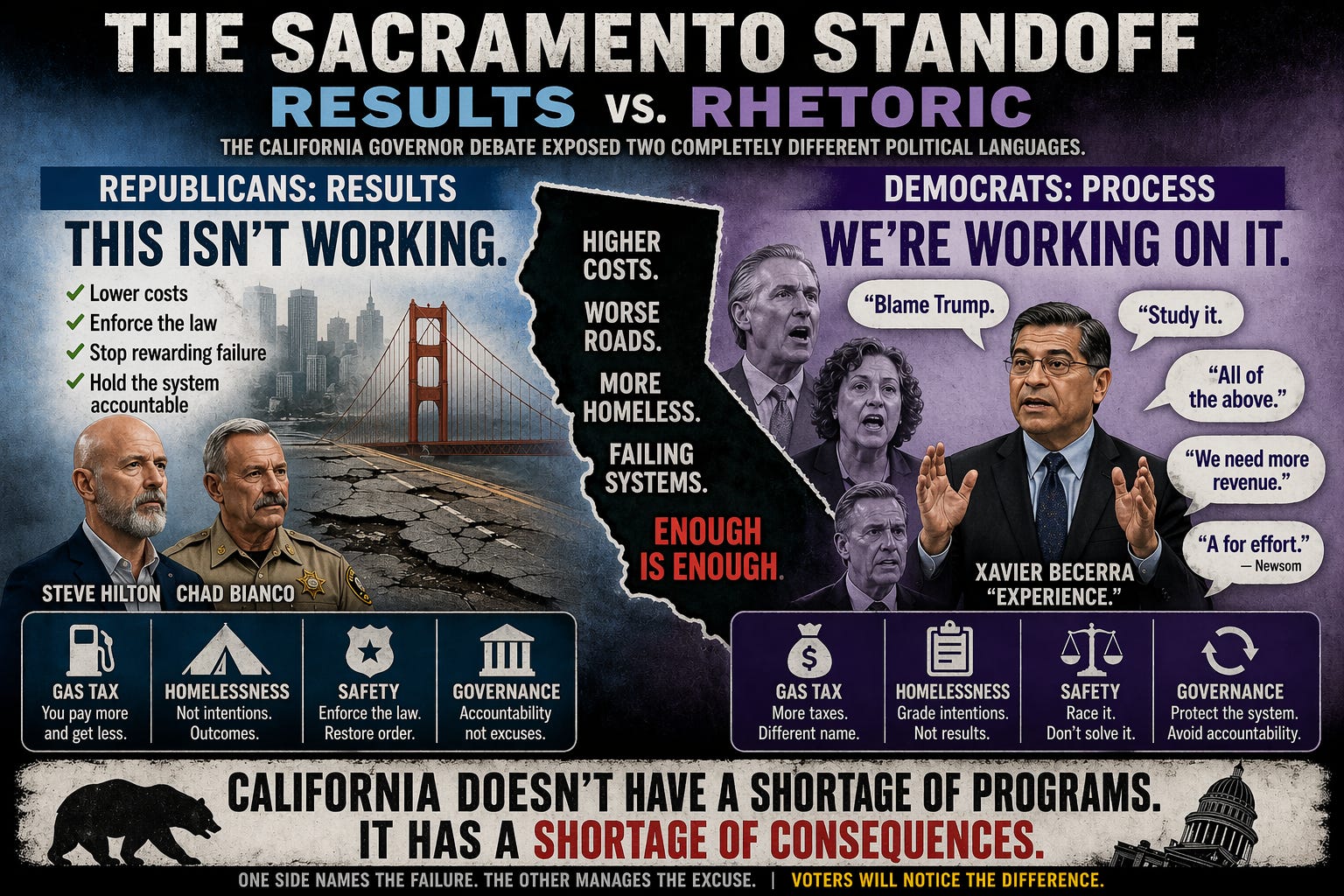
The Sacramento Standoff: Results vs. Rhetoric
By Jim Reynolds | www.reynolds.com
April 23, 2026
The California governor debate didn’t just showcase candidates. It exposed two completely different political languages.
Republicans spoke in results.
Democrats spoke in process.
One side said: This isn’t working.
The other said: We’re working on it.
That’s the whole debate.
———
Accountability vs. Evasion
Steve Hilton and Chad Bianco had the easier job—and the better one. They didn’t have to defend California. They just had to point at it.
High costs. Bad roads. Homeless encampments. Failing systems.
No theory required. Just observation.
Democrats had the opposite burden. They had to sound like reformers without admitting failure. They had to defend compassion while explaining visible disorder. They had to promise change without touching the machine that produced the problem.
That’s why they sounded slippery.
And no one embodied that more than Xavier Becerra—who answered hard questions the way a seasoned bureaucrat does: not with solutions, but with résumé.
When the system fails, experience inside that system isn’t a credential.
It’s evidence.
———
Gas Taxes and the Art of Not Answering
The gas tax question was simple: why are Californians paying among the highest rates in the country and still getting lousy roads?
Republicans: Because the system is mismanaged.
Democrats: Because… Trump, oil companies, and maybe Iran.
Matt Mahan, to his credit, broke ranks and said the obvious: suspend it. It’s regressive. It hits working people hardest.
Then the rest of the field went sideways:
Steyer blamed geopolitics and proposed another tax.
Porter suggested moving the burden somewhere else—same cost, different pocket.
Becerra… wandered.
He talked about roads. He talked about Trump. He invoked Iraq. He circled back to “experience.”
What he never did was answer the question.
That wasn’t a mistake. That’s the method.
When the answer is politically inconvenient, you fog it out.
Republicans cut through it: you’re paying more and getting less.
That argument doesn’t need polish. It just needs daylight.
———
The “A for Effort” Problem
Then came homelessness—the issue no one can hide from.
180,000 people. Encampments everywhere. Public disorder as a daily reality.
And the grades?
B.
B-.
A for effort.
That’s not analysis. That’s a participation trophy.
It tells you everything: Democrats grade intentions. Voters live with outcomes.
They see spending as compassion.
Voters see tents, needles, and untreated mental illness.
Porter talked prevention. Fine. Some homelessness is economic.
But the public isn’t reacting to edge cases. They’re reacting to the core: addiction, psychosis, and streets that no longer function.
Becerra did the same—programs, early intervention, soft edges.
Bianco and Hilton went straight at it: enforce the law, mandate treatment, restore order.
That’s the divide.
One side manages programs.
The other names the failure.
———
The Credentialism Trap
Becerra’s weakest moment came when Porter pressed him for specifics—numbers, plans, tradeoffs.
His response?
“I’ve run big things.”
That’s not a plan. That’s a LinkedIn profile.
If the institutions you’ve run are failing, “experience” isn’t your shield—it’s your burden.
California doesn’t lack experienced managers.
It lacks results.
———
When Everything Becomes About Race
The truck driver question should have been straightforward: should commercial drivers understand the language needed to operate safely?
Republicans: Yes. It’s a safety issue.
Democrats: This could be discriminatory.
Becerra immediately reframed it: who gets tested? People who “look like me”?
That’s the reflex. Before solving the problem, redefine it as a moral risk.
Safety becomes secondary. Optics come first.
Mahan again tried to ground it—focus on competence, not identity.
But the pattern held: practical question → ideological detour.
———
The Trump Crutch
When in doubt, invoke Trump.
Gas prices? Trump.
Foreign policy? Trump.
State governance? Also Trump.
The Democrats treated the California governorship like a branch office of the resistance.
Hilton flipped it: maybe working with a federal administration matters more than theatrically opposing it.
That’s not a small distinction.
One approach governs.
The other performs.
———
The Real Outcome
The Democrats didn’t lose because they were out-polished.
They lost because they couldn’t say the obvious.
They couldn’t say the gas tax is too high—because they want the revenue.
They couldn’t say Newsom failed—because he’s their system.
They couldn’t answer the mileage tax—because more revenue is always on the table.
They couldn’t treat enforcement as neutral—because everything runs through identity.
And Becerra couldn’t offer change—because he is continuity.
———
The Line That Matters
California doesn’t have a shortage of programs.
It has a shortage of consequences.
It’s not expensive because it taxes too little.
It’s expensive because government drives up the cost of everything it touches.
Homelessness isn’t persisting for lack of compassion.
It’s persisting because compassion without order becomes surrender.
Public agencies aren’t failing because voters are impatient.
They’re failing because one-party rule removed accountability.
Republicans said that out loud.
Democrats couldn’t.
That’s why one side sounded clear—and the other sounded careful.
And for the first time in a long time, California voters might notice the difference.
Yes, for anybody noticing, it was a stark difference. Always is.
Excellent autopsy of a debate that further exposed what is already apparent to conservatives - the Democrat (NOT Democratic) ) candidates won’t do anything different than Newsom and his minions. They will continue dragging California down a rat hole. It was Harris’ notorious statement about Biden that doomed her campaign in eyes of voters tired of their destructive policies. Hope voters see the light but never underestimate the ignorance of left coastal voters.