


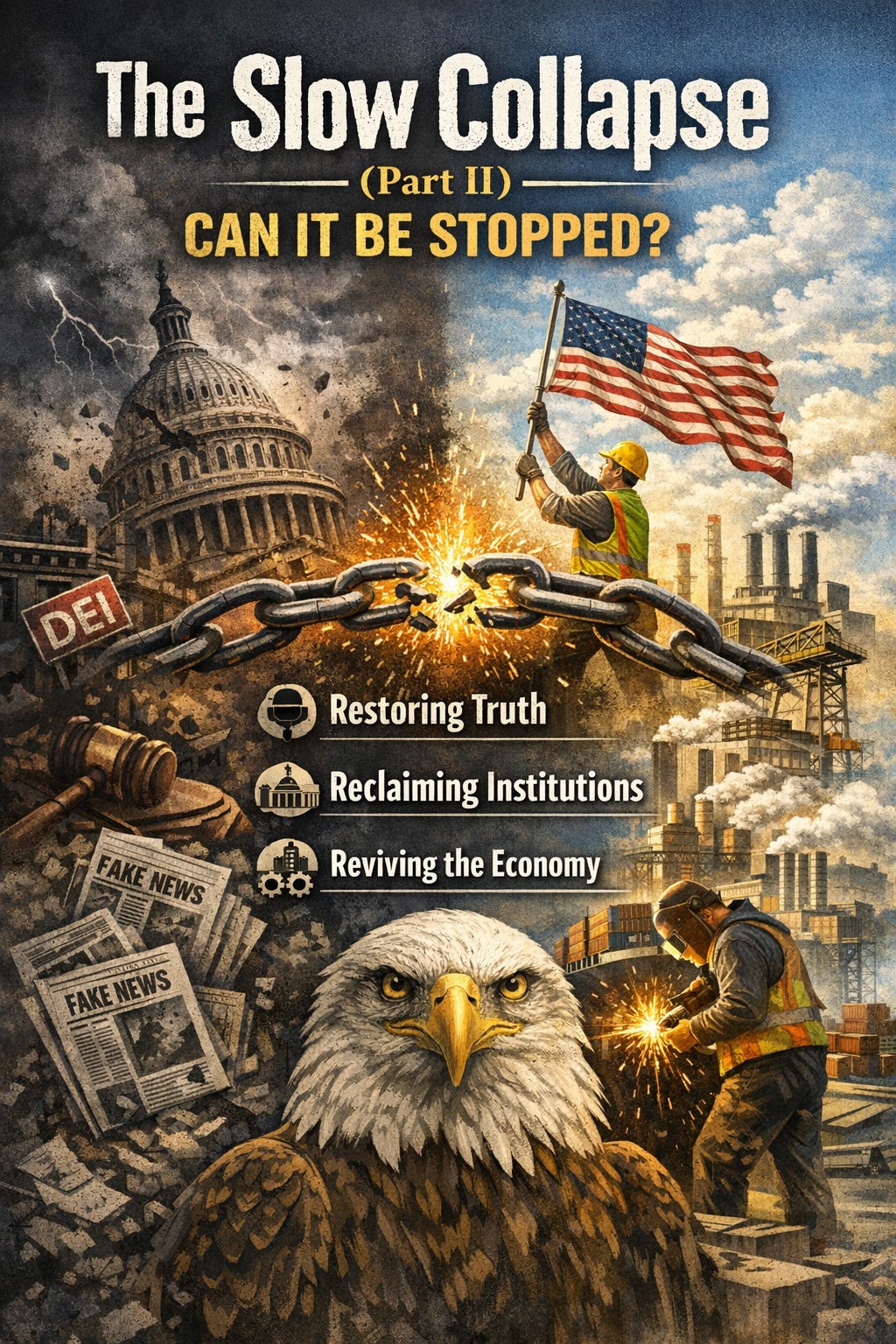
The Slow Collapse (Part II)
Can It Be Stopped?
By Jim Reynolds | www.reynolds.com
March 31, 2026
Part I laid out the drift—the slow unraveling that most people feel before they can name.
Part II is simpler and harder:
Is anyone actually trying to stop it?
And if so—are the efforts real, or just another layer of narrative?
⸻
Restoring a Common Reality
If truth was the first thing to break, it has to be the first thing addressed.
The current administration has gone directly at the credibility layer—particularly legacy media and the broader narrative machine that shapes perception before policy ever lands.
Not politely. Directly.
Calling out falsehoods in real time.
Bypassing traditional filters.
Forcing contested issues into the open rather than letting them be quietly managed.
That alone changes the terrain.
Because once competing claims are visible, people can compare outcomes to rhetoric again.
Bob: “Sunlight is step one. You can’t fix what you can’t see.”
⸻
Challenging Institutional Capture
There’s been a clear effort to confront ideological capture inside major institutions—especially around hiring, promotion, and standards.
DEI, in particular, has been treated not as a cultural preference, but as a structural distortion.
The push is toward:
Merit over signaling.
Performance over compliance.
Standards that apply evenly rather than selectively.
Whether one agrees with every execution detail, the direction is unmistakable:
Re-center institutions around function instead of ideology.
Bob: “If you don’t fix incentives, nothing else matters.”
⸻
Closing the Elite Gap
A different tone has emerged—less managerial, more blunt.
Policies are framed in terms people actually experience:
Cost of living.
Energy.
Safety.
Work.
There’s an attempt—imperfect, but visible—to align decision-making with lived reality instead of abstract modeling.
It doesn’t eliminate the gap.
But it narrows it.
And even a partial narrowing restores something important:
the sense that leadership is at least looking in the same direction as the public.
Bob: “You don’t need perfection. You need recognition.”
⸻
Rebalancing the Economy Toward Production
There’s a noticeable shift away from pure financialization toward tangible output.
Doers over talkers.
Builders over destroyers.
Energy development.
Domestic manufacturing.
Supply chain resilience.
Trade leverage.
The idea is straightforward:
A nation that doesn’t make things becomes dependent on those who do.
This is less about short-term optimization and more about long-term positioning.
Not everyone likes the trade-offs.
But the intent is clear—move from paper gains back to real capacity.
Bob: “You can’t run a country on spreadsheets.”
⸻
De-Weaponizing the Bureaucracy (or Trying To)
This is the hardest problem—and the least solved.
There are real efforts to:
Reduce regulatory overreach.
Challenge unelected authority.
Limit process-as-punishment.
But bureaucracies don’t unwind easily.
They defend themselves.
What you’re seeing isn’t resolution—it’s resistance.
Friction.
And friction, at this stage, is the signal.
Because when you start pulling power out of a system that’s grown used to it, the system reacts.
In real terms, the push isn’t theoretical:
Over 300,000 federal jobs were eliminated in 2025 alone—through layoffs, buyouts, and attrition.
That’s not trimming.
That’s pressure.
And the response has been immediate—legal, political, institutional.
Which tells you something important:
You’re not pushing on the edges.
You’re pushing on the core.
Bob: “When the machine pushes back, you’ve found the machine.”
⸻
The Line of Resistance
This is where the entire effort either holds—or breaks.
Because what’s being challenged isn’t just policy.
It’s power.
Entrenched, unelected, self-protecting power.
And systems like that don’t reform themselves.
They absorb pressure. Redirect it. Wait it out.
They turn process into delay.
Delay into paralysis.
Paralysis into defeat.
If this push stalls here—inside the machinery—everything else becomes surface-level.
You can win elections.
You can change messaging.
You can even pass laws.
But if the underlying system remains intact, it will outlast all of it.
Quietly.
Patiently.
And when the moment passes, it resets the board.
That’s the risk.
Not loud failure—
but slow absorption.
Not confrontation—
but neutralization.
And if that happens, the drift doesn’t just continue.
It accelerates.
Bob: “If you don’t break the machine here, the machine breaks you.”
——
Rebuilding a Sense of “We”
This is where policy hits culture.
The administration’s posture leans toward:
Shared citizenship over fragmented identity.
National interest over group segmentation.
Common ground over constant division.
It’s not a full cultural reset.
But it is a directional shift.
And direction matters more than rhetoric.
Bob: “You don’t need everyone to agree. You need them to belong.”
⸻
Competence as a Priority
There’s a renewed emphasis—again, uneven but present—on execution.
Faster decisions.
Clearer priorities.
Less deference to process for its own sake.
It shows up most in areas like:
Energy approvals
Border enforcement
Operational follow-through
Competence isn’t a speech. It’s a pattern.
And patterns take time to prove.
Bob: “Results are the only argument that sticks.”
⸻
Letting Reality Back In
There’s less appetite for rebranding problems.
More willingness to name them directly—even when it’s uncomfortable.
Inflation isn’t “transitory.”
Security problems aren’t “perception gaps.”
Policy failures aren’t “messaging issues.”
That shift alone changes expectations.
Because once you name a problem plainly, you’re on the hook to deal with it.
Bob: “Call it what it is, or it keeps growing.”
⸻
Reasserting Equal Standards
There’s an effort—still contested—to push back on double standards.
The idea is simple:
Same rules. Same consequences.
No carve-outs. No parallel systems.
This is where rhetoric runs ahead of reality.
But even the attempt matters.
Because fairness isn’t restored by perfection—it’s restored by direction and enforcement.
Bob: “One system. Or no system.”
⸻
Reducing Overreach, Restoring Order
There’s a simultaneous attempt to:
Scale back unnecessary control
While enforcing core rules more clearly
That balance is difficult.
But the intent is to move away from:
Endless rule-making + selective enforcement
Toward:
Fewer rules + consistent enforcement
If it holds, it stabilizes.
If it doesn’t, the old cycle returns.
Bob: “Simple rules. Actually enforced.”
⸻
Stabilizing the Human Base
Some of the efforts here are indirect:
Economic stability
Job creation
Public safety
Cost containment
The idea is that strong conditions lead to stronger families and communities.
This is long-cycle work.
You don’t see results immediately.
But you do see whether the trajectory changes.
Bob: “Fix the conditions, people can fix themselves.”
⸻
Reasserting External Strength
This is one of the clearer areas of movement.
More direct posture with adversaries.
Less automatic deference in trade and diplomacy.
Clearer signaling of national interest.
It doesn’t eliminate risk.
But it changes expectations.
And expectations shape behavior—both abroad and at home.
Bob: “Strength travels.”
⸻
Rejecting the Absurd
There’s a visible refusal—at least in tone—to normalize what would have once been unthinkable.
Calling out excesses.
Mocking contradictions.
Refusing to pretend.
That matters more than it seems.
Because once absurdity is challenged, it stops being invisible.
And once it’s visible, it can be rejected.
Bob: “If you don’t laugh at it, you end up living in it.”
⸻
So—Is It Working?
Too early to declare victory.
Too late to pretend nothing was broken.
What’s happening now is not resolution.
It’s confrontation.
Some systems are being corrected.
Some are resisting.
Some haven’t moved at all.
The key question isn’t whether every policy succeeds.
It’s whether the correction mechanism itself is being restored.
⸻
The Real Test
Do bad ideas get challenged?
Do failed policies get reversed?
Do people in power face consequences?
If the answer starts becoming “yes”—consistently—
then the drift slows.
If not, nothing else matters.
⸻
The Line That Matters
You don’t need perfection.
You need:
Truth that can be spoken
Rules that apply
Leaders who can be held accountable
Everything else builds from that.
⸻
Where This Ends
If accountability returns, the loop breaks.
If it doesn’t, the loop tightens.
That’s it.
Bob: “We finally have a chance to turn the wheel.
The question is whether we actually do it.”