


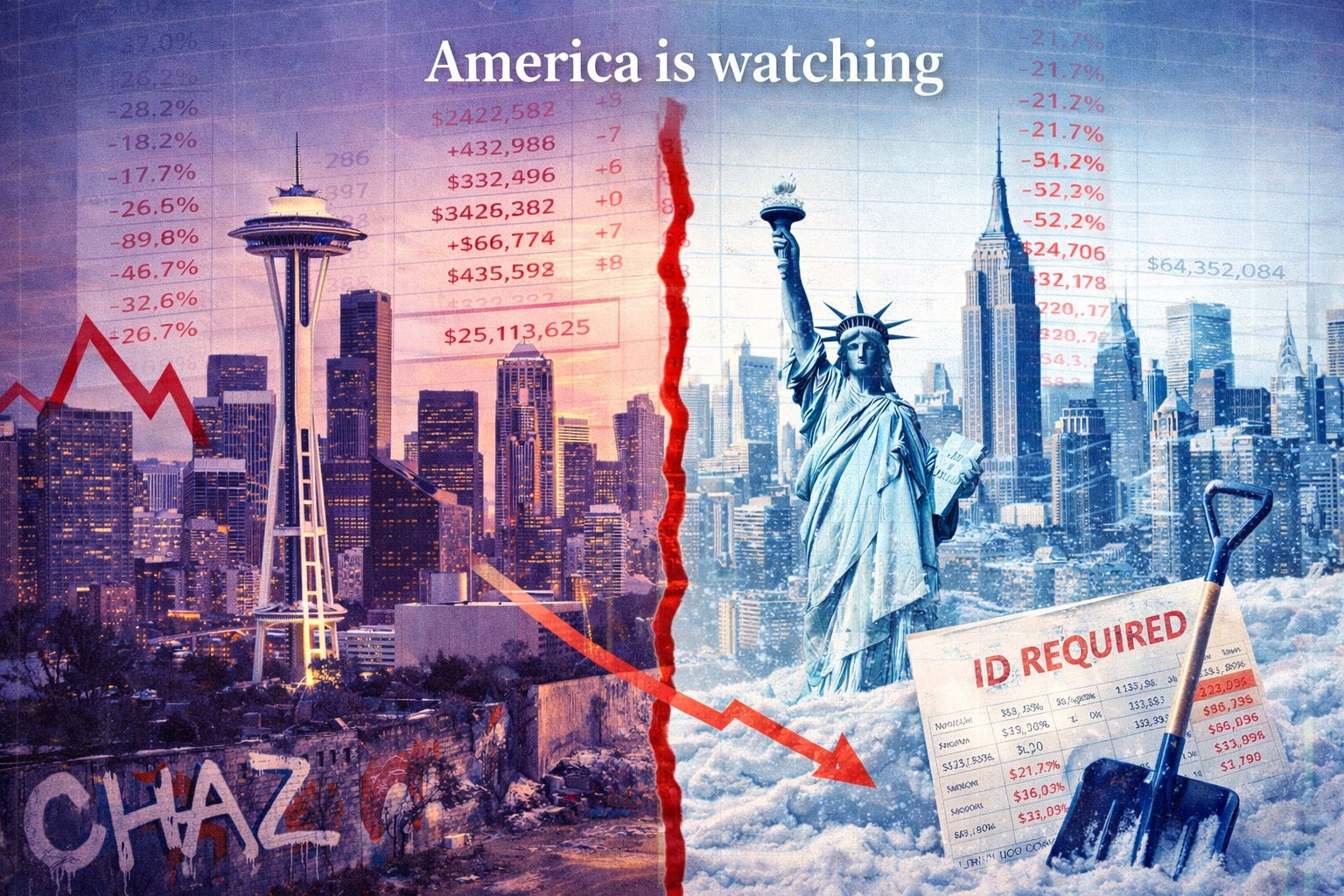
The Socialist Stress Test
Seattle, New York, and the Arithmetic of Reality
By Jim Reynolds | www.reynolds.com
Let’s be clear.
Katie Wilson doesn’t just represent “a city.”
She represents Seattle.
Seattle — birthplace of CHAZ/CHOP.
Six blocks of police-free utopianism in 2020.
A city government that ceded territory to activists and then tried to pretend it was a civic dialogue experiment.
That wasn’t theoretical.
It produced lawsuits. Injuries. Businesses shuttered. National embarrassment.
Now Seattle has elected a democratic socialist mayor.
This is not a rupture from the past.
It’s a refinement of it.
Her first State of the City address landed softly outside progressive circles. Grand moral framing. Limited fiscal detail. In a city staring at a projected budget gap north of $200 million. Pension obligations rising. Public safety staffing still below pre-2020 levels.
Arithmetic, meet aspiration.
Seattle runs on a $7+ billion annual budget. It has roughly 750,000 residents. It manages transit, policing, zoning, utilities, homelessness programs, and one of the most volatile housing markets in America.
That is not a campus coalition.
That is a machine.
Now look east.
New York.
Nearly 8.5 million residents.
A municipal budget over $110 billion.
Debt approaching levels that make bond markets twitch.
Zohran Mamdani’s early tenure has already collided with weather and waste.
After a major snow event, entire neighborhoods sat buried for days. Trash piled up on snowbanks. Residents — and celebrities — openly mocked the city as a “snow-covered dump.”
Critics said the city felt effectively locked down — not initially by decree, but by dysfunction.
And then Mamdani banned most travel across New York City for fifteen hours, closing streets, highways, and bridges to all non‑essential vehicles under a state of emergency.
Then came the instantly-infamous “ID required” episode.
To sign up for temporary city snow-removal work — $19 per hour — applicants were required to present multiple forms of identification and a Social Security card.
Two IDs.
Copies.
Verification.
For a shovel.
A movement that bristles at voter ID requirements suddenly very concerned about paperwork integrity when payroll is involved.
Bob would raise an eyebrow: “ID to dig. No ID to vote. Interesting.”
But here’s the serious part.
This isn’t about gotcha moments.
It’s about scale.
Seattle’s violent crime spiked more than 20% between 2019 and 2022. Police staffing fell dramatically after the 2020 unrest and has struggled to rebound. Businesses cite theft and disorder as relocation factors.
New York’s migrant shelter costs alone have run into billions over recent years. Sanitation, public safety overtime, and infrastructure maintenance are perpetual budget strains. Snow removal in New York typically costs tens of millions per major event — and performance is measured in hours, not ideology.
Cities are unforgiving.
They operate on thin margins and high complexity.
Socialism, historically, thrives in abstraction — where distribution sounds clean and structural friction is theoretical.
Municipal governance is friction.
Garbage contracts.
Overtime rules.
Union negotiations.
Bond ratings.
Insurance liability.
Procurement law.
The spreadsheet is undefeated.
These experiments are not happening in a vacuum.
They are being watched — by bond markets, by business owners, by suburban voters, and by a country that remembers how similar adventures have tended to end.
From 1970s New York fiscal collapse to Detroit’s bankruptcy to San Francisco’s more recent retail exodus — large-scale ideological governance layered over fiscal stress has rarely concluded with applause.
That doesn’t mean Seattle or New York are destined for catastrophe.
It does mean the stress test is real.
Bob would put it this way: “Anyone can design a better world. Try plowing it.”
The question isn’t whether turbulence comes.
It’s whether adaptation follows.
Because cities do not grade on intent.
They grade on outcomes.
Trash picked up or not.
Streets cleared or not.
Crime down or not.
Budgets balanced or not.
We are watching two large municipal organisms run ideological operating systems under high load.
America is paying attention.
Not to sneer.
To measure.
And history suggests one thing:
Arithmetic eventually votes.
Whether these mayors adapt — or double down — is still an open question.
But the experiment is underway.
And the spreadsheet is watching.
"We can neither abide our vices nor the remedy for them." Livy