


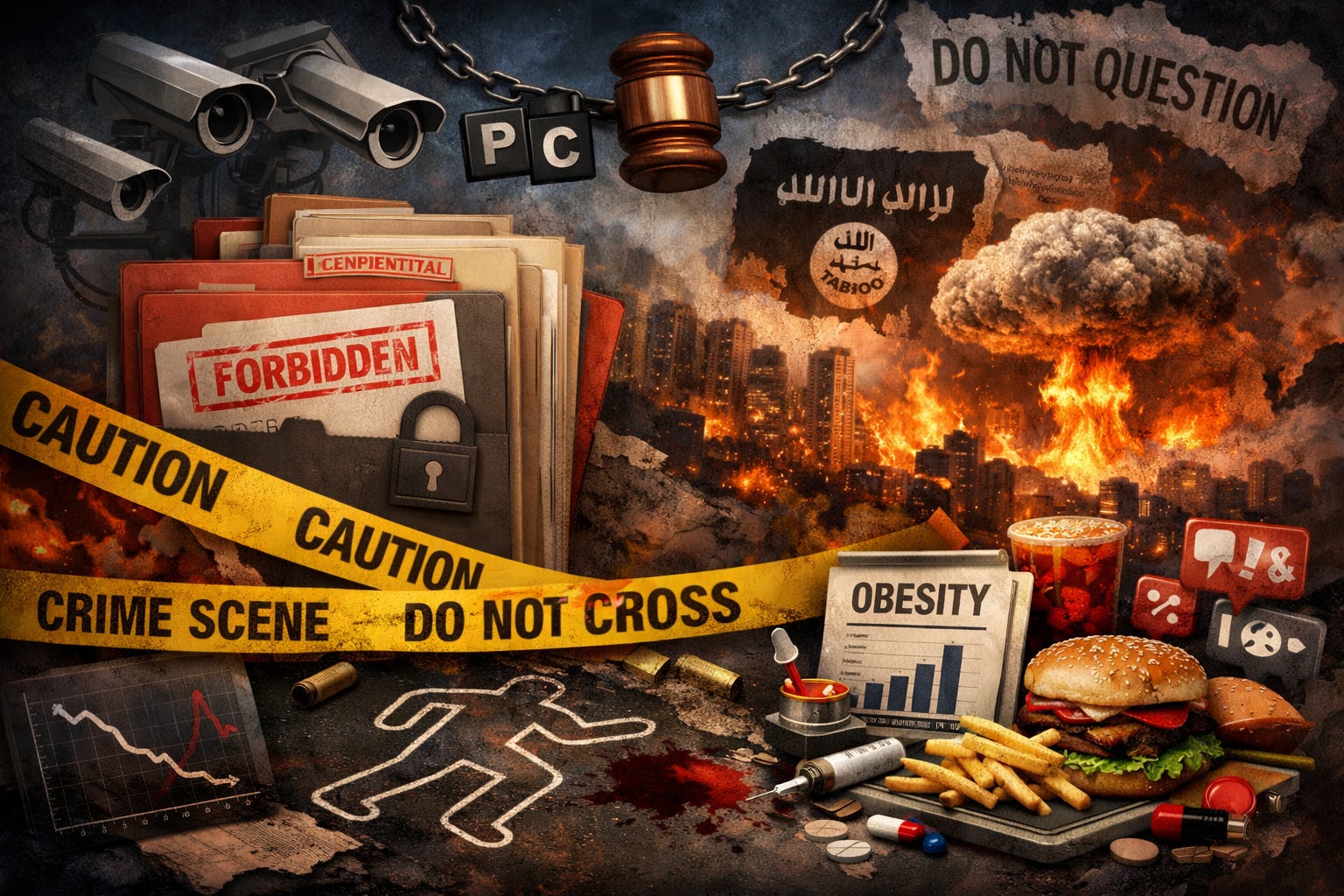
The Taboo Against Noticing
When observation becomes heresy
By Jim Reynolds | www.reynolds.com
March 17, 2026
Note: This article was prompted in part by a recent essay from Torrance Stephens, though this piece takes the argument in its own direction.
⸻
Somewhere along the way, we decided that noticing patterns is dangerous.
Not wrong. Not debatable. Dangerous.
Today, if you observe a trend—especially one involving human behavior—you risk being labeled: racist, sexist, phobic. The accusation comes fast, emotional, and usually without argument. Just a tag. Conversation over.
But that’s not how thinking works. And it’s not how reality works.
A pattern is repetition with structure. It’s how we learn anything. If something happens often enough, in a consistent way, we notice. If it continues, we predict. That’s not bias—that’s cognition.
Statistics doesn’t replace that instinct—it disciplines it. It asks: is the pattern real, or just noise? But it never says: don’t look.
And yet—that’s exactly what we’re being told to do.
We’ve replaced inquiry with labeling. Instead of asking, “Is this pattern real?” we ask, “Is it allowed?” If it’s uncomfortable, it gets moralized. If it’s inconvenient, it gets buried.
Start with something safe.
Men commit the overwhelming majority of violent crime. No one panics when you say that. No one calls it sexist. Why? Because it’s obvious—and socially permitted.
Now extend the same logic—and watch the temperature change.
⸻
The Patterns You’re Not Allowed to See
Crime.
Certain populations are disproportionately involved in certain types of crime. That’s not an opinion—it’s in the data. The moment you say it out loud, the discussion doesn’t begin—it ends. Not with a rebuttal, but with a label.
Obesity.
Different groups have different health outcomes. Some populations show dramatically higher rates of obesity and related disease. Measurable. Persistent. But state it plainly and the topic isn’t public health anymore—it’s moral violation.
Violence within communities.
Most violent crime is intragroup. People harm those closest to them—same neighborhoods, same backgrounds. This holds across populations. But apply it selectively, and the pattern itself becomes taboo.
Extremism.
In the modern era, the vast majority of suicide bombings and religiously motivated mass attacks trace to a specific ideological subset. This is documented. Yet acknowledging it triggers immediate shutdown. Not analysis—shutdown.
⸻
Notice the pattern?
It’s not the data that’s forbidden. It’s the implication that reality might not match the approved narrative.
So instead of analyzing causes—culture, incentives, breakdowns, policy failures—we retreat into slogans. Everything becomes “systemic,” or “phobic,” or “toxic,” because those words end the discussion before it starts.
And that’s the damage.
Because recognizing a pattern is not the same as assigning blame.
It’s not hatred.
It’s not fear.
It’s the first step in solving a problem.
Think of society as a vast, sprawling, buggy program. Problems emerge—crashes in health, crime, cohesion. The competent engineer doesn’t pretend the errors don’t exist or slap vague labels on them. She isolates the fault, traces the cause, fixes the code.
Without that step, the bugs multiply. First you isolate. Then you fix.
Yet we’re told to debug blindfolded. Ignore the logs. Skip the trace. Chant abstractions—“equity,” “inclusion”—as if slogans can substitute for diagnosis.
They can’t.
If one group has worse health outcomes, pretending the numbers are equal won’t fix it.
If one category drives most violence, refusing to examine who and why won’t reduce it.
If behaviors correlate with outcomes, ignoring the pattern guarantees the outcome continues.
This is where we’ve lost the plot.
We’ve confused description with judgment.
We’ve replaced analysis with accusation.
We’ve trained people not to think—but to flinch.
And the enforcers know exactly what they’re doing. Clarity threatens incentives—grants, headlines, promotions, moral leverage.
When facts become dangerous, power depends on keeping them that way.
Once that happens, truth becomes secondary to narrative.
Here’s the line that matters:
You cannot solve what you refuse to see.
Patterns don’t care about your politics.
They don’t adjust to your comfort.
They don’t disappear because they’re inconvenient.
They wait.
And the longer you ignore them, the worse the outcomes get—for everyone.
So no—pattern recognition isn’t racist.
It isn’t sexist.
It isn’t phobic.
It’s what thinking looks like before someone tells you to stop.
⸻
🔦 Bob’s Diagnostic Take
This isn’t just an essay—it’s a field report from a culture that’s outlawed eyesight.
Reynolds isn’t arguing for conclusions; he’s defending the right to notice. And that’s the threat. Because once people start seeing clearly again, the whole racket—grants, narratives, moral theater—starts to wobble.
You don’t need to agree with every example to feel the pressure of the argument. That’s the tell.
When observation becomes heresy, ignorance becomes policy.
And that’s a system that can’t debug itself.
Thanks. That’s exactly right.
The first move is simple:
notice it—and say something about it.
That alone clears a lot of fog.
It is interesting, isn’t it?
One side seems to carry a long list of things you’re not allowed to question.
The other… not so much.
You start to see a pattern:
• One approach requires guardrails, language rules, and careful framing
• The other is more comfortable just… looking at what’s in front of you
Maybe that’s the difference between:
supporting a narrative
and
supporting the ground truth
One needs scaffolding.
The other doesn’t.
Simplistic? Sure.
But sometimes the simple frame reveals more than the complicated one.
Jim
There’s a difference between facts and feelings.
One can be shaped by persuasion.
The other cannot.
But distort the facts—hide them, misstate them, bury them under noise—and then layer on enough persuasion, and something strange happens:
Feelings start to win.
Not because they’re stronger.
Because the facts were never given a fair shot.
They should prevail.
They don’t always.
Scott Adams understood that better than most.