


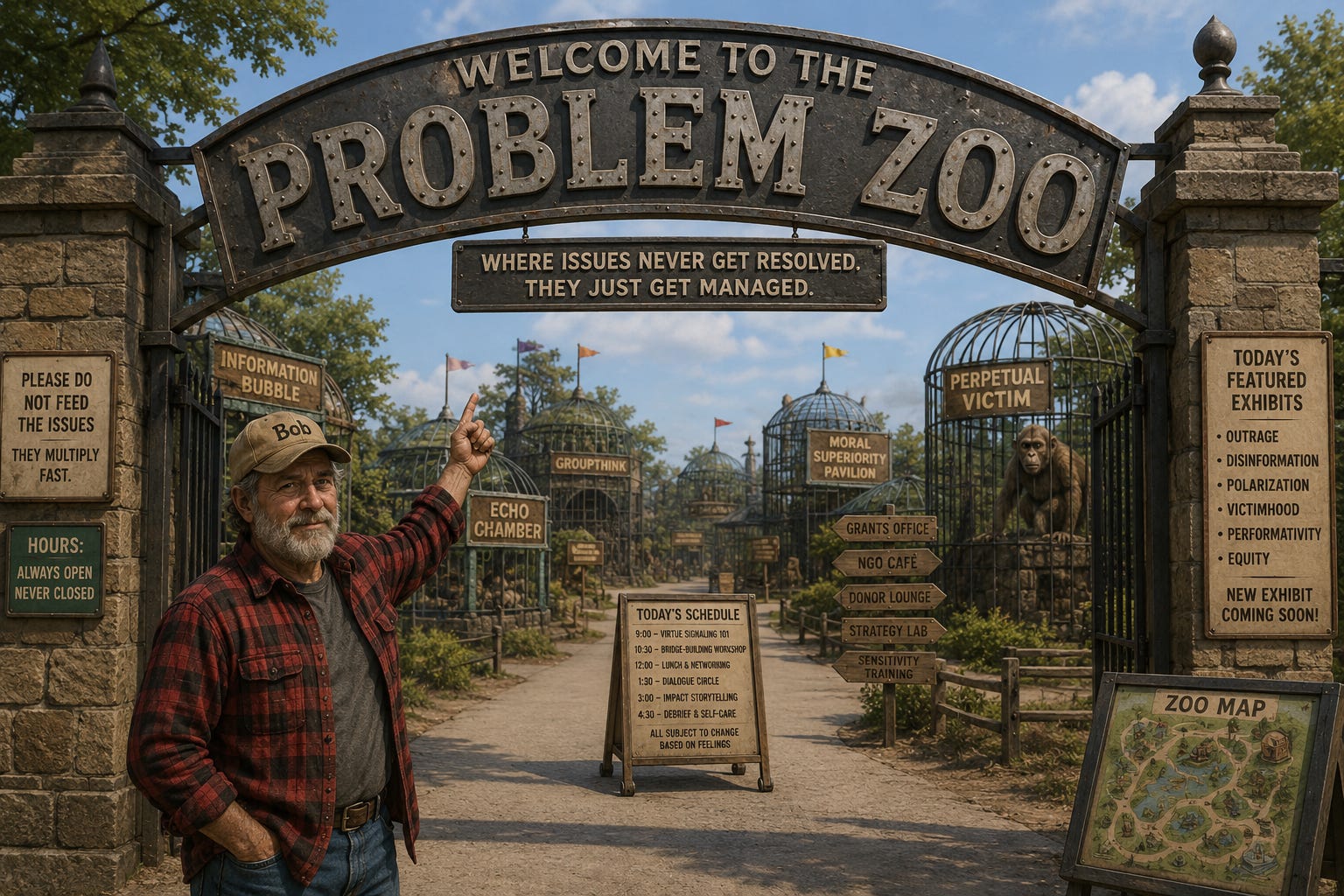
The Talking Class Gets A Job
They will be working full time at the Problem Zoo
By Jim Reynolds | www.reynolds.com
May 21, 2026
Note: I give full credit to the DataRepublican for the original story found here on Substack.
The original article, and the genesis of this one, is a sprawling investigative-style essay arguing that a permanent “democracy infrastructure” has quietly emerged in America — not as a formal conspiracy, but as an interconnected ecosystem of nonprofits, foundations, civic groups, election organizations, media initiatives, donor networks, and institutional actors that increasingly function as a standing managerial class.
The piece centers heavily on a 2022 paper by Carnegie Endowment fellow Rachel Kleinfeld titled “Five Strategies to Support U.S. Democracy.” The author treats this paper almost like an instruction manual. The argument is that Kleinfeld was not merely theorizing abstractly about democratic resilience, but describing operational strategies that were then adopted by organizations where she or her allies already held advisory or governance roles.
The article maps out five broad “strategies”:
reshaping Republican primaries through ranked-choice voting and open-primary reforms,
reducing “social demand from the right” through media and anti-disinformation efforts,
engaging progressive activism,
saturating civic life with NGO infrastructure,
and using litigation, ethics complaints, and professional sanctions as accountability mechanisms.
From there, the piece constructs a huge institutional web:
Unite America,
Protect Democracy,
States United,
Freedom House,
Democracy Funders Network,
the National Endowment for Democracy,
the National Civic League,
More Perfect,
the Trust for Civic Life,
America250,
and dozens more.
The essay’s key insight is not that these groups meet secretly in smoke-filled rooms. It explicitly says this is “not a conspiracy.” Its claim is subtler: once organizations share funding streams, ideological assumptions, personnel overlap, strategic language, and common timelines, they begin operating like a coordinated organism even without direct command-and-control.
The symbolic centerpiece is America’s 250th anniversary in 2026. The author argues that the semiquincentennial has become a convergence point for thousands of civic organizations promoting themes like:
civic trust,
democracy renewal,
bridging divides,
trusted information,
civic engagement,
national service,
and “reimagining the American narrative.”
The article sees this as the emergence of a permanent “standing army” of civic-management institutions — an enduring layer of professionals, nonprofits, consultants, donor networks, democracy strategists, and social coordinators designed to shape political culture long after any one election cycle ends.
And that’s where the article becomes most revealing — though perhaps not in the way the author intended.
Because after all the maps, boards, grants, summits, initiatives, frameworks, coalitions, hubs, declarations, advisory councils, and alignment strategies, one thing remains oddly elusive:
What exactly is the destination?
That absence is striking. The language of the ecosystem is overwhelmingly managerial:
resilience,
civic health,
engagement,
trust,
alignment,
bridge-building,
democratic renewal,
coordination,
belonging.
These are not destination words. They are maintenance words.
That’s the tell.
The article unintentionally documents the full flowering of what might be called the Talking Class: a professional-managerial ecosystem whose primary output is not tangible production — not steel, energy, housing, medicine, engines, or factories — but process itself.
Conversation about conversation.
Coordination about coordination.
Bob looked over the whole thing and said:
“Looks like the Department of Talking About Stuff finally found full employment.”
An expanding layer of facilitators, moderators, civic-health consultants, democracy fellows, engagement strategists, trust architects, and social mediators whose role is to continuously manage legitimacy and social cohesion.
The problem is not necessarily bad intent. Many participants probably sincerely believe institutional distrust and polarization are dangerous. But structurally, ecosystems like this naturally perpetuate themselves:
grants create staff,
staff create programs,
programs create conferences,
conferences create networks,
networks justify new grants.
And because the outputs are intangible — “trust,” “engagement,” “resilience,” “civic health” — success becomes difficult to falsify. If polarization worsens, the answer is rarely that the framework failed. The answer becomes:
more coordination,
more intervention,
more funding,
more infrastructure.
In other words: Problem Zoo on steroids.
Bob:
“The zoo always needs another zookeeper.”
A confident civilization tends to orient itself around verbs like:
build,
invent,
produce,
defend,
discover,
explore.
A managerial civilization increasingly speaks in verbs like:
facilitate,
align,
convene,
moderate,
sustain,
steward.
That tonal shift may be more important than any one nonprofit or donor network.
Bob:
“One group built bridges. The other group schedules webinars about bridge equity.”
The article thinks it is exposing a hidden command structure. What it may actually be exposing is something stranger:
a civilization drifting from production toward administration, from confidence toward management, and from shared purpose toward permanent therapeutic supervision.
For more on the Problem Zoo, please read my original story.
The Problem Zoo

Who are these zoo visitors? NGOs, Consultants, Professors, Politicians, Activists, Journalists. Who are they not? Problem solvers.
To say that the ruling class is the managers is almost the same thing as to say that it is the state bureaucracy..
James Burnham