


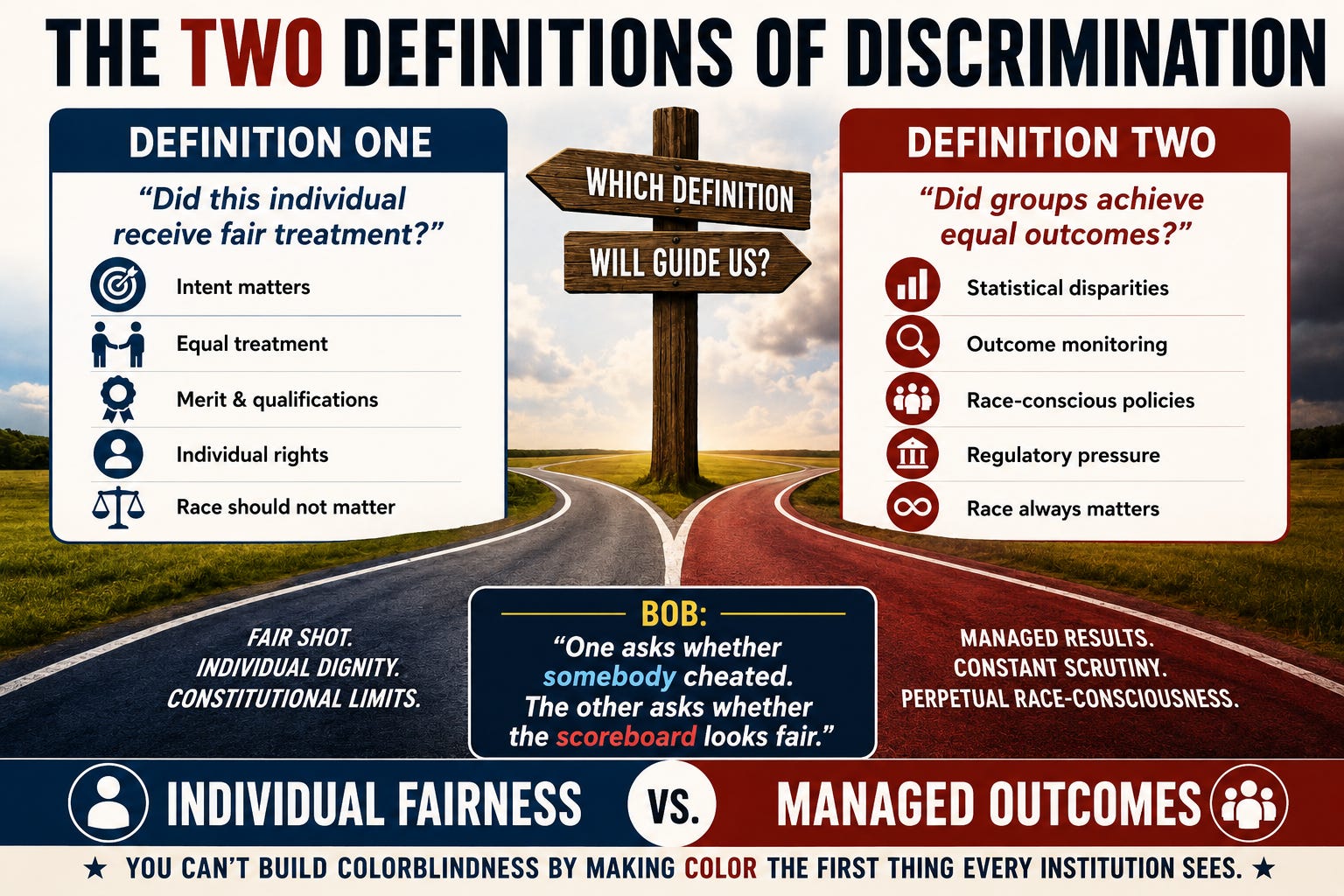
The Two Definitions of Discrimination
By Jim Reynolds | www.reynolds.com
June 11, 2026
For sixty years, America has been arguing about civil rights without admitting the argument changed.
The old definition of discrimination was simple: treating a person differently because of race.
That was the moral center of the Civil Rights Act. Judge the individual. Ignore the color. Hire, fire, promote, punish, admit, reject, or reward people based on conduct, merit, qualifications, and character. Not skin.
That was the deal.
Then came disparate impact, and the definition quietly shifted.
Now discrimination did not require discriminatory intent. It did not require unequal treatment. It did not even require a victim who could say, “I was treated differently because of my race.”
All it required was a statistical gap.
If a neutral policy produced different outcomes among racial groups, the policy itself became suspect. A test. A hiring standard. A promotion exam. A background check. A physical requirement. A school discipline policy.
If the numbers came out wrong, the institution had a problem.
That changed everything.
The question was no longer: Did you discriminate?
The question became: Did your system produce equal racial outcomes?
Those are not the same question. They are not cousins. They are not even in the same moral family.
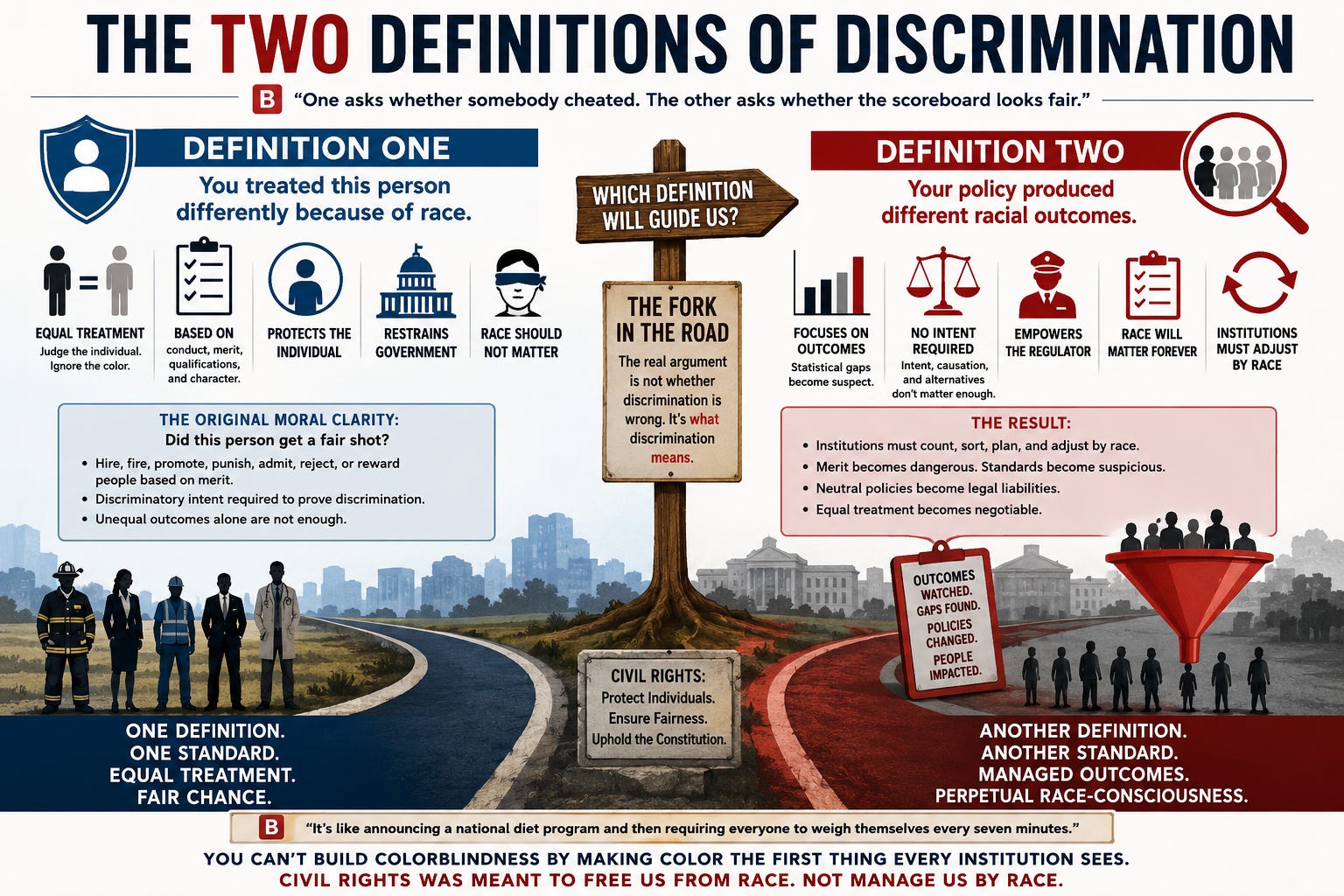
Bob:🅱️ “One asks whether somebody cheated. The other asks whether the scoreboard looks fair.”
One asks whether a person was treated unfairly because of race.
The other asks whether groups ended up in the same place.
Once that switch happened, institutions learned the lesson fast. Employers, schools, universities, corporations, and agencies began watching racial outcomes obsessively—not because they wanted to discriminate, but because the law trained them to think racially in order to avoid being accused of racism.
That is the perversity at the center of disparate impact.
A law designed to move America beyond race became a mechanism forcing institutions to count by race, sort by race, plan by race, and adjust by race.
Bob: 🅱️ “It’s like announcing a national diet program and then requiring everyone to weigh themselves every seven minutes.”
The cure started manufacturing the disease.
That was Justice Scalia’s warning in Ricci v. DeStefano. The New Haven firefighters took the promotion exam. The city did not like the racial distribution of the results, so it threw the results away. The city claimed it was trying to avoid discrimination. But to do that, it discriminated against the firefighters who had passed.
That is the whole problem in miniature.
When equal outcomes become the standard, equal treatment becomes negotiable.
Now the Office of Legal Counsel has finally said the quiet part out loud.
The government cannot use civil-rights law to pressure employers into race-based decision-making. Statistical disparities alone are not enough. Intent matters. Causation matters. Alternatives matter. Most of all, the Constitution matters.
That is not a small administrative tweak. That is a philosophical reversal.
For decades, the dominant theory said: to achieve fairness, we must pay attention to racial outcomes.
The emerging theory says: to achieve fairness, we must stop making race the operating system.
Same words. Opposite meanings.
“Civil rights” used to mean protecting individuals from racial discrimination. Then it came to mean managing institutions until group outcomes looked acceptable to regulators. “Fairness” used to mean equal treatment. Then it came to mean statistical symmetry. “Non-discrimination” used to mean don’t judge by race. Then it somehow became a command to monitor everything by race.
People have been dancing around this for years.
The real argument is not whether discrimination is wrong. Almost everyone agrees it is. The real argument is what discrimination means.
Definition One: You treated this person differently because of race.
Definition Two: Your policy produced different racial outcomes.
One definition protects the individual.
The other empowers the regulator.
One definition restrains government.
The other invites government to inspect every private decision for demographic imbalance.
One definition says race should not matter.
The other guarantees race will matter forever.
That is the fork in the road.
If unequal outcomes are treated as proof of discrimination, then every institution must become race-conscious to survive. It must pre-sort, pre-adjust, pre-engineer, and pre-apologize. Merit becomes dangerous. Standards become suspicious. Neutral rules become legal liabilities.
But if unequal treatment is the standard, the law returns to its original moral clarity: did this person get a fair shot?
That is the question.
Not whether every group landed in identical proportions.
Not whether every test produced politically comfortable numbers.
Not whether every promotion chart looked like a census table.
Was the individual treated fairly?
That was the promise.
The OLC opinion matters because it challenges the bureaucratic empire built on the second definition. It does not abolish civil rights. It attempts to rescue civil rights from the people who turned it inside out.
America was told for decades that race-conscious enforcement was necessary to achieve a race-blind society. That was always the contradiction. You cannot build colorblindness by making color the first thing every institution sees.
Bob would put it more simply:
🅱️ “If your plan to end discrimination requires everyone to discriminate more carefully, maybe the plan has a problem.”
That is where we are.
The country is not moving away from civil rights. It may finally be moving back toward them.
What can I say? You don’t have to be a professional pattern recognizer to notice that certain problems recur in predictable ways. But the point of this article is not to indict an entire race, religion, or population group. That is too broad, too crude, and too easy to abuse.
The real target here is the people and institutions that quietly changed the meaning of “discrimination” from unequal treatment under the law into unequal statistical outcomes anywhere in society. Once that switch was made, every disparity became presumed evidence of bias, and every institution became guilty until proven innocent.
That is the argument.
Not that every group is the same in every measurable outcome. Not that culture, family structure, education, immigration patterns, crime rates, or religious ideology are irrelevant. They are not irrelevant. But the central fraud is definitional: the word “discrimination” was stretched until it no longer described an act of unfair treatment, but a political weapon used to explain away every inconvenient result.
That’s all I’m saying.
I read a quote the other day that struck home for me. "We don't have a race problem in this country. We have a problem RACE!" Look at crime statistics and compare population totals. Look at Ben Carson's "talented ten percent". The quote not only goes for the Black race, but for Muslim religions as well.