


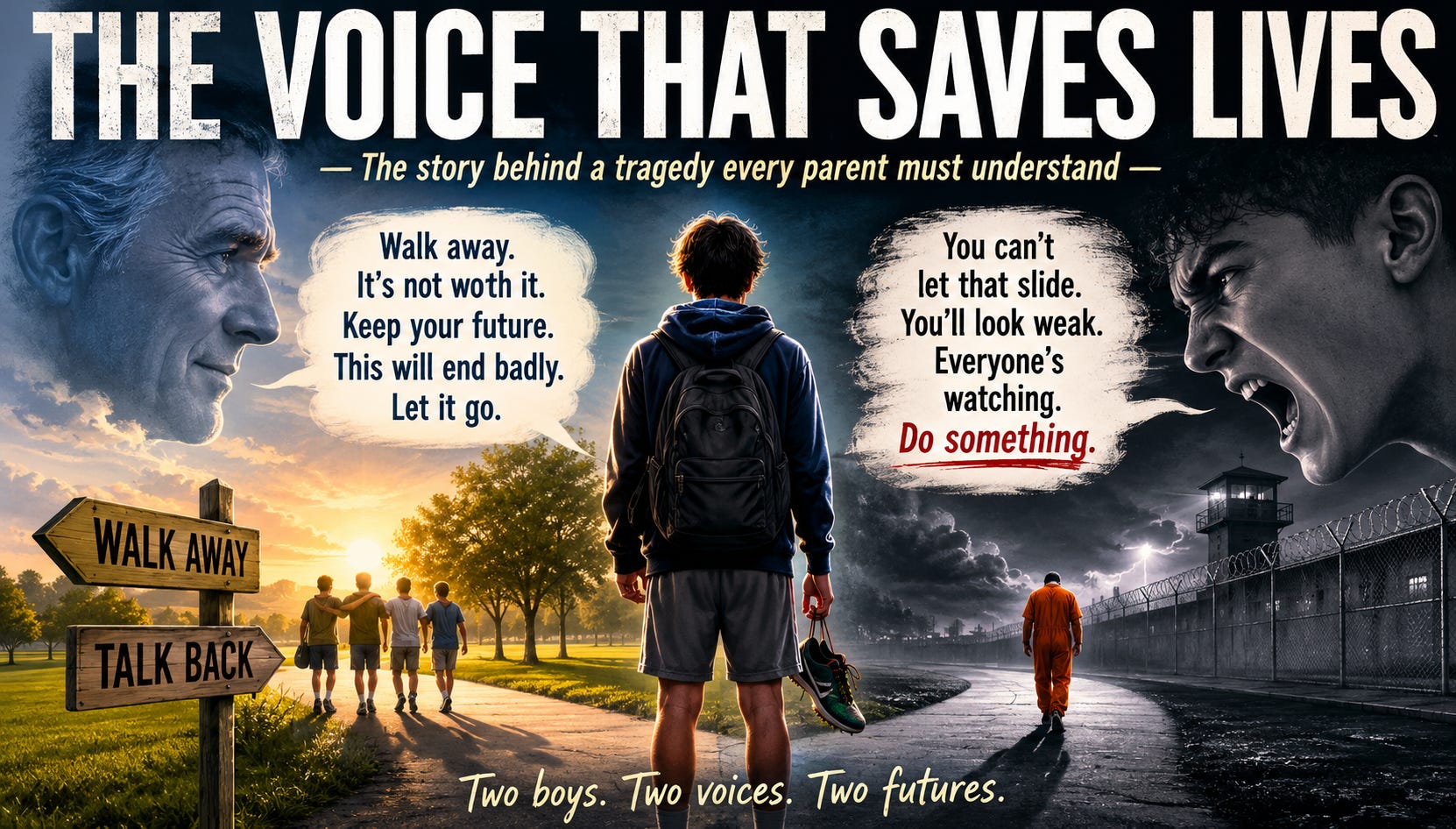
THE VOICE
The Inner Dialog That Saves Lives
By Jim Reynolds | www.reynolds.com
June 10, 2026
Most of us can remember a moment when we almost did something stupid.
Not evil.
Not criminal.
Just stupid.
A fight at school. A confrontation at work. A road-rage incident. A barroom argument. Somebody insults us. Somebody embarrasses us. Somebody challenges us in front of other people.
For a few seconds, a voice appears.
“You can’t let him get away with that.”
“You need to do something.”
“Everybody is watching.”
“Don’t look weak.”
Most people hear that voice.
The lucky ones hear another.
The second voice is quieter.
It doesn’t shout.
It doesn’t demand.
It simply asks:
“Where is this going?”
The older I get, the more convinced I become that success, happiness, and even survival often come down to which voice wins that argument.
On April 2, 2025, at a high school track meet in Frisco, Texas, that argument ended badly.
Very badly.
Two seventeen-year-old boys encountered one another under a team tent.
Words were exchanged.
One boy was told to leave.
He refused.
A confrontation followed.
A shove.
A knife.
A single stab wound.
One boy died.
The other will spend much of his adult life in prison.
The legal questions have largely been settled. A jury heard the evidence. A verdict was delivered.
But the legal questions are not the most important ones.
The more important question is what happened before the knife appeared.
What voices were speaking?
One voice almost certainly said:
“Leave.”
Another replied:
“Why should I?”
One voice said:
“Ignore him.”
Another answered:
“He can’t talk to me like that.”
One voice said:
“This is ridiculous.”
Another said:
“Everybody is watching.”
That is how tragedy often works.
Not through grand decisions.
Through small decisions.
One after another.
Each one narrowing the available exits.
Each one increasing the cost of retreat.
Until the participants no longer feel they are making choices at all.
They feel trapped.
And many traps begin with the same bait:
Disrespect.
For thousands of years, human beings have killed one another over insults, slights, challenges, and perceived humiliations.
Dueling was built on it.
Gang violence is built on it.
Road rage is built on it.
Honor cultures are built on it.
The details change.
The mechanism rarely does.
Someone feels disrespected.
Someone feels compelled to restore status.
Someone decides that backing down would be worse than escalating.
Then reason slowly leaves the room.
The tragedy in Frisco wasn’t really about a tent.
It wasn’t about a track meet.
It wasn’t even about a shove.
It was about two young men caught in one of the oldest traps in human history.
The need to save face.
One perceived disrespect.
The other perceived a challenge.
Neither wanted to absorb a small loss.
Neither wanted to look weak.
And so a tiny conflict became a life-altering one.
Civilization exists largely to teach us how to resist that temptation.
Parents teach it.
Coaches teach it.
Teachers teach it.
Older brothers teach it.
Grandfathers teach it.
Or at least they are supposed to.
The lesson is remarkably simple.
Not every challenge deserves a response.
Not every insult requires an answer.
Not every fool deserves your attention.
And not every battle is worth winning.
Especially when the cost is your future.
As I thought about this case, I found myself remembering a rhyme my parents taught me when I was very young:
“Sticks and stones may break my bones,
But words will never hurt me.”
As a child, I thought it was silly.
As an adult, I think it may be one of the wisest things I was ever taught.
The rhyme isn’t really about words.
Of course words can hurt.
The lesson is that words should not control you.
Another person’s opinion should not own your actions.
Another person’s insult should not determine your future.
The goal of life is not to avoid being disrespected.
The goal is to avoid letting disrespect govern your behavior.
The mature voice understands this.
The mature voice says:
“This is getting out of hand.”
“This may end badly.”
“This person is being unreasonable.”
“Why should I make his problem my problem?”
“Walk away.”
“Keep your future.”
That voice has saved more lives than any law ever written.
Its absence has destroyed countless others.
This was a tragedy.
Two young lives have essentially ended.
One boy is dead.
The other will spend much of his adulthood behind prison walls.
The escalation was never bounded by perspective, wisdom, or restraint. The voices that should have governed the situation were overruled by pride, territorial instinct, and the belief that disrespect must always be answered.
And now we know why the old lessons mattered.
The rhyme.
The warnings.
The advice from parents and grandparents who had already made enough mistakes to recognize danger when it appeared.
They understood something many modern adults have forgotten:
Temporary embarrassment is survivable.
A wounded ego is survivable.
Looking weak for thirty seconds is survivable.
What is often not survivable are the consequences of refusing to let those things go.
The lesson could not be more important.
Teach your children perspective.
Teach them that not every challenge requires a response.
Teach them that not every insult requires an answer.
Teach them that walking away is often the strongest move available.
Teach them that preserving their future is more important than winning a moment.
Because somewhere between disrespect and disaster lives a small voice that says:
“Stop.”
Make sure your child learns to hear it.
That voice may save his life.
Or someone else’s.
Great comments.
Any time we’re talking about human behavior, I ask myself a simple question: Why were we designed this way in the first place?
Young men often seem wired to focus on the immediate challenge rather than the long-term consequences. From a modern perspective, that can appear irrational. But viewed through the lens of history, it may have served an important purpose.
For most of human existence, tribes and families survived because some young men were willing to act immediately, fight fiercely, and risk everything to protect their group. The warrior who carefully calculated every possible consequence might not have been the one who saved the village.
We are here, at least in part, because those traits existed.
The problem is that civilization changes the equation. The instincts remain, but the environment changes. Civilization acts as a governor. It teaches restraint, perspective, and judgment. Good parenting serves much the same purpose.
Girls often seem to acquire some of these skills earlier. Their ability to think ahead, manage emotions, and focus on consequences frequently develops before it does in boys. That can make them natural teachers of the very lessons that later save lives.
The goal isn’t to eliminate the engine. The goal is to install the brakes.
Perhaps that’s why the old lessons mattered so much. They weren’t trying to eliminate aggression. They were trying to teach wisdom to outrank aggression.
I realize that’s a simplified explanation, but I suspect there is more than a little truth in it.
Let's break it down a bit differently. An opinion is just that, what somebody else thinks about something. We all have them. Some are based on evidence, most on hearsay. Political opinions are a classical example. Look at the expressed opinions about any politician. Most of us don't personally know any politicians. We see them on television, hear about them from the evening news but we don't know them personally, don't see them in the morning after a sleepless night, don't have lunch with them, don't sit down and exchange ideas with them. Why, we should be asking, do I take another's statement about a politician as having any validity? More importantly, is it worth fighting another over an opinion about a politician? Or fighting over another's opinion about anything? Not really. Opinions aren't worth the effort. Do I believe I can force another to think the way I do? Will fighting another person compel them to think as I do? The obvious answer is "no"! Also, I might get hurt, seriously. Of course we're talking about human nature here. That's not a valid personal excuse, however.