

The War That Raised Us
By Jim Reynolds | www.reynolds.com
July 6, 2026
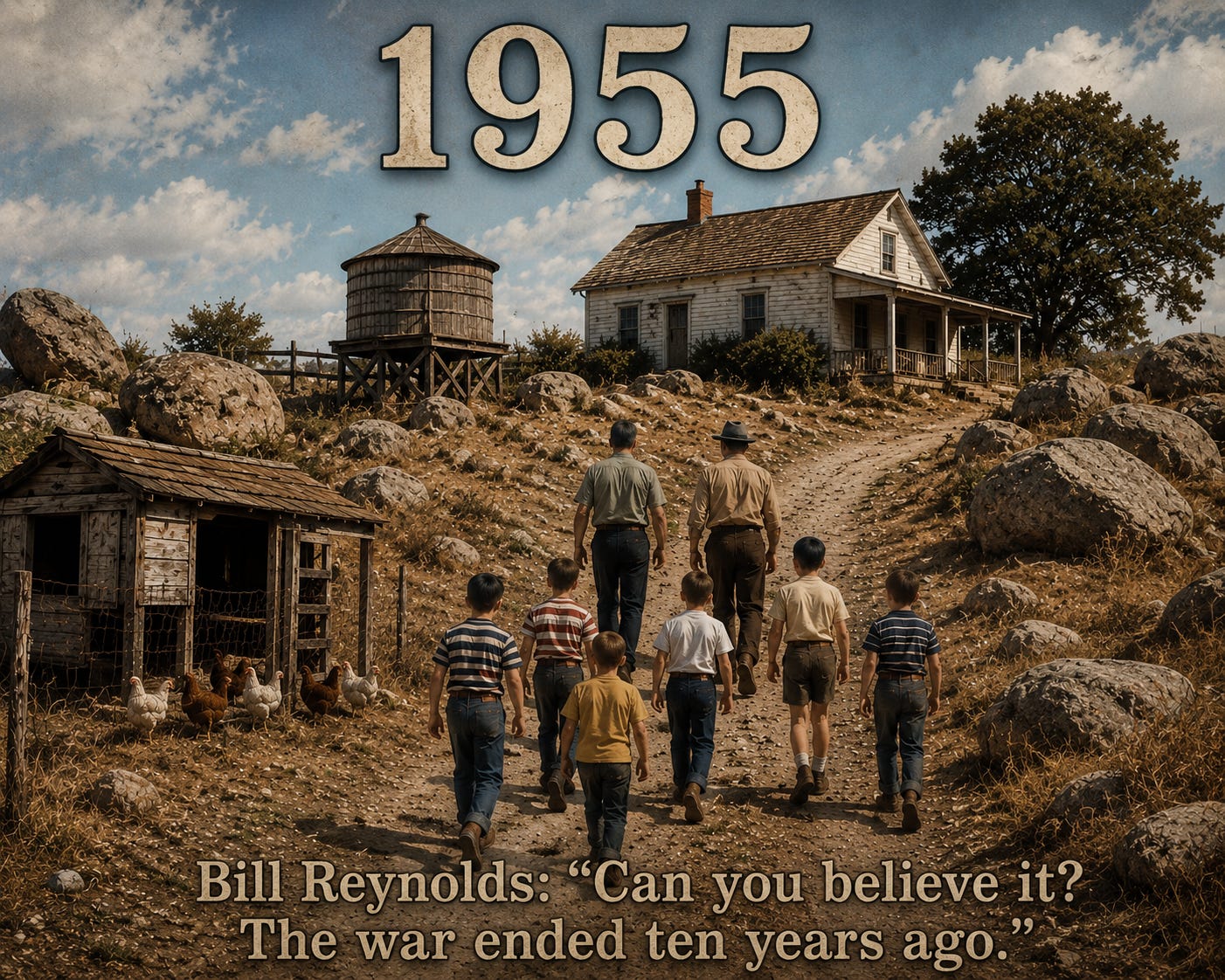
“Can you believe it? The war ended ten years ago.”
I was five years old when my father said those words.
He said thousands of things during his lifetime that I no longer remember.
I never forgot that one.
It was 1955.
Our family was visiting my father’s best friend, Carl Ritter, at his place outside El Cajon, California. Carl had worked in the sports department of a San Diego newspaper and, during World War II, had served on the Stars and Stripes reporting staff. Dad and Carl had known each other since the eighth grade in Ashtabula, Ohio. Like so many friendships forged before the war, theirs had survived it.
Carl had purchased several rocky acres that must once have been part of a ranch. My mother called it, with affectionate sarcasm, “Carl’s Rock Ranch.” It fit.
The property seemed to consist mainly of enormous boulders, dry weeds, abandoned chicken coops, and an old water tower standing watch over the place like the last survivor of better days. Whatever dreams someone once had for that land had apparently been defeated by rocks, drought, or both.
Our family—Mom, Dad, my two brothers, my baby sister, and me—stayed in a small shack about a hundred yards from the main farmhouse. There was no electricity. No running water. It looked like it had once housed farm laborers and hadn’t improved much since.
To a five-year-old, it was wonderfully spooky.
Carl had three boys roughly the same ages as us, although my brother Jeff, born in 1943, was the oldest of the bunch. One of them had once stood on a rock wall and peed on me when I was about three. I cried. Brian got into serious trouble.
I eventually forgave him.
It wasn’t the last time someone would try to piss on me, although later attempts became mostly metaphorical.
One afternoon both families set out on a walk across the property. Carl proudly pointed out various features, which consisted primarily of additional rocks. There may even have been some Indian markings on one of the larger boulders. I honestly can’t remember.
But I remember what happened as we walked back.
We were climbing the last dusty hill toward the farmhouse.
Dad and Carl, both Army veterans, were talking quietly.
Carl had seen the war from overseas as a journalist. He served with Andy Rooney.
Dad never saw combat. As Jerry liked to joke, he fought heroically in “the Battle of Mineral Wells, Texas.” The joke ignored one important fact. Camp Wolters was one of the Army’s largest training centers, where thousands of young Americans were prepared for war. Dad’s battlefield wasn’t Normandy or Okinawa. It was making sure the men headed there had what they needed.
As we climbed that hill, Dad looked around almost as if he were talking to himself.
Then he said, with genuine wonder,
“Can you believe it? The war ended ten years ago.”
That was all.
Nobody stopped walking.
Nobody launched into a deep discussion.
The conversation simply moved on.
Yet somehow, a five-year-old boy quietly filed that sentence away forever.
For seventy-one years.
I’ve often wondered why.
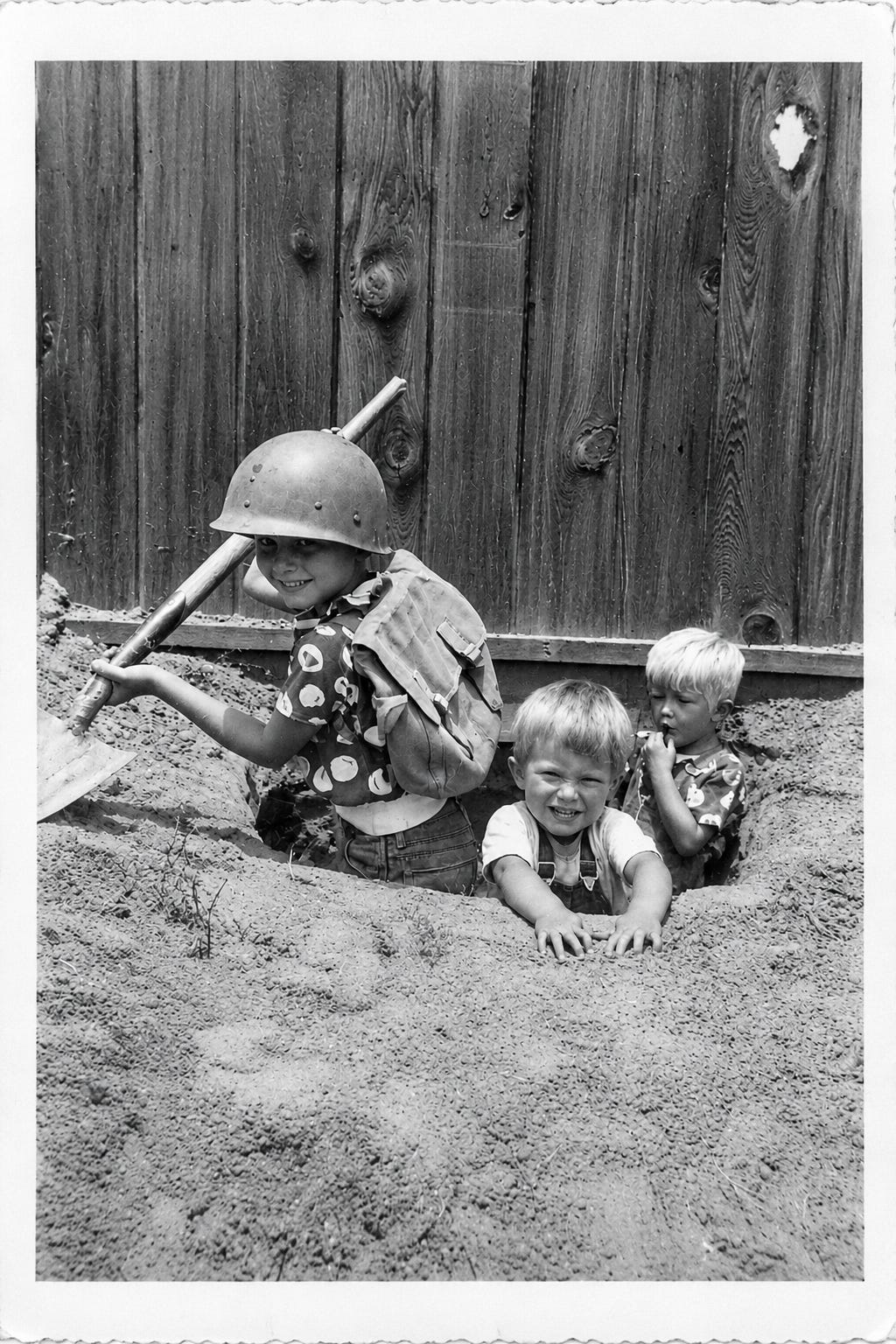
In the foxhole: Jeff, Jimmy, and Jerry — Norwalk, CA, 1954
I think I finally know.
World War II wasn’t just something our fathers had lived through.
It was the world we children inherited.
The war was everywhere.
The movies were full of Normandy, Guadalcanal, Midway, Bastogne, and Iwo Jima.
Television replayed those stories over and over.
John Wayne seemed permanently dressed in olive drab.
Army surplus stores sold web belts, helmet liners, canteens, and packs that transformed ordinary boys into imaginary infantrymen.
Every neighborhood had veterans.
Every family had stories.
Every Memorial Day actually remembered something.
History wasn’t locked away in museums.
It was sitting across the dinner table.
So naturally, we played Army.
The orange groves around our neighborhood became Europe one afternoon and the South Pacific the next.
We dug foxholes.
We crawled through irrigation ditches.
Invisible walkie-talkies crackled with urgent messages.
Pretend grenades exploded with perfect timing.
Somebody always had the important mission.
Somebody always volunteered.
And somebody always got shot.
If you were the one who got shot, there was an unwritten rule.
You had to die well.
My brother Jerry elevated this to an art form.
He would stagger heroically, clutch an imaginary wound, collapse dramatically onto the ground, and then whisper,
“Come closer…”
The rest of us would kneel beside him.
“What is it?”
He’d struggle for breath.
“There’s… something… I have… to say…”
We leaned in.
“Tell us.”
Another painful breath.
“It’s… very… important…”
Long pause.
Longer pause.
Then, just before delivering what we were sure would be his final words…
He died.
Silence.
We stood respectfully around the fallen hero.
Finally someone would say,
“That was a really good one.”
Jerry would blink.
Stand up.
Brush himself off.
And die all over again.
Probably even better the second time.
Looking back now, I realize those games weren’t really about war.
They were about courage.
Duty.
Sacrifice.
Loyalty.
Winning.
Those were the stories we inherited.
That quiet sentence my father spoke on a dusty hillside was really his own moment of astonishment.
Only ten years.
To him, the war still felt close enough to touch.
To me, it simply felt like the world.
I didn’t know I was growing up in the long shadow of history.
None of us did.
We simply accepted that America had done something extraordinary before we were born.
We assumed courage was normal.
We assumed freedom required defending.
We assumed that when the time came, ordinary people would do extraordinary things because that was simply what Americans did.
Children don’t inherit history from textbooks.
They inherit it from the adults around them.
Sometimes all it takes is one quiet sentence on a dusty hillside to last a lifetime.
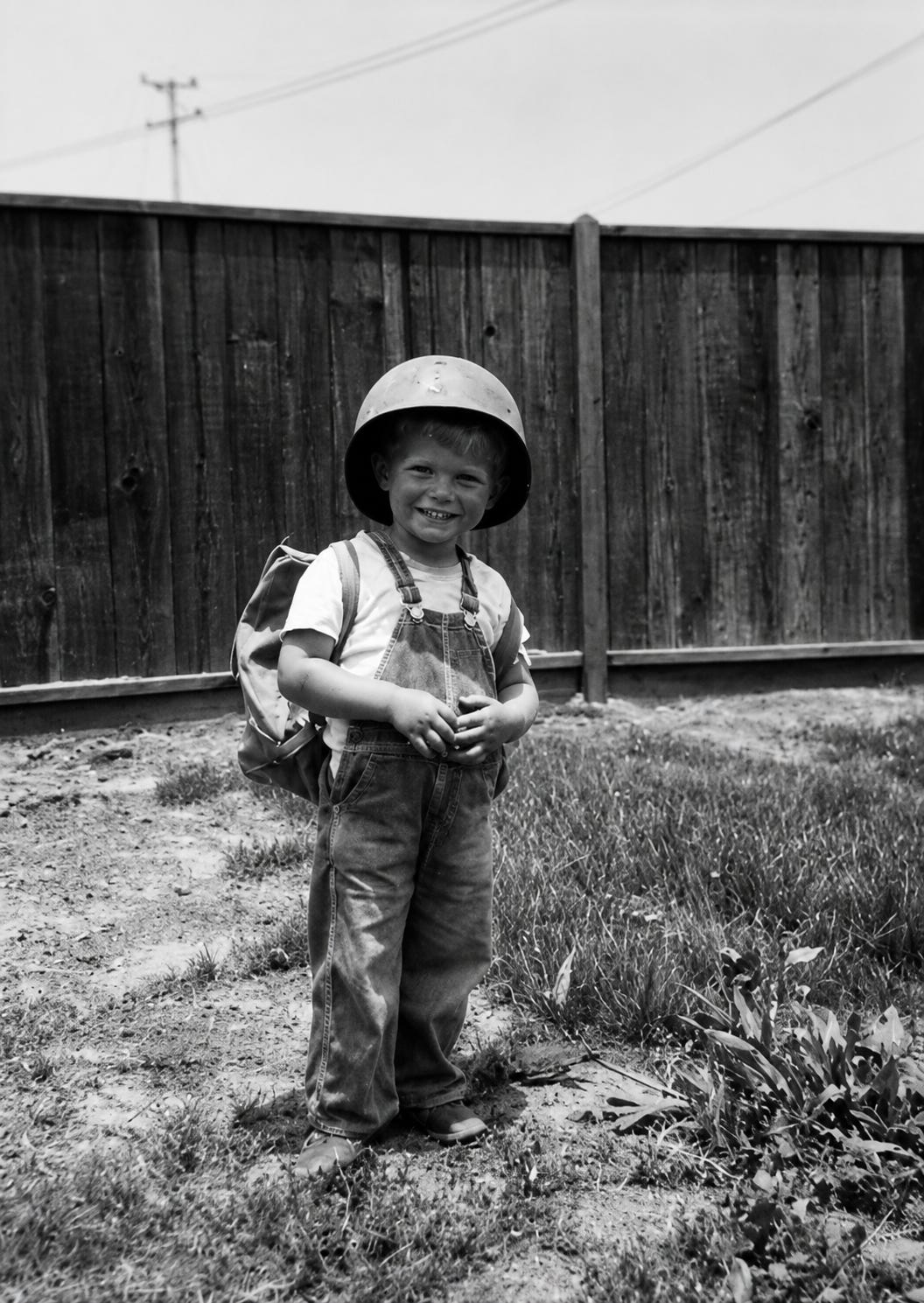
The Author, 1954
Next scheduled play date: bring fake grenades and be ready to dig a foxhole.
If a story brings a tear to my eye while I’m writing it, I figure there’s a good chance it will do the same to others. That’s when a story breaks through to some deeper part of our shared experience.
We are happy to relive those moments, yet saddened by the realization of what we’ve lost. And we have lost much.
Those experiences shaped us. The experiences of today’s children will shape them. That’s simply the way life works. Character isn’t formed in textbooks. It’s formed in neighborhoods, families, friendships, adventures, scraped knees, victories, disappointments, and the ordinary moments that become treasured memories decades later.
I wouldn’t trade my childhood for any other. It truly was a wonderful time to be a kid.