


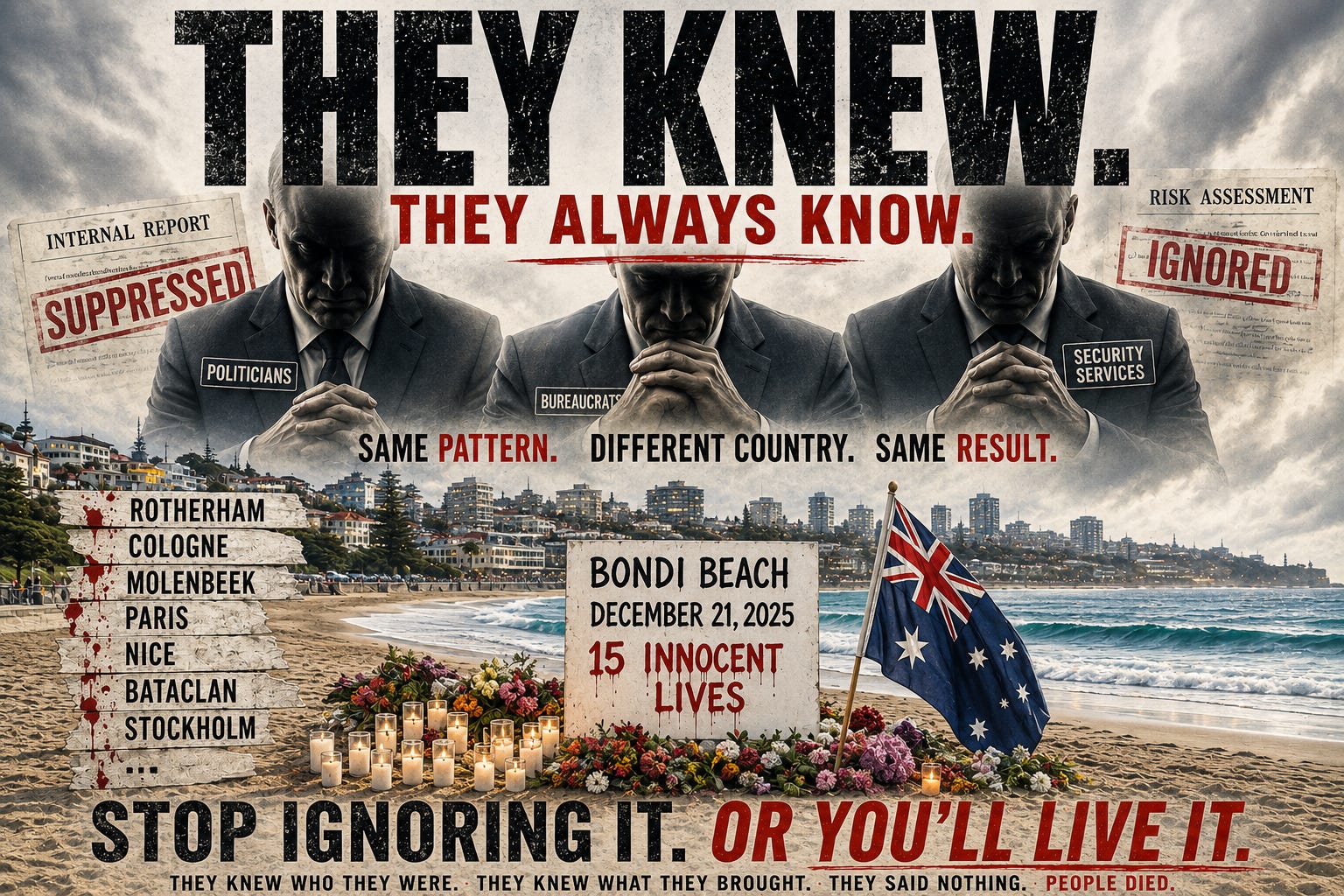
THEY KNEW
Bondi Beach, Rotherham, Cologne… and the Pattern Australia Refuses to Name
By Jim Reynolds | www.reynolds.com
June 3, 2026
The authorities knew who they were. They knew what they brought. They said nothing. People died.
On December 21, 2025, two jihadists walked onto Bondi Beach during a Hanukkah celebration and murdered 15 Australians.
The attackers were known to security services. They came from communities that have produced a disproportionate share of Australia’s radicalization cases, organized crime networks, and integration failures for decades. The authorities knew who they were. The authorities knew what those communities produce. The authorities said nothing — because saying something would have required admitting that the immigration system had been importing the problem for thirty years.
They knew. They always know. That’s the chunk.
THE RECEIPT
Australia is the best-case scenario. Points-based system. Geographic isolation. No land borders with poor countries. And yet:
3 million temporary visa holders — one in every nine people in the country — living in a shadow population with no path to permanence and no incentive to integrate.
432,000 people on bridging visas — a record. Trapped in legal limbo. Not going anywhere. Future permanent residents who simply haven’t been counted yet.
306,000 net overseas migration in 2024–25, against an official permanent cap of 185,000.
0.7% housing vacancy rate. Rents and prices spiraling beyond reach for anyone without family wealth.
53% of Australians say immigration is too high. Both major parties ignore them.
The government circumvents its own caps through administrative sleight-of-hand while telling the public the system is under control. The permanent cap is theater. The real number is the one they don’t advertise.
Bob: 🅱️ “The advertised price and the real price finally met each other.”
THE PATTERN
The UK: Pakistani Muslim grooming gangs operated across Rotherham, Rochdale, Telford, Oxford, Bristol — dozens of towns — for decades. Thousands of white British girls raped, trafficked, and abused. The authorities knew. They suppressed it. The explicit reason, documented in official reports: fear of being called racist.
Sweden: grenade attacks, no-go zones, immigrant overrepresentation in violent crime so stark that the state crime council stopped publishing ethnicity data. When you stop publishing the data, you’ve admitted what the data shows.
Bob: 🅱️ “If the numbers supported the policy, they’d be printed on billboards.”
France: hundreds of neighborhoods where police don’t enter. Charlie Hebdo. Bataclan. Nice. Samuel Paty, beheaded for showing cartoons in a free speech lesson. The attacks are punctuation. The separatism is the text.
Germany: Cologne New Year’s Eve 2015 — mass sexual assaults by groups of North African and Middle Eastern men. Over 1,200 criminal complaints. Police and media initially denied it happened.
Belgium: Molenbeek. Produced the Paris attackers, the Brussels bombers, multiple other plots. A neighborhood where the Belgian state is foreign territory.
Same pattern. Different languages. Different colonial histories. Different welfare systems. One variable matters: who you let in, and whether you demand assimilation.
THE MATH THEY WON’T SHOW
Hindu Indians, Sikhs, East Asians, Christian Africans, secular Iranians — they match or outperform the native-born on education, income, employment. These are not white people. They are immigrants. They succeed.
Pakistani Muslims, Afghan Muslims, Somali Muslims, certain Lebanese Muslim cohorts — they don’t.
If this were about skin color, the pattern would be uniform. It isn’t. It’s about culture, religion, and clan structure. The data exists. The government has it. They don’t publish it. You know why.
Bob: 🅱️ “Nothing builds confidence quite like hiding the evidence.”
The groups that fail share specific features:
Cousin marriage rates of 20–50%. When your entire extended family is a closed kinship network, the clan supersedes the state. Witness intimidation, honor violence, community cover for criminals — these are structural, not incidental. You don’t integrate a clan into a nation of individuals. The clan resists by design.
Pew polling consistently shows 20–40% of certain Muslim diaspora populations supporting Sharia over secular law. That’s not a religion in the Western sense. That’s a competing sovereignty claim. You’re not importing fellow citizens with different beliefs. You’re importing subjects of a different political order.
And then there’s the violence: honor killings, FGM, forced marriage, blasphemy enforcement. Rushdie stabbed on stage. Theo van Gogh shot and stabbed on an Amsterdam street. Charlie Hebdo slaughtered. Samuel Paty beheaded. When criticizing a religion carries a credible threat of death, free speech is a privilege contingent on the forbearance of people who don’t believe in it.
WHY IT CONTINUES
The Left wants demographic transformation. This is not a conspiracy theory. It’s discussed openly in progressive strategy documents. Imported populations vote for the parties that imported them. The math is the math.
The Corporate Right wants cheap labor. The Business Council, the Chamber of Commerce, the tech lobby, hospitality — all immigration-maximalist. Labor costs are their problem. Housing costs, hospital waiting lists, school crowding, and neighborhood friction are yours.
The bureaucracy wants institutional expansion. More visas mean more staff, more budgets, more agencies. The Department of Home Affairs doesn’t benefit from reduced immigration any more than a weapons manufacturer benefits from peace.
All three factions win. None bears the costs. The working class absorbs the housing crisis, the hospital queues, the school overcrowding, the wage suppression, and the consequences of failed integration. The elites live in postcodes where none of this touches them, send their children to private schools where demographic change is theoretical, and lecture the public about tolerance from positions of total insulation.
Bob: 🅱️ “The people prescribing the medicine never seem to swallow any.”
And when anyone objects: the smear. “Racist.” “Far-right.” “Misinformation.” These words are not arguments. They are social-cost imposition mechanisms. The goal is to make honest discussion so personally expensive that most people self-censor.
Bob: 🅱️ “When somebody calls you a name instead of answering the question, keep asking the question.”
The tell: security services and politicians acknowledge these problems privately while denying them publicly. When the people with the data won’t say publicly what they say behind closed doors, you’re not in a democracy with a healthy information environment. You’re under an information regime designed to protect policy from the people it harms.
THE GRIFT
Integration programs. Community engagement. More funding. More outreach. It’s been tried for decades across multiple countries. It fails every time.
Bob: 🅱️ “When a program fails for thirty years, government calls it a pilot project.”
Integration requires willingness from both sides. When a community’s religious and cultural framework explicitly prohibits integration — intermarriage forbidden, secular law rejected, host culture viewed as degenerate — no amount of government-funded bridge-building fixes the problem. You’re paying people to pretend to integrate while insulating them from the pressures that historically drove assimilation.
The groups that succeeded — Irish, Italians, Greeks, Vietnamese, Chinese — didn’t do it through programs. They did it because they arrived wanting to join the society, their religions were private matters, economic necessity drove intermarriage and linguistic assimilation, and the host society demanded it without embarrassment.
Mass immigration of culturally incompatible populations into welfare states with multiculturalist ideology is a historically unprecedented experiment. There is no prior example of it working. The results are in. The cost is measured in dead girls in Rotherham, dead cartoonists in Paris, and dead families on Bondi Beach.
WHAT IT TAKES
The solutions are not mysterious. They are suppressed, not difficult.
Reduce volume. Net migration below 100,000. The 185,000 cap is fiction. Close the gap between stated policy and actual numbers.
Select for compatibility. A computer science degree from a country with 40% cousin marriage and majority Sharia support is not equivalent to the same degree from a liberal democracy. Screen for it. Unapologetically.
End chain migration. Spouses and minor children only. No parents, siblings, cousins. Every family reunion slot is a slot not filled by a screened, compatible applicant. The current system prioritizes genetic proximity over national interest.
No parallel legal systems. Sharia councils, religious arbitration that violates women’s rights, community pressure to handle crimes internally — criminalize it. The state’s legal monopoly is non-negotiable.
Demand assimilation. This is a liberal democracy with secular law, individual rights, gender equality, and free speech. Those who cannot accept this should not come. Those here who reject it should leave.
Publish the data. Crime by ethnicity and immigration status. Integration by origin country and visa category. Welfare dependency. Educational outcomes. Publish everything. Let the public see what elites see privately. If the data is embarrassing to the policy, the problem is the policy.
Deport. Dual nationals involved in terrorism, organized crime, or honor violence — revoke citizenship. Permanent residents convicted of serious offenses — mandatory deportation. A guest who assaults the host does not get to stay.
End the temporary visa racket. Three million people in a shadow workforce with no path to permanence and no reason to integrate. If someone is needed enough to live and work here for years, screen them and put them on a path to citizenship. If they aren’t, they shouldn’t be here. The current system gives employers cheap labor while socializing the costs and deferring the consequences.
The countries that do this will remain viable liberal democracies. The ones that don’t will discover — too late — that you cannot maintain a rights-based society when a growing portion of the population rejects its foundational premises, and that no slogan changes the arithmetic on the ground.
A government that took this seriously could announce the above on day one. The political support exists. The policy tools exist. What’s been missing is the will to confront the elite consensus and the courage to endure the smear machine.
The machine runs on fear. Stop fearing it, and it stops working.
Bob: 🅱️ “Every bully eventually discovers the same terrible secret. The act only works while the audience cooperates.”
I consider poor immigration standards and lack of screening our #1 issue. That’s how you get hollowed out from within. We need to be open about this discussion. There is no earthly reason to allow people into the country who want to destroy us.
Bob: 🅱️ “A nation can be welcoming and still ask who’s knocking on the door.”
The broader challenge for any country is balancing openness with security, economic needs with social cohesion, and immigration benefits with the risks that can arise when screening, enforcement, or integration policies fail. Those tradeoffs are difficult, but they are exactly the kinds of issues democratic societies are meant to debate openly rather than avoid.
Terry, you ask a lot of questions. And these are important ones.
This is actually one of the oldest questions in political philosophy:
Why do intelligent people repeatedly support policies that produce outcomes they deny, excuse, or fail to foresee?
I’ll give you a very Bobistic, multi-colored answer palette.
Bob rejects any single explanation.
There are likely several overlapping mechanisms.
Bob: 🅱️ “People always want one reason. Human beings are rarely that efficient.”
Let’s walk through them.
1. Power
The simplest explanation.
Politicians want votes.
Bureaucracies want budgets.
NGOs want grants.
Activists want influence.
If a policy increases their power, they will tend to favor it.
Not because they’re evil.
Because institutions self-perpetuate.
Bob: 🅱️ “A bureaucracy’s favorite reform is the one that requires a bigger bureaucracy.”
⸻
2. Money
Often paired with power.
Corporate interests frequently support immigration because labor shortages disappear.
Housing developers benefit.
Universities benefit.
Large employers benefit.
The costs are often distributed while the benefits are concentrated.
Bob: 🅱️ “The people making money from a policy are usually standing closest to the microphone.”
⸻
3. Status Signaling
This one gets overlooked.
For many elites, certain beliefs become markers of virtue.
Holding the “correct” opinion signals membership in the educated class.
The opinion becomes socially valuable regardless of outcomes.
Bob: 🅱️ “Sometimes people defend a policy because changing their mind would cost them friends.”
⸻
4. Ideology
Some genuinely believe humanity is basically interchangeable.
If people are fundamentally the same everywhere, then culture becomes trivial.
If culture is trivial, assimilation is automatic.
If assimilation is automatic, concerns look irrational.
This isn’t necessarily dishonest.
It may simply be wrong.
Bob: 🅱️ “A bad map can still be drawn honestly.”
⸻
5. Fear
This one appears repeatedly in Reynolds essays.
People see the problem.
But they fear:
* social consequences
* professional consequences
* reputational consequences
So they remain silent.
Over time silence becomes complicity.
Bob: 🅱️ “Most lies survive because the truth is expensive.”
⸻
6. The Expert Trap
Experts often become attached to theories.
When reality contradicts the theory, they protect the theory.
Not because they hate reality.
Because they’ve built careers around the theory.
This was a major theme in the Expert Failure series.
Bob: 🅱️ “When the facts disagree with the expert, the facts don’t have tenure.”
⸻
7. Moral Vanity
This is the C.S. Lewis angle.
People enjoy seeing themselves as compassionate.
Sometimes more than they enjoy solving problems.
Feeling good becomes more important than being right.
Bob: 🅱️ “Some people would rather display virtue than achieve it.”
⸻
8. Spiritual Blindness
Now we’re entering territory philosophers and theologians have argued about for thousands of years.
Many traditions hold that pride clouds judgment.
Not stupidity.
Pride.
The belief that human wisdom is sufficient.
The belief that old rules can be discarded.
The belief that consequences can be engineered away.
This is the Promethean critique.
Bob: 🅱️ “The tower usually collapses right after somebody announces they’ve outgrown gravity.”
⸻
If Bob had to choose one explanation?
I don’t think he’d choose any single one.
He’d probably say:
Bob had to think about this one for a while. 🅱️ “Power explains some of it. Money explains some of it. Pride explains a lot of it. But mostly it’s people refusing to update the story after the facts changed.”
That answer feels very Bob.
Not because it is dramatic.
Because it treats human nature as stubborn rather than mysterious.
In Bob’s world, most disasters don’t begin with evil geniuses.
They begin with ordinary people becoming emotionally invested in a story that reality no longer supports. Then they keep defending the story long after the evidence has left the room.
Bob: 🅱️ “The hardest thing to surrender isn’t power. It’s the story you’ve been telling yourself for twenty years.”