


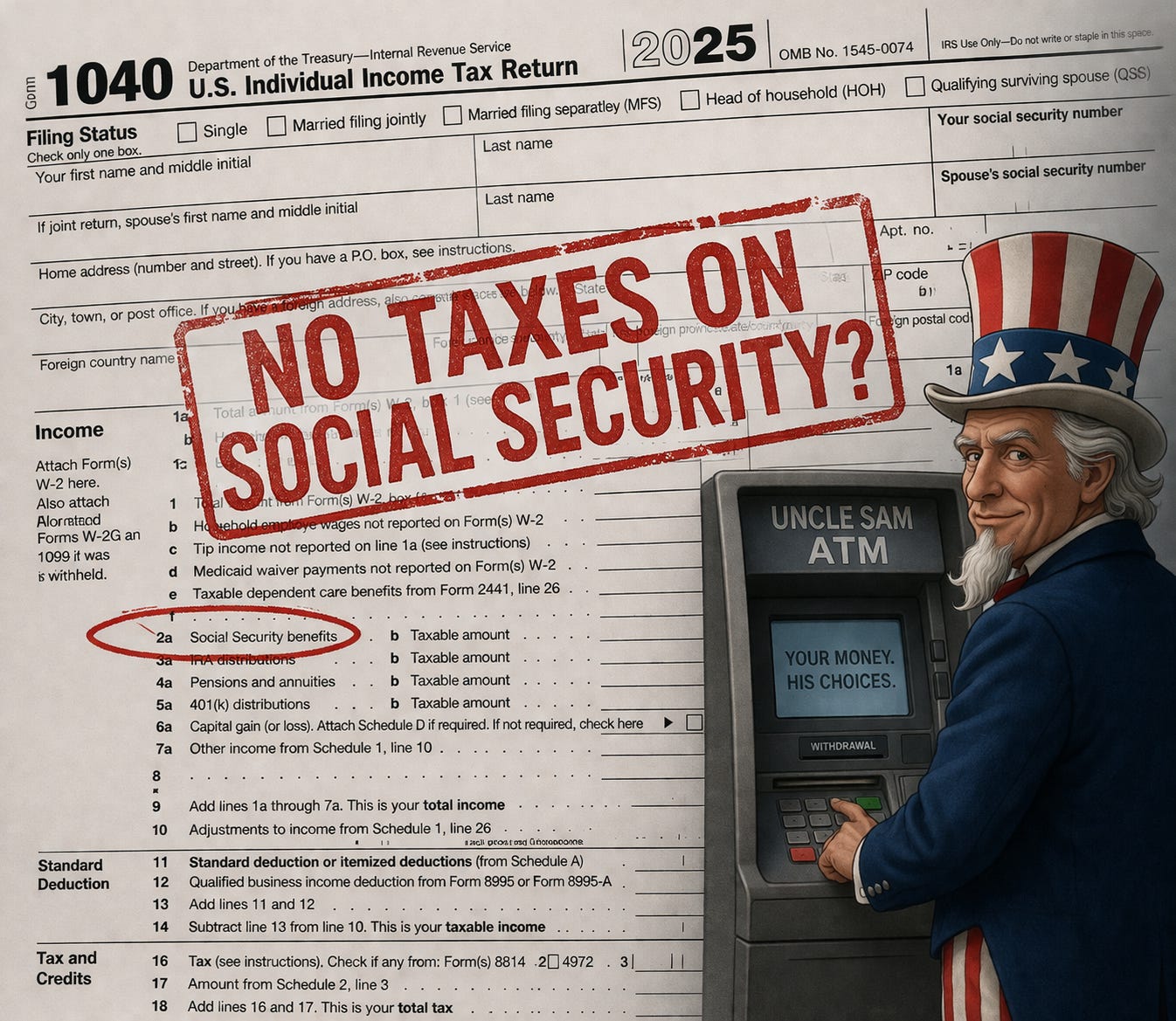
They Weren’t Taxed—Until They Were
By Jim Reynolds | www.reynolds.com
April 15, 2026
Note: I just did my taxes again a couple days ago. Hard to believe I’ve gone through this ritual over 50 times. It still feels slightly foreign.
I started out doing everything by hand. Then H&R Block software. Switched to TurboTax about ten years ago. Apparently I’m a model citizen—the app consistently rates my audit risk under 5%. Apparently I am not sufficiently creative.
This year I got money back federally. As usual, I owed California. I’m still trying to figure out how you can get thousands back from the IRS and owe Sacramento at the same time.
This piece is about taxes on Social Security.
We were told—repeatedly—that there would be no taxes on that income.
That didn’t happen.
Yes, the deduction expanded, which helped the federal result. But there was no change in what I paid on Social Security. Zero.
To qualify for “no taxes,” you essentially need to be at or near the poverty level.
I’m not.
Peter Navarro says 88% of seniors won’t pay tax on Social Security. I suppose I’m in the other 12%—the ones who saved, draw from IRAs, and have some investment income.
Apparently, that disqualifies you.
So this is the part where I thank myself for saving money my entire life.
Thanks, Jim.
You’re now in the taxable group.
Tell me about your tax experiences. Any different this year?
Now — on to the story.
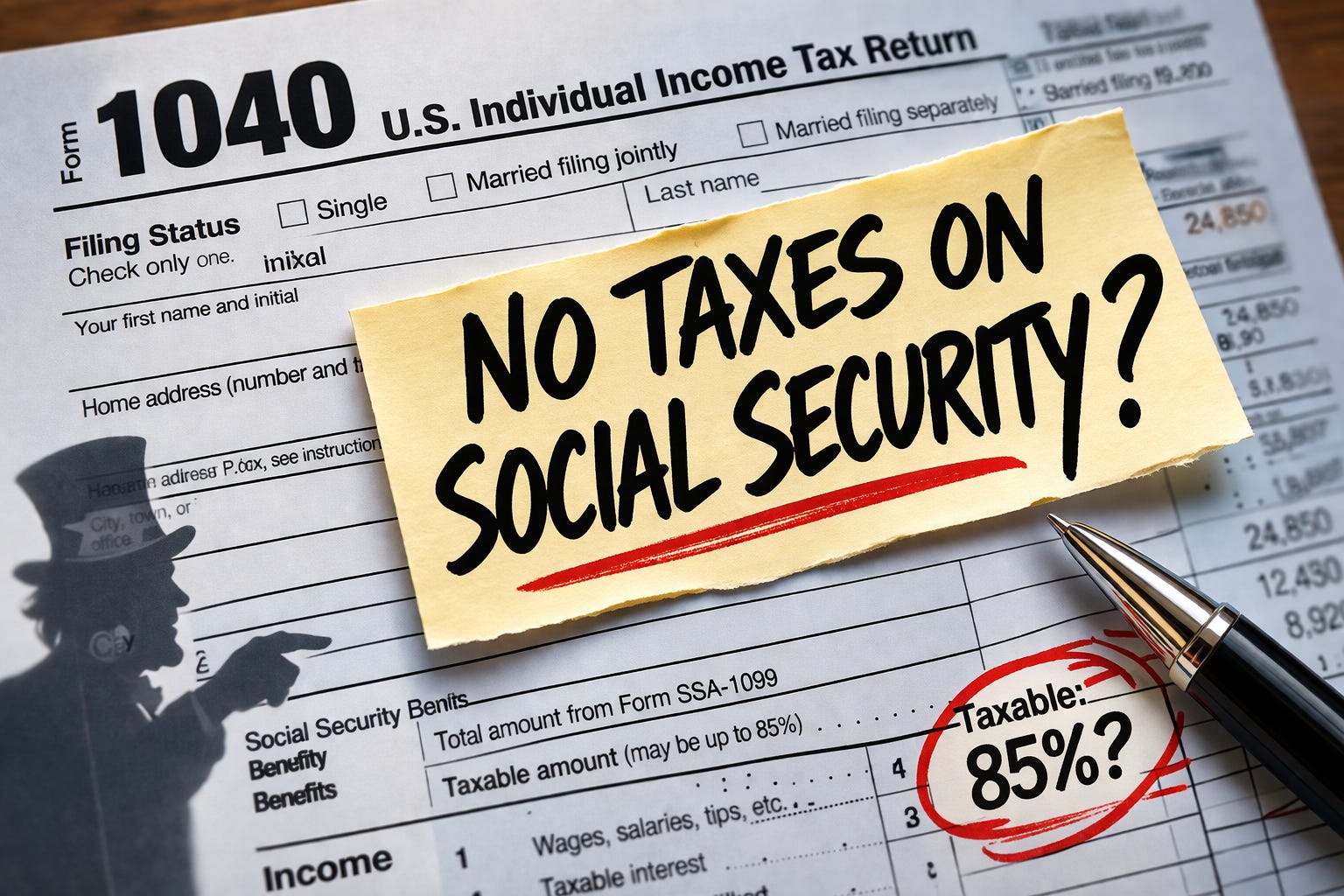
They Told Me There Was Going To Be No Tax On Social Security
There was a time—not ancient history—when Social Security benefits were not taxed. Not partially. Not conditionally. Not with formulas and thresholds buried in worksheets.
Just not taxed.
That changed with the Social Security Amendments of 1983.
At the time, the argument sounded reasonable enough:
• Only “higher-income” retirees would be affected
• Only a portion of benefits would be taxed
• Most people would never feel it
Then, in 1993, they expanded it:
• Up to 85% of benefits could be taxed
Still framed as a targeted measure. Still “not most people.”
⸻
The Quiet Shift
Here’s what they didn’t do:
They didn’t index the thresholds.
• $32,000 (single)
• $44,000 (married)
Those numbers were set decades ago—and left there.
No adjustment. No correction. No acknowledgement of inflation.
⸻
Do the Math
Take those thresholds and adjust them to today’s dollars:
• $32k → roughly $80k+
• $44k → roughly $110k+
In other words:
What was once “higher income” is now squarely middle-class retirement.
That’s not opinion. That’s arithmetic.
⸻
The Result
More and more retirees—people who played by the rules, worked their careers, paid payroll taxes—are pulled into a system that was never originally aimed at them.
They look at their return and see:
• Benefits they already funded
• Being partially taxed
And they ask a simple question:
When did this become taxable?
Answer: slowly.
⸻
The Mechanism Nobody Explains
The formula is elegant in a bureaucratic way:
• Take your other income
• Add half your Social Security
• Cross an outdated threshold
• Watch up to 85% of your benefits become taxable
Not at a special rate—just folded into income like everything else.
Clean. Quiet. Effective.
⸻
The Core Argument
You paid payroll taxes for decades.
Those weren’t optional.
They weren’t small.
And they weren’t labeled as “partial prepayment on a future taxable benefit.”
Yet here we are.
The system says:
• Part of your benefit is “return of principal”
• Part is “income”
Convenient distinction.
⸻
The Reality
At today’s income levels, many retirees don’t feel “high income.”
They feel… normal.
And yet:
• They cross the threshold
• They enter the formula
• They pay the tax
Not because they’re wealthy.
Because the thresholds never moved.
⸻
Conclusion
This wasn’t a sudden change. It was a structural drift.
A rule aimed at the top…
quietly expanded downward…
until it captured the middle.
⸻
Button
Social Security wasn’t taxed—until inflation did the work no one in Congress had to vote for.
All they had to do was put the funds in the general stock market. They would have been trillions ahead and Social Security would be solvent forever. Instead, they got greedy.
First social security funds were grabbed by voracious “vote buying” politicians. NOT kept separate to grow and then be used for payments out.
Then they started taxing funds paid which were already taxes while earned.
Outrageous beyond belief.
The road to serfdom.