


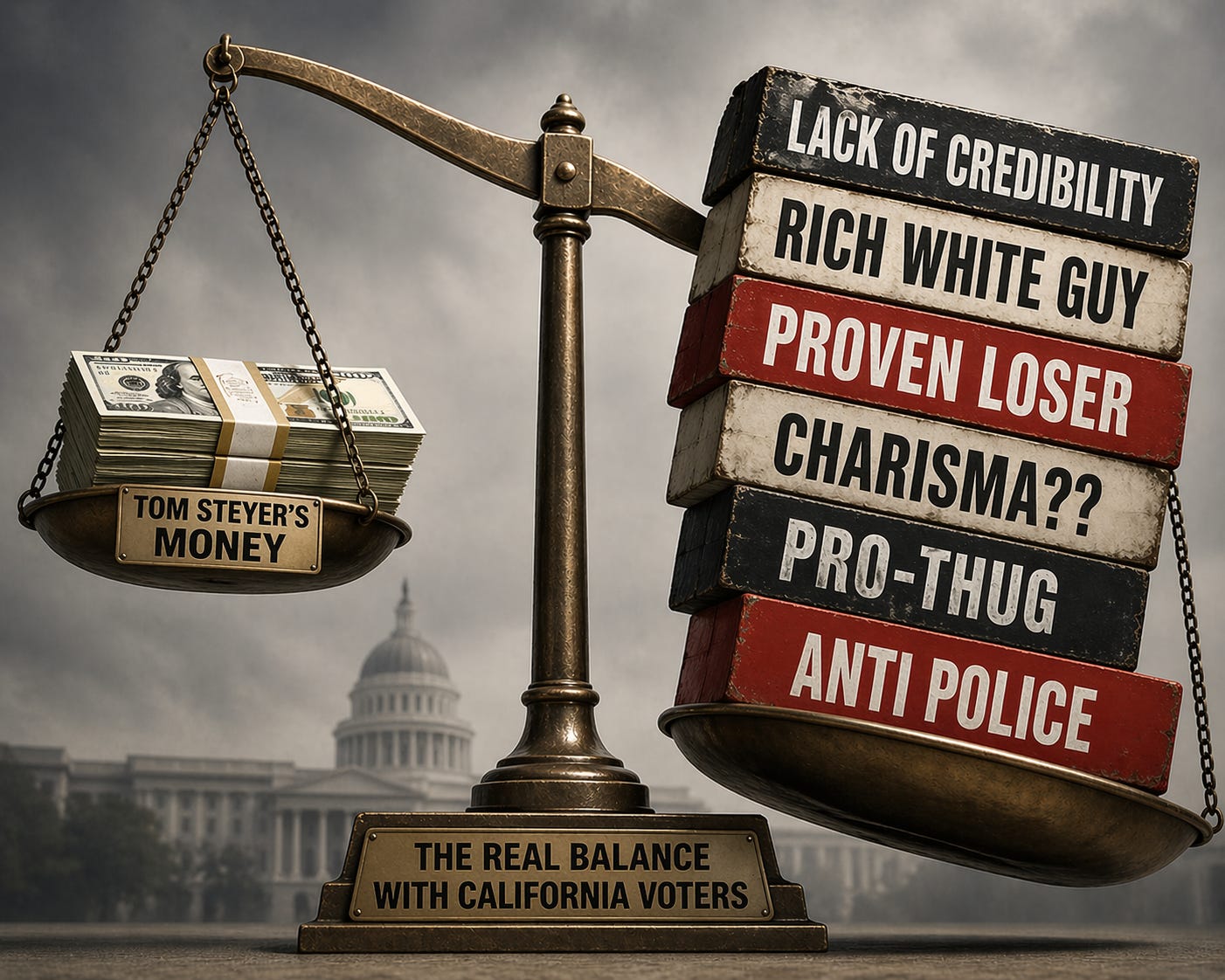
Tom Steyer’s Campaign Is a Million-Dollar Dead End
By Jim Reynolds | www.reynolds.com
April 21, 2026
Tom Steyer’s campaign has the look of a campaign that can buy motion but not momentum.
Yes, he has money. Yes, he can flood California with ads. Yes, in a fractured jungle primary, a billionaire with universal name ID and a massive checkbook can show up near the top of a poll. But that is not the same thing as political strength. In fact, Steyer’s early surge may be the most expensive illusion in California politics.
The problem is not merely that Steyer is rich. The problem is that he is almost perfectly miscast for this moment.
California voters are angry about affordability, disorder, crime, homelessness, taxes, and one-party incompetence. Steyer’s answer is to offer them a billionaire climate activist, failed national candidate, anti-ICE absolutist, cash-bail abolitionist, and self-funded political vanity project. That is not a profile built for durability. It is a profile built for a spectacular collapse.
Start with the obvious: Steyer has already shown voters what happens when he tries to buy affection. In 2020, he ran for president, spent heavily, finished third in South Carolina with 11.3%, won zero pledged delegates there, and suspended his campaign after that contest. Politico reported at the time that Steyer had spent nearly $200 million on TV and digital ads and still “never made a splash in primaries or caucuses.”
That is not a small warning sign. That is the whole movie.
Steyer is not an Obama-style natural politician. He is not a Newsom-style California showman. He is not even a Bloomberg-style technocrat with a governing record. He is a rich man with a cause, a camera, and a belief that if he purchases enough airtime, the public will eventually mistake exposure for charisma.
They usually don’t.
His new anti-ICE plan makes the problem worse. Steyer says “ICE must be abolished” and describes the agency as “acting like a criminal organization,” accusing it of “racial profiling,” “violence,” “intimidation,” “terrorism,” and “the murder of Americans.” He promises to “criminally prosecute and imprison not just the ICE agents who are committing these crimes, but the leadership directing them to do so.”
That is not a public-safety platform. It is a civil-war-within-law-enforcement platform.
The legal theory is not as clean as either side pretends. Federal officers do not have blanket immunity from state prosecution, but they are protected when acting reasonably within lawful federal duties, and any such prosecutions would likely be removed to federal court, where Supremacy Clause defenses would be litigated. In other words, Steyer is not offering California a governing plan so much as a lawsuit factory.
That may thrill a slice of the online left. It may impress activists who think every political problem can be solved by escalating the rhetoric. But California’s general electorate is not a graduate seminar in resistance theory. Most voters do not want a governor whose central promise is to pick a legally dubious fight with federal law enforcement while the state is already struggling to maintain basic order.
This is where Steyer’s cash-bail record becomes politically lethal. California voters rejected Proposition 25 in 2020, the measure that would have replaced cash bail with risk assessments, by 56.41% to 43.59%. Steyer had worked for years to end money bail in California and publicly celebrated the 2018 law that attempted to do it.
Since then, voters have moved sharply away from the progressive criminal-justice mood of 2020. San Francisco voters recalled progressive District Attorney Chesa Boudin in 2022 by a 55% to 45% margin. Los Angeles County voters then ousted George Gascón in 2024, with Nathan Hochman defeating him 59.89% to 40.11%.
The statewide signal was even clearer. California voters overwhelmingly passed Proposition 36 in 2024, a measure that increased penalties for certain theft and drug crimes and rolled back parts of Proposition 47. The Legislative Analyst’s Office explained that Proposition 36 turned some misdemeanors into felonies, lengthened some felony sentences, required some sentences to be served in prison, and created “treatment-mandated felony” charges for some repeat drug offenders.
That is the electorate Steyer is now asking to embrace him.
And notably, the loudest opposition to cash bail tends to come from the most insulated and affluent—those least likely to live with the consequences of their theories.
He is running left on immigration, left on criminal justice, left on climate, and left on wealth redistribution, while trying to pose as the candidate of practical affordability. That contradiction will not survive contact with a real campaign.
His billionaire status is another trap. California’s left has spent years teaching voters to view billionaires as villains, hoarders, profiteers, tax avoiders, and symbols of everything wrong with modern capitalism. Now Democrats are supposed to nominate one for governor?
The timing could hardly be worse. California may face a 2026 billionaire-tax initiative that would impose a one-time 5% wealth tax on California residents with at least $1 billion in net worth. Fortune reported that the California Billionaire Tax Act was filed by SEIU-United Healthcare Workers West and would apply to individuals worth more than $1 billion who were California residents as of Jan. 1, 2026.
So Steyer is trying to win the nomination of a party whose coalition is simultaneously flirting with punishing people exactly like him. That is not just awkward. It is structurally absurd.
Then there is the hypocrisy problem. Steyer’s firm invested roughly $90 million in CoreCivic, a private prison operator that has run facilities used to detain undocumented immigrants, and Steyer has called that investment a “big mistake.” That gives every opponent the same clean attack line: the man now promising to “put ICE in jail” helped make money from the detention infrastructure he now denounces.
That is the kind of contradiction voters understand immediately.
The media may treat Steyer’s rise as a sign of strength because he is polling competitively after Eric Swalwell’s collapse. A SurveyUSA poll cited by RealClearPolitics had Steyer at 21%, Steve Hilton at 18%, Swalwell at 9%, Chad Bianco at 8%, and Katie Porter at 8%. But polls at this stage in a chaotic top-two primary mostly measure confusion, advertising saturation, and name recognition.
The Associated Press described the race as wide open, with more than 50 candidates in the June 2 primary and Democrats worried that a divided field could lock them out of the general election under California’s top-two system. That means Steyer’s current position may say less about enthusiasm for Steyer than about Swalwell’s collapse and the splintering of everyone else.
A rich man can buy a lane in a crowded race. He cannot buy political fit.
And Steyer’s fit is terrible. He is too rich for the anti-billionaire left, too radical for the crime-weary middle, too performative for serious institutional Democrats, too green-ideological for voters focused on affordability, and too personally uncharismatic to turn contradiction into charm.
His campaign has all the ingredients of a classic California political flameout: giant money, giant ego, activist applause, legal fantasy, public-safety vulnerability, and no natural constituency outside the paid-media universe he creates around himself.
The attack almost writes itself:
Tom Steyer is a billionaire who wants to tax and regulate everyone else’s prosperity, a former hedge-fund manager who invested in private prisons before discovering ICE was evil, a failed presidential candidate who spent a fortune to win zero delegates, and a criminal-justice radical running in a state that just voted for accountability.
That is not a frontrunner.
That is a very expensive mirage.
Mr. Reynolds, I completely agree with your article. And understand why it isn't presented in your usual format. The only question is...you're preaching to the choir with the same script. Hope it works.