


Trump’s SOTU: Anatomy of a Persuasion Stack
By Jim Reynolds | www.reynolds.com
Trump’s 2026 SOTU isn’t a speech.
It’s a persuasion stack.
If you watch it through a Scott Adams lens, you stop asking, “Is this accurate?” and start asking, “What levers are being pulled, and in what order?”
And the order is not random.
First: Identity.
Then: Contrast.
Then: Villain.
Then: Live compliance tests.
Then: Destiny.
That’s the spine.
1. Identity First — “Our nation is back”
He doesn’t open with policy. He opens with status.
“Our nation is back: bigger, better, richer and stronger.”
That’s not a claim you debate. That’s a team chant.
Four adjectives. Clean rhythm. Stadium cadence.
When a leader tells you who you are before telling you what he’s doing, he’s shaping identity. And identity is sticky. Once people accept “we are winning again,” they reinterpret everything else through that filter.
You’re not evaluating proposals.
You’re joining a comeback story.
That’s Move #1.
2. The Before/After Movie Trailer
Now watch the contrast engine.
Last year: chaos.
This year: turnaround “for the ages.”
Border chaos → secure.
Inflation → plummeting.
Crime → historic drop.
Wars → ended.
Markets → records.
This is cinematic persuasion. You don’t prove transformation. You narrate it.
Contrast is powerful because it lowers the burden of proof. If “before” was terrible, “after” only has to feel better, not perfect.
And he compresses time: “in just one year.”
Time compression = miracle multiplier.
3. Repetition as Reality
“Today our border is secure.”
Pause.
“Today our border is secure.”
Repetition is not laziness. It’s installation.
The human brain treats familiarity as truth. If you hear it twice in rhythm, it starts feeling structural.
This speech is full of that rhythm: record, historic, never before, strongest, lowest, ever.
Those are dominance words.
Dominance reads as control.
Control reads as competence.
4. Numbers as Texture, Not Evidence
56%.
1.7%.
$2.30.
53 record highs.
$18 trillion.
$5,000 saved.
$30,000 401(k) gain.
89% polling.
The point of numbers in a live speech isn’t verification.
It’s specificity.
Specifics create the feeling of mastery. You don’t remember the figures. You remember that he had figures.
Notice the oscillation:
Massive numbers (trillions) signal power.
Tiny numbers (“one more dollar to make it $1,776”) signal detail obsession.
Big and small.
Macro and micro.
That pairing builds the “I see everything” illusion.
5. The Villain Glue
Now the adhesive.
Every problem points to one tribe.
Inflation? Them.
Open border? Them.
Crime? Them.
Shutdown? Them.
High health care costs? Them.
This is simplification on purpose.
When you unify complex failures under one enemy, you remove ambiguity. Politics becomes conflict, not analysis.
And here’s the persuasion kicker:
He doesn’t just talk about them.
He points at them.
He pauses when they don’t stand.
He says, “You should be ashamed.”
He invites the camera to find faces.
The villain is not abstract.
The villain is in the room.
That’s powerful television.
6. The Stand-Up Trap
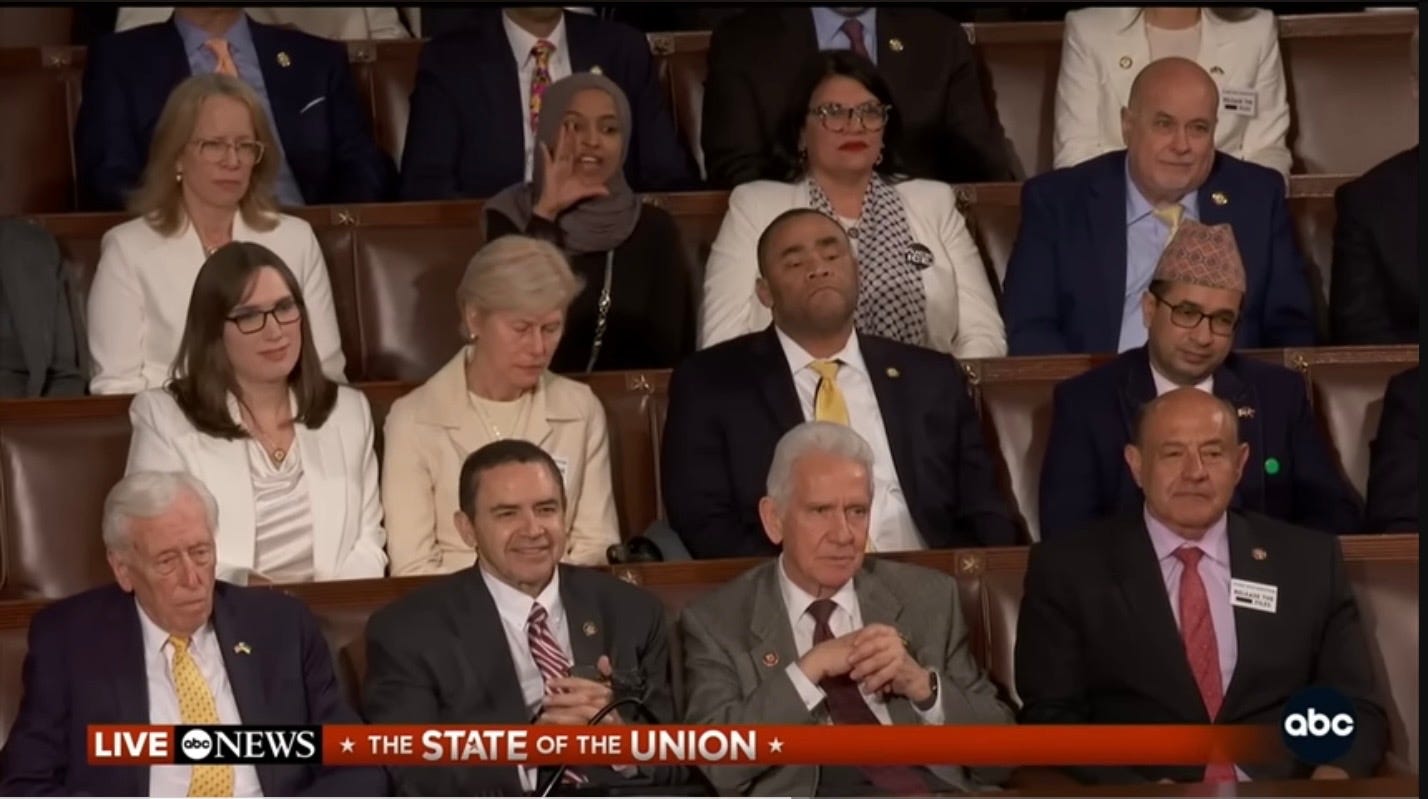
“Stand if you support protecting American citizens.”
This is genius-level persuasion theater.
If Democrats stand, he gets bipartisan optics.
If they don’t, he gets moral contrast.
It’s a no-lose trap.
This isn’t debate. It’s forced behavior. And behavior persuades more than arguments.
You can fact-check words.
You can’t unsee who didn’t stand.
7. Human Anchors Beat Policy
He floods the room with faces:
The rescued girl.
The Coast Guard swimmer.
The waitress mom.
The IVF discount customer.
The grieving mother.
The wounded soldier.
The freed Venezuelan uncle.
Statistics activate logic.
Faces activate morality.
Once a policy is attached to a victim, opposing it feels like opposing the victim.
That’s not accidental.
That’s narrative anchoring.
8. Humor as Dominance
The humor isn’t softening.
It’s dominance signaling.
“We’re winning too much.”
“I didn’t name it.”
“Fort Bragg — we have it back.”
“One more dollar.”
Humor says: I’m relaxed.
Relaxed says: I’m in control.
People don’t follow tense leaders.
They follow amused ones.
9. Labels That Stick
“Green New Scam.”
“Unaffordable Care Act.”
“Somali pirates.”
“Dalilah Law.”
“Save America Act.”
If you control the label, you control the mental shortcut.
You don’t argue with a program.
You reject a scam.
This is memetic warfare. Simple phrases that travel without him.
10. Protection Frame — The Deep Lever
Children protected.
Parents protected.
Citizens protected.
Soldiers honored.
Iran stopped.
Cartels crushed.
Protection is primal.
When you frame politics as safety, you reduce tolerance for nuance.
Fear simplifies.
Protection justifies.
That’s not left or right.
That’s human wiring.
11. The “I Did It” Loop
“I ended.”
“I negotiated.”
“I secured.”
“I designated.”
“I stopped.”
“I demanded.”
Even when Congress must act, he frames himself as the engine.
This centralizes credit and blame.
It creates a brand:
Trump = action.
12. The Mythic Ending
The final paragraphs leave policy behind.
Now it’s 1776.
Providence.
Destiny.
Liberty’s flame.
Golden age.
This is not governance language.
It’s myth language.
The speech begins with “we are back.”
It ends with “we are chosen.”
That’s not an accident.
That’s conversion framing.
The Persuasion Scorecard
Identity: 10
Contrast: 10
Villain framing: 10
Social pressure moments: 10
Ceremony / visual proof: 10
Humor dominance: 8
Policy granularity: intentionally low
The design is clear.
This speech is not trying to win a faculty lounge.
It’s trying to win a narrative cycle.
You can disagree with the claims.
You can dispute the numbers.
You can reject the tone.
But from a persuasion mechanics standpoint?
The machine is running hot.
The only persuasive democrat i can name is AOC. She is a natural persuader — but does not appear to have commensurate mental agility. But sometimes that does not make any difference. Consider her constituency. I assume that Miller was behind the speech writing for the SOTU. He definitely understands the levers of persuasion.
I am an admirer of Scott Adams. He taught me about persuasion — something I have been using all my life. Thanks.