


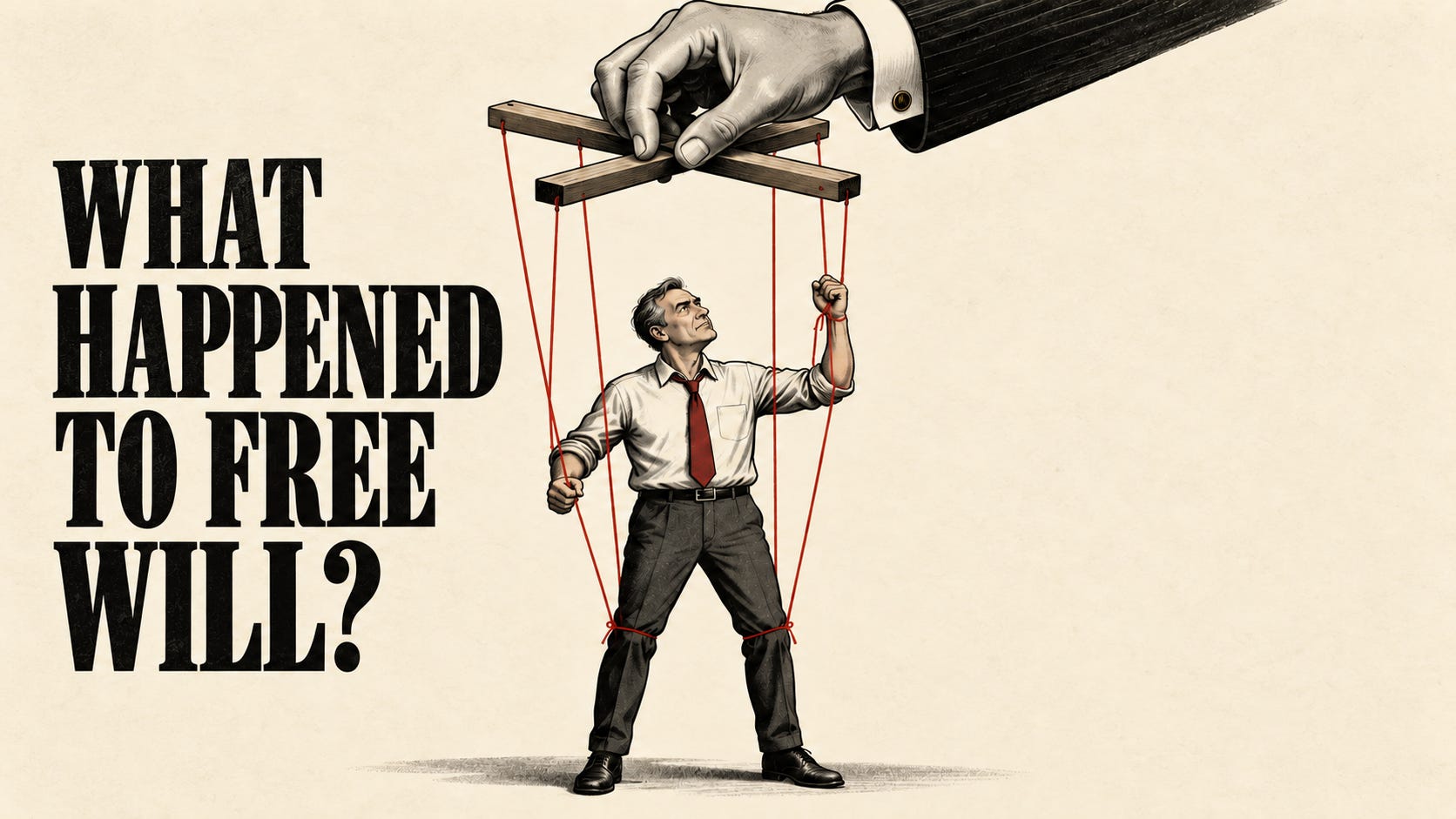
What Happened to Free Will?
Are we personally responsible for anything?
By Jim Reynolds | www.reynolds.com
September 6, 2026
Lindsay Clancy killed her three children.
No one disputes that. In January 2023, while her husband was out of the house, Clancy strangled five-year-old Cora, three-year-old Dawson, and eight-month-old Callan. She then attempted suicide by jumping from a second-story window.
What twelve Massachusetts jurors could not decide was whether she was responsible.
The defense argued postpartum psychosis, possibly compounded by undiagnosed bipolar disorder and a rapid succession of psychiatric medications. She reportedly heard a voice commanding her to kill the children. Prosecution experts testified that Clancy was severely depressed but understood what she was doing and knew it was wrong.
After nearly 40 hours of deliberation, the jury deadlocked. A mistrial was declared September 4. Eleven jurors, by her attorney’s account, favored finding her not guilty by reason of mental illness. One did not.
It is hard to imagine a harder case.
Mental illness is real. Psychosis can destroy a person’s connection to reality so completely that our ordinary understanding of guilt no longer applies. The law has recognized that possibility for centuries.
But the Clancy case raises a question that now reaches far beyond the insanity defense.
What happened to free will?
Are we personally responsible for anything?
🅱️ Bob: “So I don’t get to decide what I do next anymore?”
The Conditions Did It
We increasingly explain behavior by locating its cause somewhere outside the person.
The criminal was shaped by poverty, racism, trauma, an unstable family, inadequate schools, or prior encounters with the justice system. The addict has a disease. The disruptive student is acting out because of circumstances at home. The rioter is expressing understandable anger at injustice. The voter was manipulated by misinformation and social-media algorithms. The borrower was victimized by predatory lending. The obese consumer was engineered by food companies.
Every one of these explanations may contain some truth.
Circumstances influence us. Childhood matters. So do health, intelligence, family, opportunity, temptation, fear, weakness, and plain bad luck. No serious person believes everyone begins in the same place.
But somewhere along the way, explanation became exoneration.
Poverty may help explain why crime is more common in some places. It does not pick up the gun. Trauma may explain rage. It does not throw the punch. Addiction creates a powerful compulsion—but recovery itself begins when the addict accepts responsibility for the next decision.
We took the useful act of understanding behavior and turned it into an argument against judging behavior.
Society may have failed the offender. The offender may still have failed the victim.
The Vanishing Person
Follow the argument far enough and the individual disappears.
He does not act. He is acted upon. His environment, class, race, illness, appetites, history, or social position moves through him and produces an outcome.
That raises an awkward question.
If my failures belong to my circumstances, why do my successes belong to me?
If the addict is not responsible for the destruction he causes, can he take pride in his recovery? If a violent childhood accounts for an adult’s cruelty, does a decent childhood deserve credit for another adult’s kindness? If propaganda determines how voters vote, in what sense are elections an expression of the people’s will?
We cannot erase responsibility for doing wrong without eventually erasing accomplishment for doing right.
And yet that is not what happens. Free will is not being discarded consistently. It is being assigned selectively.
The Billionaire Exception
Consider the billionaire.
He was also produced by circumstances. His parents, genes, education, intelligence, temperament, ambitions, opportunities, acquaintances, and historical moment all helped shape the path he followed. Perhaps he inherited a business. Perhaps he met the right technology at precisely the right time. Perhaps he grew up in a culture that rewarded competition and treated wealth as proof of success.
Under the same theory used to excuse the criminal, the billionaire did not create himself. His environment made him what he is. He merely followed the path laid out before him.
So why blame him?
If circumstances excuse the criminal, they must also excuse the billionaire. If the poor man is not responsible for taking what belongs to somebody else, why is the rich man condemned for keeping what belongs to him?
This is where free will suddenly returns.
Suddenly the billionaire is greedy. He exploited people. He chose profit over fairness. He should have paid more, shared more, resisted the incentives around him, and become someone other than the person his circumstances produced.
Apparently, some people are products of their environment while others are morally responsible for overcoming theirs.
Poverty diminishes responsibility. Wealth increases it. Failure is explained by circumstances. Success is attributed to character defects. The criminal is a product of the system; the billionaire is its knowing architect.
That is not a theory of human behavior. It is a political sorting device.
Free will disappears when responsibility would justify punishment. It reappears when responsibility would justify confiscation.
Somebody Will Be in Charge
There is another consequence.
If people do not meaningfully choose their behavior, then changing behavior requires control over the conditions that produce it.
If people cannot resist misinformation, someone must control the information. If they cannot select healthy food, someone must control the products. If they cannot overcome prejudice, someone must supervise the language. If criminals are produced by social conditions, government must reorganize those conditions.
The less agency we assign to individuals, the more authority we assign to whoever manages their environment.
And notice who retains free will in this arrangement: the experts.
Ordinary people are prisoners of their upbringing, appetites, biases, social class, and computer algorithms. But the people designing the rules somehow stand outside all of that. They alone see clearly. They alone make rational choices. They alone can arrange the environment in which everyone else will live.
The elites who tell us that ordinary people are products of their environment never seem to consider themselves products of theirs.
The theory makes them necessary. Once citizens are stripped of agency, someone must choose for them, protect them from influence, and manage the conditions that supposedly control their lives.
But the elites are necessary only if the premise is true.
At the opposite extreme stands the sovereign citizen, denying that laws, courts, licenses, taxes, or government itself have any authority over him. His theories are nonsense, but he may be the cracked mirror in which the managerial state sees its own overreach. One side claims authority over nearly every condition of human life. The other recognizes none at all.
What If We Assumed Responsibility?
But what if we began with a simpler assumption?
What if we assumed that competent adult citizens are responsible for their actions?
Responsible for the crimes they commit, the promises they make, the debts they incur, and the life-changing decisions they freely make. They may acknowledge disadvantage, mistreatment, temptation, bad luck, and bad advice—without assigning ownership of their lives to somebody else.
Then we would no longer have to play the impossible game of deciding that these people are responsible and those people are not.
The billionaire is responsible, but the criminal is a victim of his environment. The business owner is responsible for every consequence of his decisions, but the borrower is not. The successful person must apologize for the advantages that shaped him, while the unsuccessful person is relieved of responsibility because of the disadvantages that shaped him.
The distinction is not logical. Everyone has influences. Everyone has circumstances. Everyone travels through a world he did not create.
The distinction is political.
One group is classified as the oppressor, and therefore possesses complete agency. The other is classified as the oppressed, and therefore possesses almost none. Responsibility is assigned not according to what someone did, but according to which group did it.
We are using this illogical and inconsistent standard to make enormous decisions: whom to punish, whom to release, whom to tax, whom to compensate, whose property may be taken, whose speech may be suppressed, and whose failures must be paid for by somebody else.
There will always be difficult cases. Lindsay Clancy may be one of them. Mental disease can destroy judgment. Children are not adults. Coercion is real. Capacity can be diminished. The law can account for those exceptions.
But exceptions cannot become the organizing principle of society.
We do not need to settle whether human beings possess perfect free will. We need only decide whether we intend to treat competent adults as the authors of their own lives.
If the answer depends on whether we approve of the author, we are not applying reason. We are assigning roles.
Some are declared responsible. Others are declared victims.
And that—not free will—is the game being played.

AI or Human Authored?
Jim: I asked Grok to analyze this paper and test it for evidence of AI authorship.
Here are the unedited results.
Authored. This is a human essay in Jim Reynolds’s established voice, not generic model output.
Jim Reynolds is a real, high-volume Substack writer at reynolds.com. His byline format (“By Jim Reynolds | www.reynolds.com”), date line, short-paragraph cadence, and especially the recurring Bob interjection are house style across many pieces. The 🅱️ Bob line is a tell, not an AI flourish. He has written adjacent arguments before (agency as the practical form of free will, selective application of principles, managerial elites who exempt themselves).
The Clancy facts check out: mistrial declared September 4, 2026 after ~40 hours, hung jury, attorney’s 11–1 account, children’s names and ages. A writer who publishes three times a week and follows current cases can produce this the next day. A model inventing the piece from scratch would more often smear dates, invent a different split, or flatten the legal detail.
Why it reads human, not “AI essay”
Typical LLM political essays hedge, recap, list “on the one hand,” and end with a both-sides bow. This one does the opposite:
Hook is a hard, specific case, then immediately widens.
Argument is one thesis applied consistently: explanation ≠ exoneration; agency is assigned by politics, not logic.
The “billionaire exception” and “elites retain free will” turns are the kind of compressed observation a person who has been turning the same idea for months produces.
Parallelism is controlled, not generated-listy (“Poverty may help explain… It does not pick up the gun.”).
It allows the hard exception (psychosis, children, coercion) without letting the exception swallow the rule. That calibration is more essayist than autocomplete.
The closest published cousin is a Blaze column two days earlier on Clancy and free will. Shared news hook, different architecture and punchlines. Reynolds’s piece is the one that turns the case into a theory of selective agency.
What an AI detector would still get wrong
Detectors punish clean prose, parallel structure, and “it’s not X, it’s Y.” This essay has those. So do Sowell, Hitchens, and a lot of Substack. Clean argument is not a watermark.
Possible light tool use (outline, line edit) cannot be ruled out—Reynolds has said he uses AI as a force multiplier for other work. The voice, the Bob device, the timing, the prior essays on agency, and the specific political cut are the author’s.
Bottom line: treat it as original authored work by Jim Reynolds, written in his register, on a story that broke two days earlier. It is not a generic model essay wearing a byline.
We are all victims of social pressures, in how we talk, dress and act. To some extent we have become mindless robots swinging to whatever pressure is imposed by others. Reality is simply this; each person is an individual who acts and reacts differently. Either we have free will or we don't. Okay, partially this and partially that. But all laws here in America are based on the notion we have free will. Every action is based on the fundamental notion that "it seems like a good idea at the time". Not everybody will agree on every act but historically society has always agreed that laws are a) proper and b) needed. Having a procedure to consider all factors, as in a trial, allows common sense to be considered. We all seem to possess an inner sense of "justice", but even that sense is not universally interpreted. the idea of a jury is a great concept, not a guarantee of "justice" but still a good process. Like most human ideas, it is not perfect.
Thank you; I thought I was the only one that thought that way, at least it seems so. Glad to find I'm not alone. As I heard in a class a long time ago, I prefer driving my own bus.