


What Trump Accounts Could Become
Real Families, Real Contributions, and the Power of Time
By Jim Reynolds | www.reynolds.com
July 2026
A Note to Readers
Part One explained what Trump Accounts are, why they were designed around low-cost American stock indexes, and where they fit alongside 529 plans, Roth IRAs, custodial brokerage accounts, and other familiar financial tools.
Now we reach the question families really want answered:
What could the money become?
The answer depends mainly on three things:
How early the account begins.
How much is contributed.
And whether everyone can resist the temptation to interfere with it.
None of the numbers that follow are promises. Markets rise and fall. There will be recessions, crashes, wars, inflation, political upheaval, technological disruption, and long periods when investors wonder whether anything is working.
But that uncertainty should not obscure the central mathematical reality.
A child beginning at birth may have sixty-five years for investment returns to generate additional returns of their own.
Time can transform modest beginnings into extraordinary results.
The Assumptions
To keep the comparisons consistent, every scenario uses the same basic assumptions:
The child receives a $1,000 federal contribution at birth.
The account earns an average annual return of 8 percent.
Additional contributions are made at the end of each year.
Childhood contributions continue through age 17.
The money remains invested.
No withdrawals are made.
The calculations do not subtract taxes that may eventually be owed when money is distributed.
All balances are expressed in future dollars.
Inflation will reduce what those future dollars can buy. But nobody knows what inflation will average over the next sixty-five years.
Rather than introduce another unknowable assumption, I will show the projected account balances themselves.
The purpose is not to promise a particular future standard of living.
It is to compare what different contribution strategies could produce under the same assumptions.
Bob 🅱️ says: “Inflation may reduce what the money buys. Fine. Any percentage of zero is still zero. Open the account.”
Scenario One: The $1,000 Seed—and Nothing More
Begin with the simplest possible case.
A qualifying child receives the one-time $1,000 federal contribution.
Nobody ever adds another dollar.
The account remains invested in its low-cost broad American stock-index fund and is never disturbed.
At an average annual return of 8 percent:
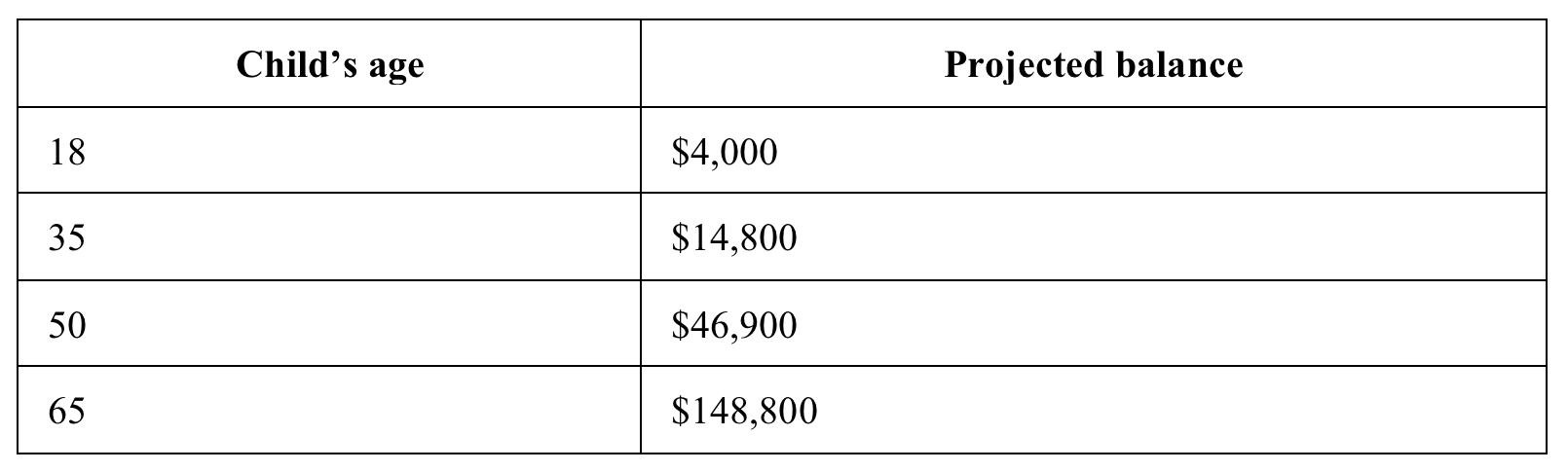
The government contributed $1,000.
By age 65, the account could contain nearly $149,000.
That is not enough to finance an entire retirement. Nobody should pretend otherwise.
But consider what happened:
No parent contribution.
No grandparent contribution.
No employer contribution.
No contribution from the child.
One initial deposit simply remained invested.
The result is not a fortune.
It is still a meaningful asset created almost entirely by time.
That alone makes opening the account worthwhile. A family unable to contribute anything should not conclude that the account has no value.
Claiming the federal contribution and leaving it invested is infinitely better than failing to begin.
The first responsibility is not to maximize the account.
It is to open it.
Bob 🅱️ says: “You do not reject a free thousand dollars because it will not make the kid a millionaire. Take the money. We’ll discuss the millionaire part next.”
Scenario Two: Add $1,000 a Year Until Age 18
Now suppose parents, grandparents, relatives, or an employer collectively contribute $1,000 each year during childhood.
That is about $83 a month.
The child receives:
The original $1,000 federal contribution.
Another $1,000 at the end of each year through age 17.
Total additional contributions of $18,000.
No further contributions after age 18.
The projected results:
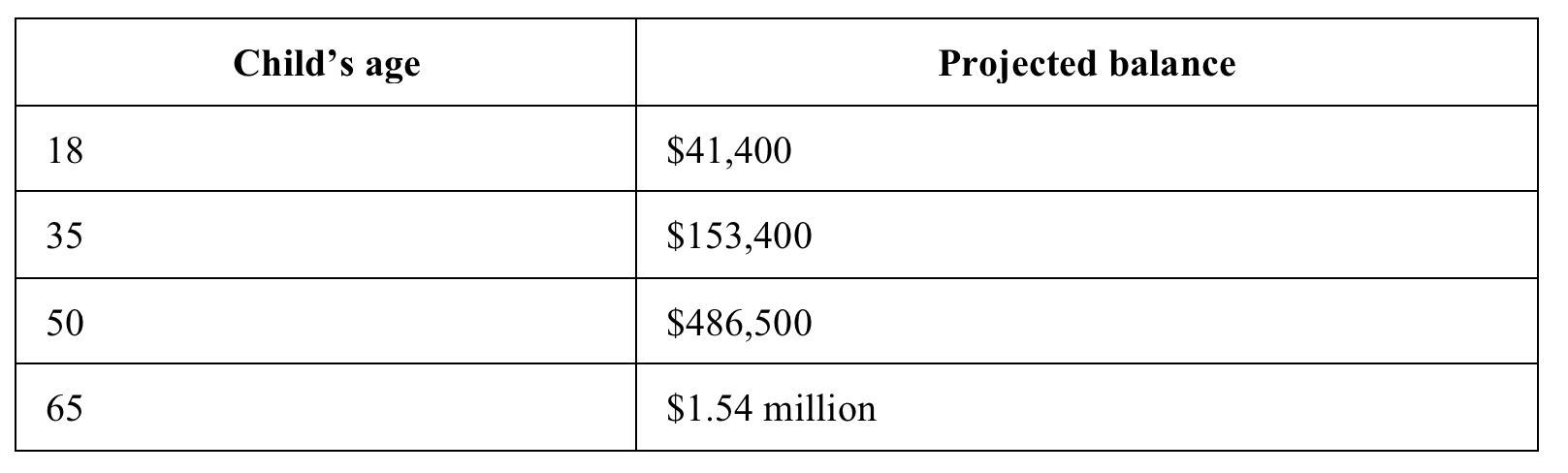
The government contributed $1,000.
The family and others contributed $18,000.
By age 65, the account could contain more than $1.5 million without another dollar being added after childhood.
That is the power of front-loading time.
The family does not merely contribute $18,000.
It contributes forty-seven additional years of compounding after the child turns 18.
The Most Important Number May Be $41,400
The age-65 total is impressive.
But the more consequential figure may be the projected balance at age 18:
$41,400.
That balance already contains the raw material for a substantial retirement account.
The young adult does not have to build the foundation from nothing. The foundation already exists.
The assignment is simple:
Leave it alone.
Instead of telling an 18-year-old, “You should begin saving for retirement someday,” the family can say:
“You already have a retirement foundation. Protect it.”
The parents did the difficult part.
They began before the child could begin.
Bob 🅱️ says: “The parents planted the tree. At 18, the child’s job is to stop digging it up.”
Scenario Three: Keep Adding $1,000 a Year
Now suppose the annual habit continues after age 18.
During childhood, family members and employers may contribute. Once the child becomes a working adult, the individual continues contributing $1,000 each year, assuming sufficient earned income and eligibility under the IRA rules then in effect.
After the special Trump Account growth period ends, most ordinary traditional IRA rules generally begin to apply. That means adult contributions would ordinarily require eligible compensation and would be governed by the contribution limits then in effect. (IRS)
One thousand dollars a year is approximately:
$83 a month.
$19 a week.
$2.74 a day.
The projected results:
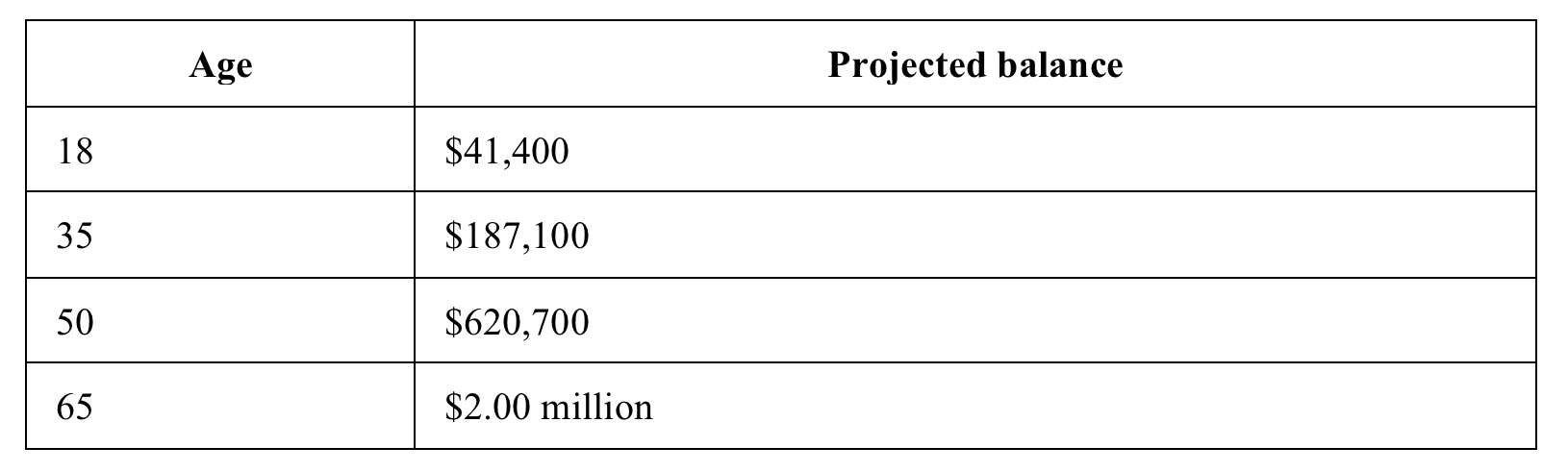
Continuing the $1,000 annual habit raises the projected age-65 balance from approximately $1.54 million to almost $2 million.
The later contributions matter.
But the early start still does most of the heavy lifting.
The deposits made during childhood receive decades to grow. The deposits made later strengthen an account whose foundation has already been built.
This is an achievable lifetime habit—not a strategy reserved for wealthy families.
Scenario Four: Add $3,000 a Year Until Age 18
Three thousand dollars a year equals $250 a month.
That may sound substantial, but the entire amount need not come from the parents.
One possible arrangement:
Parents contribute $100 a month: $1,200 annually.
Two sets of grandparents contribute $600 each: $1,200 annually.
An employer contributes $600 annually.
Total:
$3,000 a year.
Trump Accounts can receive deposits from several sources during the growth period, including individuals and employers. Employer contributions currently have their own $2,500 limit and count toward the account’s overall ordinary annual contribution limit. (IRS)
Under this scenario:
The federal government contributes $1,000.
Family members and others contribute $3,000 annually through age 17.
Total additional contributions equal $54,000.
Contributions stop at adulthood.
The projected results:
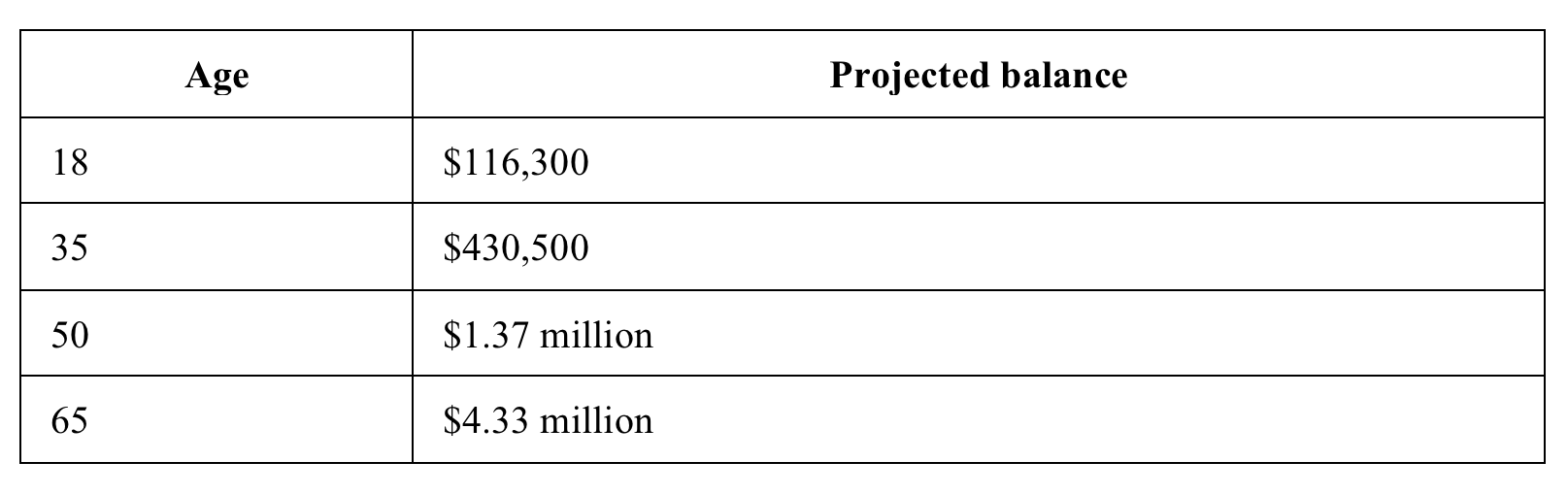
The child could enter adulthood with more than $116,000 invested in American business.
If the account were never touched again, it could grow to approximately $4.33 million by age 65.
This is not necessarily the result of one wealthy relative writing a giant check.
It can be the result of several people sharing responsibility.
Parents.
Grandparents.
Other relatives.
An employer.
Perhaps a charitable or community program.
The Trump Account gives them one destination into which their contributions can flow.
Scenario Five: Continue $3,000 a Year Through Age 65
Now suppose the $250-a-month habit continues throughout the child’s working life.
The projected results:
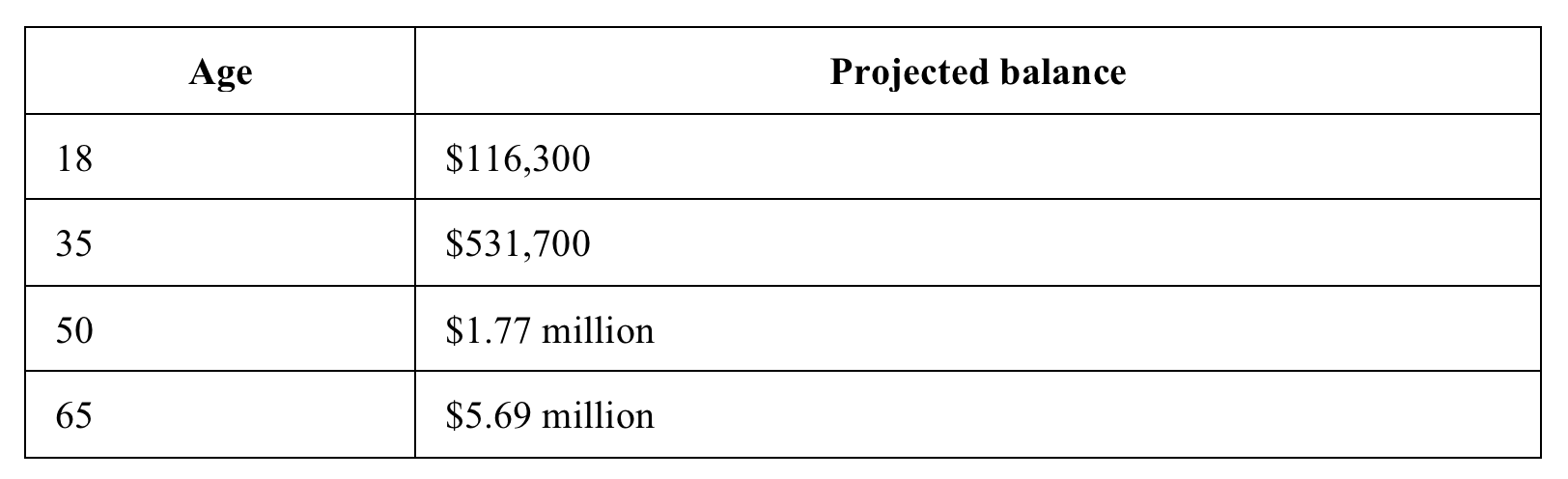
The projected age-65 balance rises to approximately $5.69 million.
Nobody accidentally saves that much.
But many people accidentally spend $250 a month.
The difference is not always income.
It is direction.
Subscriptions.
Restaurant meals.
New phones.
Expensive vehicles.
Convenience purchases.
Things bought and forgotten.
A family does not need to eliminate every pleasure. Life is meant to be lived.
But a sustained $250 monthly investment can eventually become an independent financial force.
Bob 🅱️ says: “Nobody accidentally builds a $5.7 million account. Plenty of people accidentally spend $250 every month.”
Scenario Six: Maximize Contributions at $5,000 a Year Until Age 18
Now we reach the current ordinary annual maximum during the childhood growth period.
Five thousand dollars a year equals approximately:
$417 a month.
$96 a week.
$13.70 a day.
For many families, that will be impossible.
For others, it may become possible when several people participate.
The $5,000 could come from some combination of:
Parents.
Grandparents.
Other relatives.
Employers.
Other eligible contributors.
The child does not need one wealthy benefactor.
The child may need several adults who agree that building ownership is more important than buying more temporary things.
Assume:
The child receives the $1,000 federal contribution.
Another $5,000 is contributed annually through age 17.
Total additional contributions equal $90,000.
All contributions stop after childhood.
The projected results:
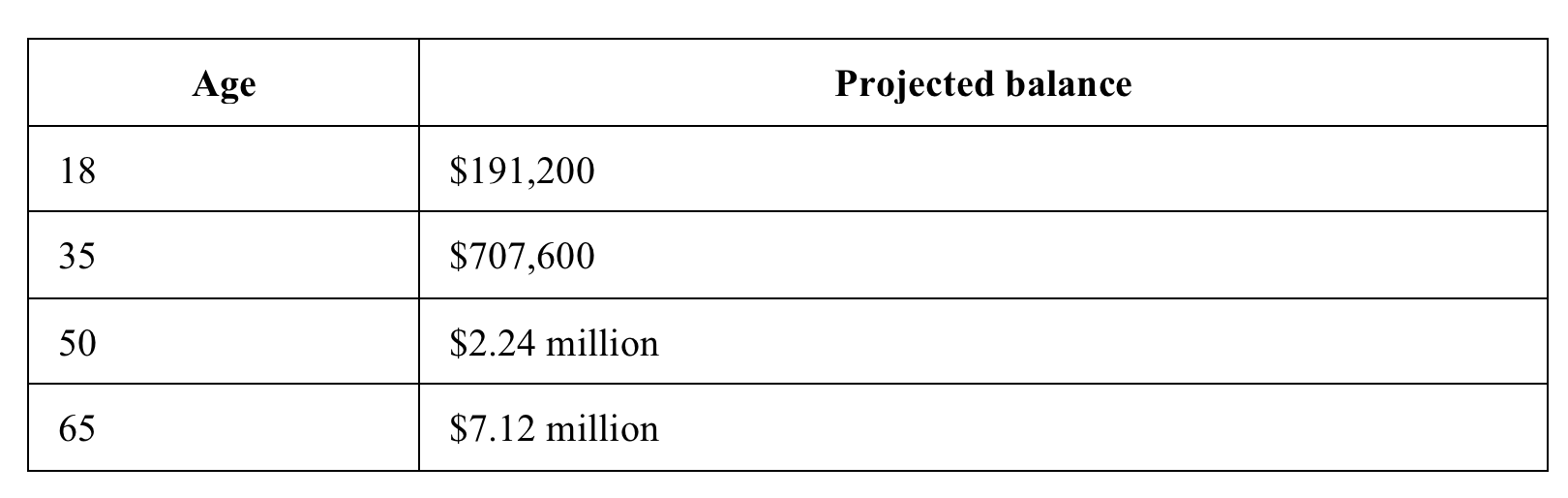
The child could enter adulthood with approximately $191,000.
Even if nobody ever contributed again, the account could grow to more than $7.1 million by age 65.
This is where people may begin to doubt the arithmetic.
How can $91,000 in total deposits—including the original federal contribution—become more than $7 million?
Because the money deposited in the first year does not grow for ten years.
It grows for sixty-five.
The deposits made throughout childhood continue producing returns long after the original contributors may be gone.
The account becomes a financial inheritance built not from one enormous fortune, but from many manageable deposits given extraordinary time.
Scenario Seven: Continue $5,000 a Year Through Age 65
Finally, suppose the child becomes an adult, earns sufficient income, and continues contributing $5,000 every year.
The projected results:
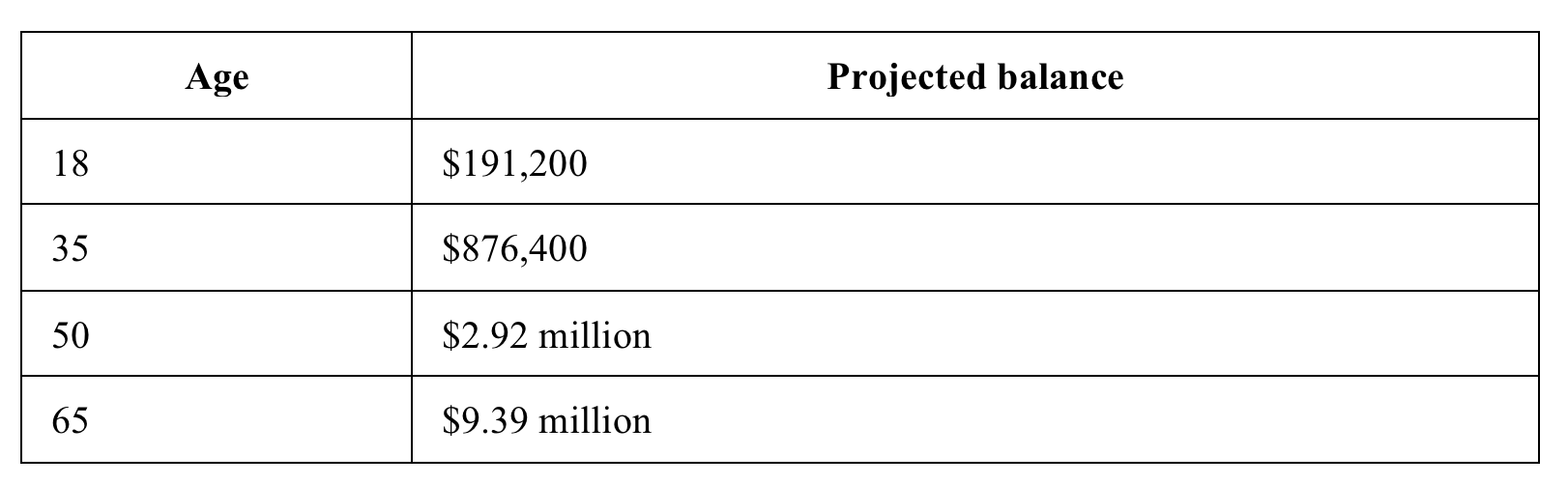
The projected balance approaches $9.4 million.
That is an exceptional outcome.
It is not a promise.
It assumes sixty-five years of uninterrupted investment, an average annual return of 8 percent, no withdrawals, and a consistent willingness to keep contributing.
But it demonstrates what the structure makes possible.
The child begins with a government seed.
The family builds the childhood foundation.
The adult continues the habit.
The market supplies the compounding.
No single participant does everything.
Time does more work than anyone.
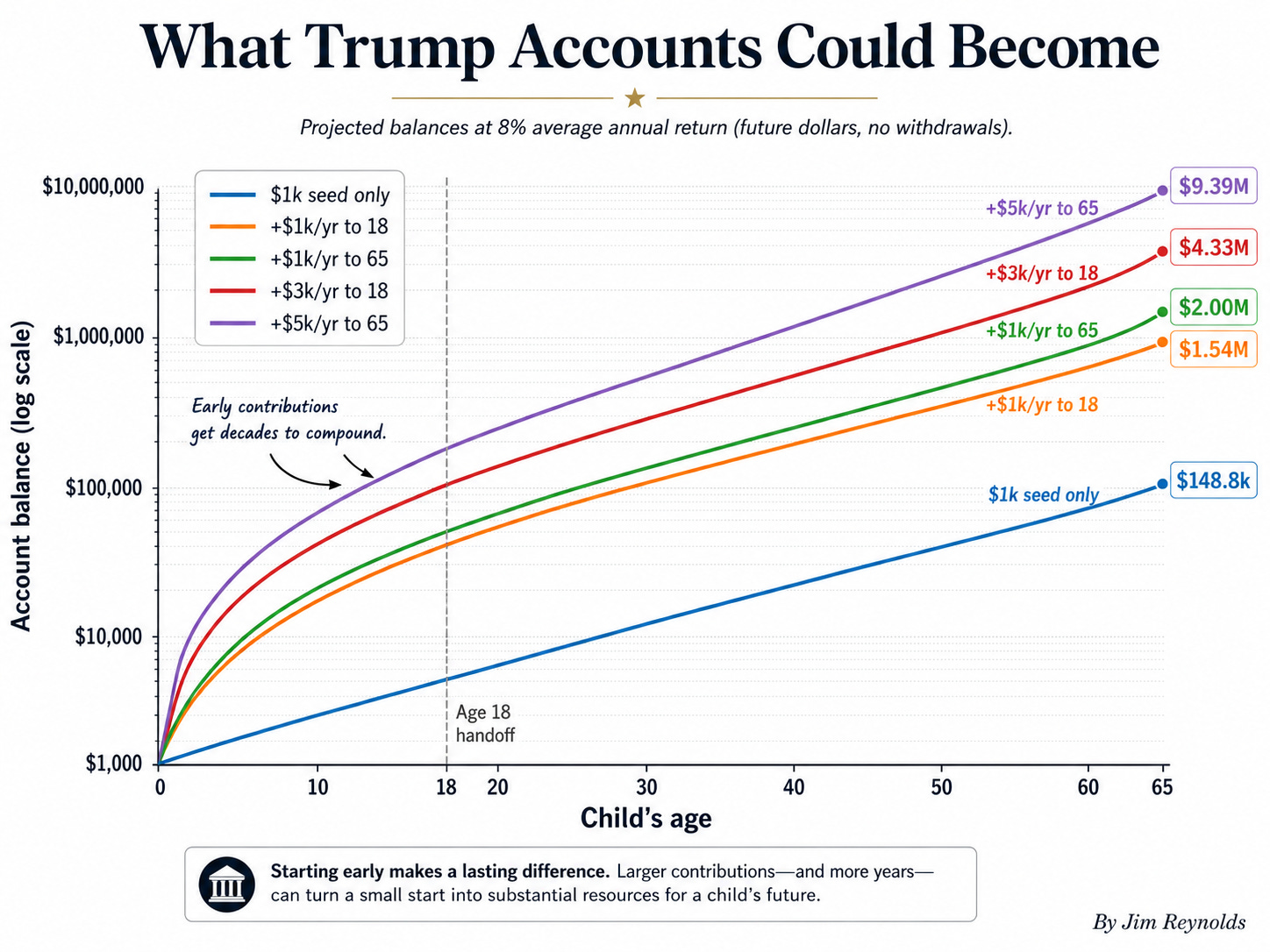
The Progression at a Glance
All figures assume the $1,000 federal seed, an average annual return of 8 percent, end-of-year contributions, and no withdrawals.
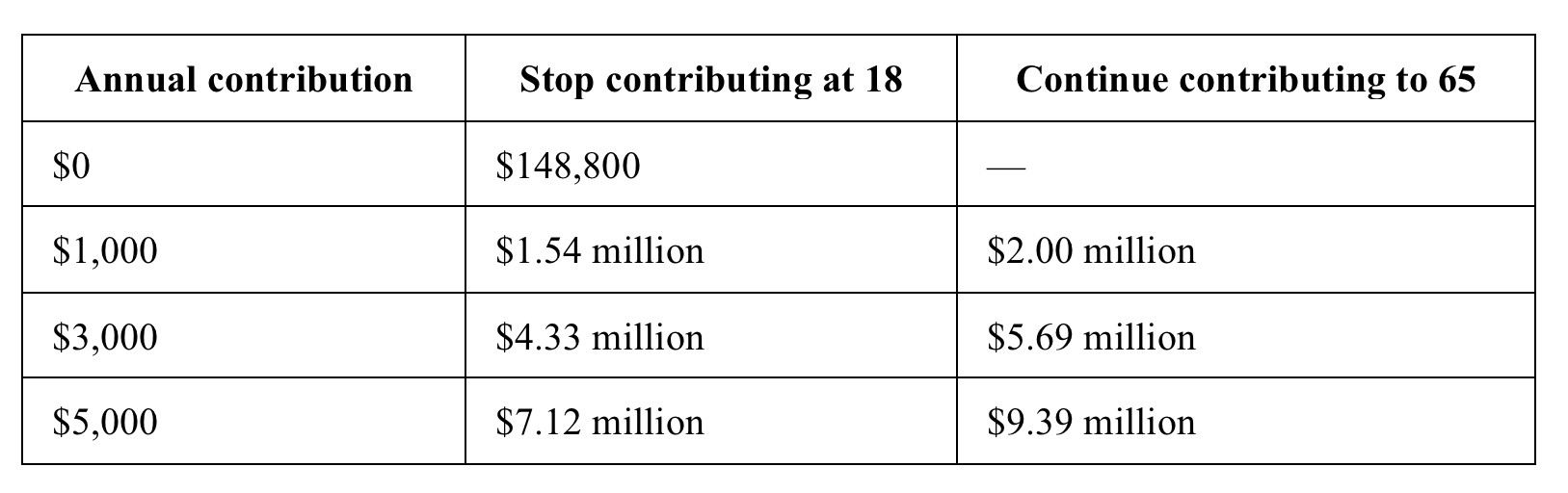
The pattern is clear.
The federal seed alone can become meaningful.
A modest annual contribution can become substantial.
A shared family contribution can become transformative.
A maximized account can become a major financial asset.
But every scenario depends upon the same four actions:
Begin early.
Contribute consistently.
Keep costs low.
Stop fiddling with it.
The Family That Cannot Contribute Anything
We should return to the family with no available money.
That family may look at the larger scenarios and conclude that the program is intended for somebody else.
It is not.
Open the account.
Claim the federal contribution if the child is eligible.
Check whether an employer contributes.
Check for state, local, tribal, community, charitable, or philanthropic programs.
Tell grandparents and relatives that the account exists.
Then leave the money invested.
The account may begin with only $1,000. But it creates a destination into which future help can flow.
A family’s circumstances can change.
A parent may receive a raise.
A grandparent may decide to contribute.
A new employer benefit may appear.
A charity may fund children in a particular area.
None of those possibilities matters if the account was never opened.
The perfect contribution is not the requirement.
The first contribution is.
The Grandparent Opportunity
Trump Accounts may become one of the finest grandparent vehicles ever devised.
Grandparents frequently want to give something meaningful but face a familiar problem.
Toys disappear.
Clothing is outgrown.
Electronic devices become obsolete.
Cash is often spent and forgotten.
A contribution to a child’s ownership account remains visible for decades.
A grandparent—or group of grandparents—who collectively contributes $1,000 annually during childhood will have added $18,000.
Under the assumptions used here, those deposits combined with the federal seed could become more than $1.5 million by the child’s age 65 without another dollar being added after age 18.
The child may not remember every birthday present.
The child may always remember who helped build the account.
This is not merely a financial gift.
It is a multigenerational message:
We believed in your future before you were old enough to understand it.
The Employer Opportunity
Employers should pay attention too.
A company may struggle to distinguish itself with another minor workplace perk.
A Trump Account contribution for an employee’s child is different.
It is concrete.
It is personal.
It is emotionally powerful.
And it may continue benefiting the employee’s family decades after the employee leaves the company.
Imagine the loyalty created when a parent can tell a child:
“My employer helped build this for you.”
A relatively small annual company contribution could eventually become one of the most valuable benefits the family receives.
A Brief Brush With the Alternatives
Trump Accounts are not the only accounts families should use.
Each alternative has a different job.
The 529 Plan
The 529 remains the specialist for education.
When money is likely to be spent on qualified educational expenses, tax-free withdrawals and possible state tax benefits can make the 529 superior for that purpose.
But tuition money is expected to leave the account when the child is young.
Trump Account money can remain invested for life.
One pays for education.
The other builds ownership.
Many families will sensibly use both.
The Roth IRA
Once the child has legitimate earned income, a Roth IRA may become the most attractive destination for additional long-term retirement money because qualified withdrawals can eventually be tax-free.
The Trump Account solves the years before employment.
The Roth can strengthen the years after employment begins.
Trump first.
Roth next.
Not one instead of the other.
The Taxable Account
A custodial taxable account provides flexibility. The funds can be invested more broadly and spent for many purposes.
That freedom can be useful.
It can also be dangerous.
The Trump Account’s restrictions reduce the temptation to trade, speculate, panic, or spend the money prematurely.
The taxable account permits more choices.
The Trump Account deliberately eliminates many bad ones.
Why We Used 8 Percent
Every projection in this article assumes an average annual return of 8 percent.
That is not a guarantee.
It is not a prediction.
Markets rise and fall, sometimes violently, and no one knows what returns will average over the next sixty-five years.
But 8 percent is not an extravagant assumption.
Ten percent is frequently used in long-range stock-market illustrations because the S&P 500’s long-term annualized total return dating to 1926 has been approximately 10.5 percent, including reinvested dividends. (S&P Global)
Recent results have been considerably stronger.
S&P Dow Jones Indices’ July 14, 2026 return report showed that the S&P 500 total-return index had gained approximately:
21.5 percent during the preceding twelve months.
20.2 percent annually over three years.
13.1 percent annually over five years.
15.2 percent annually over ten years. (S&P Global)
Nobody should assume those recent returns will continue.
There will be bad years.
There may be disappointing decades.
Markets do not move upward in a smooth line, and any family using these accounts must be prepared to watch the balance decline at times.
That is why I used 8 percent rather than 10 percent.
Eight percent gives us a strong but measured illustration. It sits below both the market’s very long historical record and its recent performance.
But consider what happens if the account actually averages 10 percent.
In our most ambitious scenario—the $1,000 federal seed followed by $5,000 annual contributions through age 65—the projected balance at 8 percent is:
$9.39 million.
At 10 percent, that same account grows to approximately:
$24.96 million.
The contribution schedule did not change.
The family did not invest another dollar.
The only difference was two additional percentage points of average annual return.
That is what sixty-five years of compounding can do.
Inflation will reduce what any future balance can buy. Nobody knows what inflation will average over the next sixty-five years, so I have not pretended to know by inserting another speculative forecast into the calculations.
These are projected account balances in future dollars.
Their purpose is to illustrate the enormous difference created by starting early, contributing regularly, keeping costs low, and leaving the money invested.
Bob 🅱️ says: “Inflation may take a bite out of the balance. Fine. Any percentage of zero is still zero. Open the account.”
These numbers are not promises.
They are possibilities.
But the opportunity is real.
The Larger Stake
There is one final point, and it may be the most important.
When we invest in the stock market, we are not investing in numbers moving across a screen.
We are investing in human ingenuity.
In engineers who solve problems nobody else can solve.
In scientists who turn ideas into medicines, materials, and machines.
In entrepreneurs who risk failure to build something new.
In workers who improve what already exists.
In managers who allocate capital, replace failure, reward performance, and keep productive institutions alive.
We are investing in the greatest economic engine ever conceived:
American capitalism.
That system is imperfect because every human system is imperfect.
Companies fail.
Executives make mistakes.
Markets overshoot.
Greed exists.
Fraud exists.
Entire industries rise and fall.
But the larger machinery keeps adapting.
Weak companies disappear.
Better companies replace them.
Bad ideas lose capital.
Good ideas attract it.
Talent moves toward opportunity.
Failure is punished.
Success is multiplied.
That is what a broad American index owns.
Not one company.
Not one industry.
Not one executive.
It owns the continuing competition among thousands of people and institutions trying to build something better.
A child who owns that index has a stake in all of it.
That changes the meaning of citizenship.
The child is no longer merely asking what the economy will provide.
The child owns part of the economy.
The child benefits when American companies innovate, expand, hire, invent, compete, and succeed.
And once millions of children become owners, we all acquire a deeper interest in preserving the conditions that make that success possible:
Stable law.
Private property.
Honest markets.
Sound money.
Open competition.
Personal responsibility.
Freedom to invent.
Freedom to build.
Freedom to fail.
Freedom to try again.
Those are not abstract economic principles.
They are the soil in which the account grows.
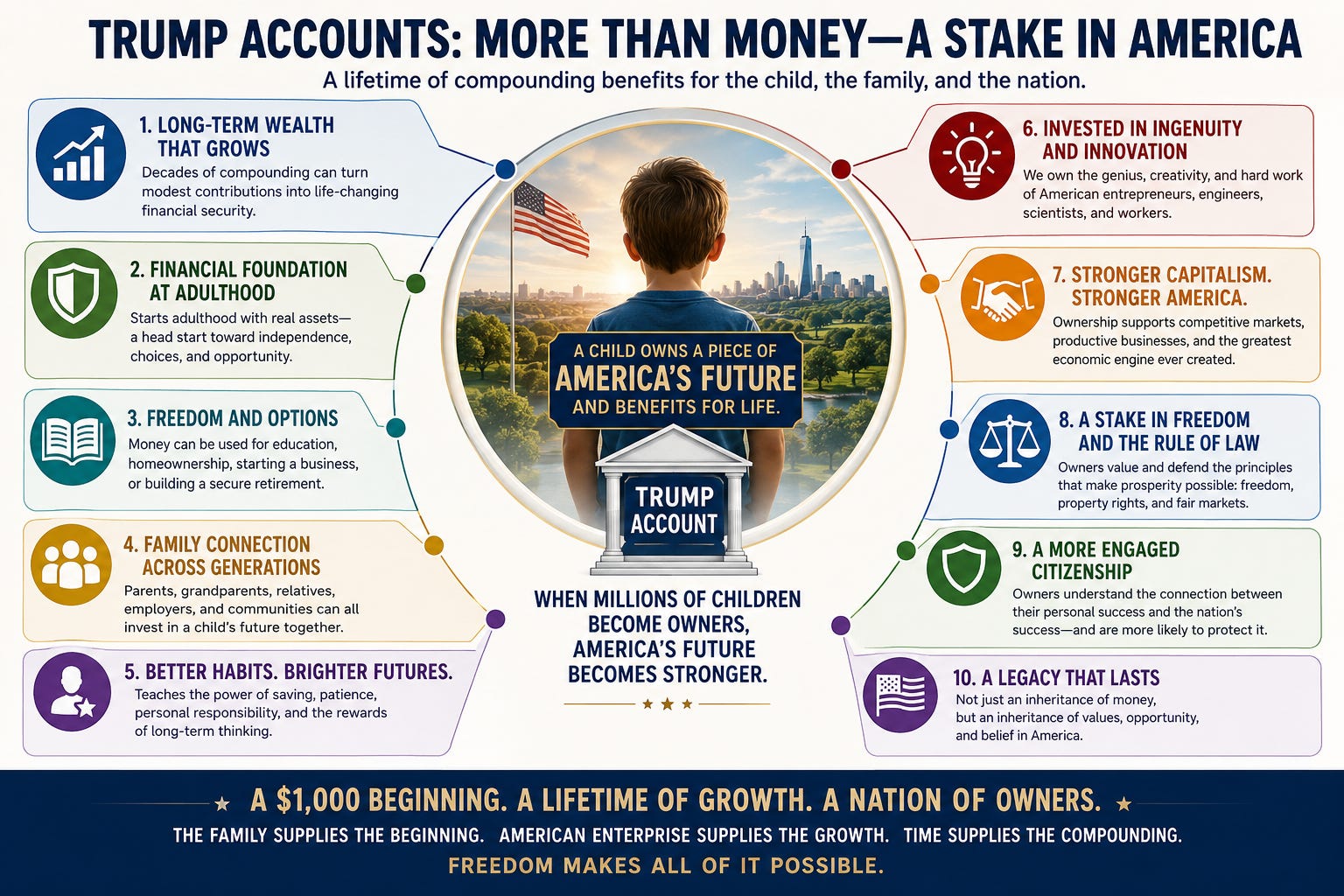
Trump Accounts may begin with $1,000.
But their deeper purpose is larger than the money.
They invite every child into the ownership economy.
They connect personal prosperity to national prosperity.
They teach that wealth is not magic, government generosity, or luck.
It is the accumulated result of imagination, discipline, risk, labor, patience, and freedom.
A generation that owns America will have a reason to understand America.
A generation that benefits from American enterprise will have a reason to defend it.
And a generation that begins life with a stake in the future may be far less willing to surrender that future to people who neither understand nor value the system that created it.
The family supplies the beginning.
American enterprise supplies the growth.
Time supplies the compounding.
Gardiner,
Are you a financial planner? They tend to dislike simple plans that ordinary people can understand and use.
The historical fact is that the American stock market has returned roughly 10.5% annually, including reinvested dividends, since the mid-1920s. I use 8% precisely because it is conservative.
Recent returns have been considerably higher, as you have probably noticed.
A Trump Account works much like an IRA. You do not pay taxes each year on dividends, interest, or capital gains earned inside the account. Taxes are deferred until the money is withdrawn, generally as ordinary income. Simple.
The principle is equally simple: put the money in as early as possible, leave it alone, and let time do the work.
If you are satisfied with 3% or 4%, then by all means stay with bonds. Municipal bonds may even provide tax advantages. They are generally safe—until an issuer runs into trouble and defaults. It happens. I have seen it.
But decades of compounded growth with no annual tax bill on the gains is difficult to beat.
You may have missed the section explaining that Trump Accounts are structured much like IRAs. I tried to make that clear.
Jim
Bonds do not pay me 8%, neither do CDs, and there is no guarantee whatever that buying stocks will pay that. Why not use a realistic figure of3 or 4% and why will the yearly payments of interest or dividends not be taxed? This is all pretty, but smells like the South end of a North facing male cow.