


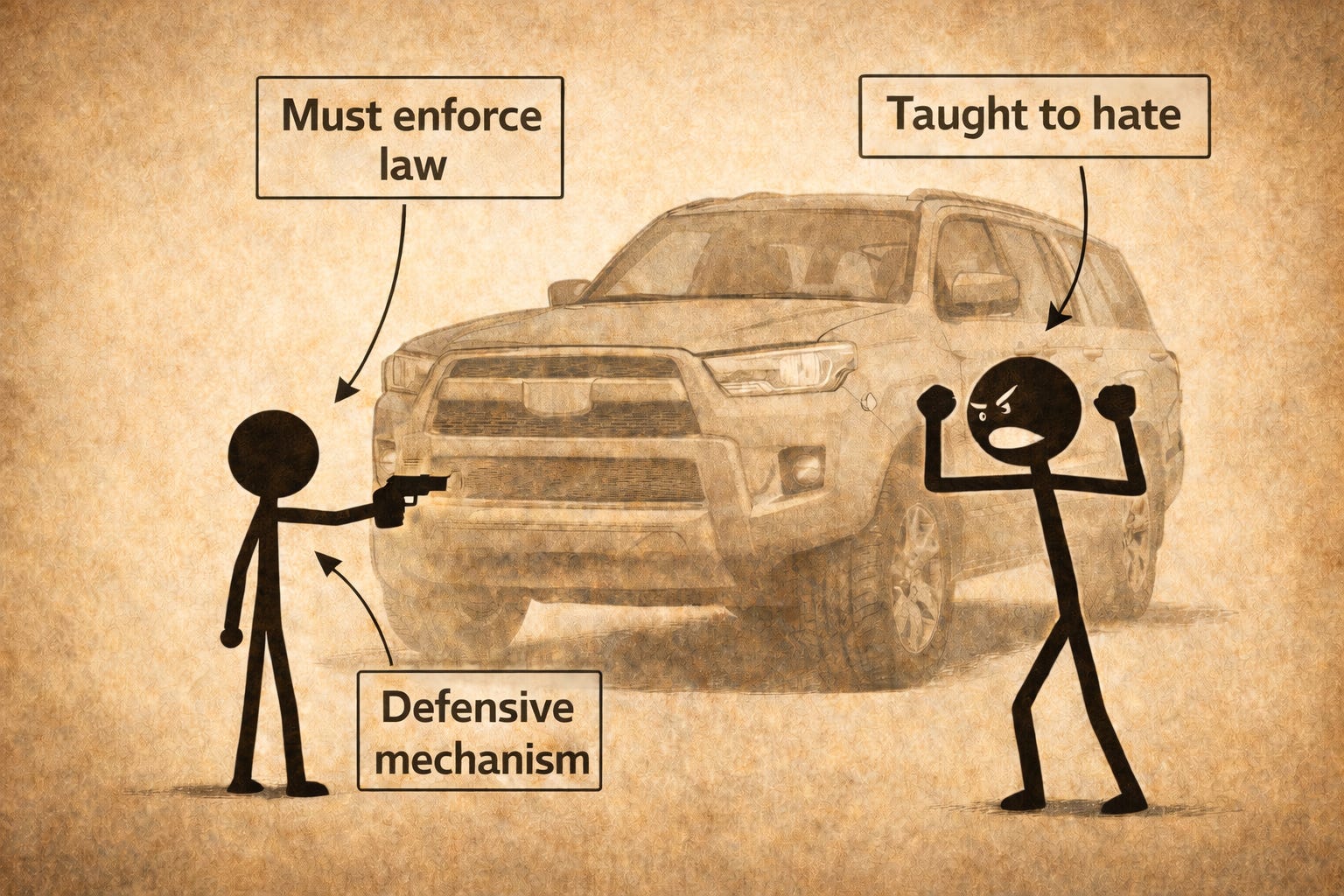
When incompatible directives coexist, outcomes are predetermined.
A federal officer is required to enforce the law.
A civilian is encouraged to obstruct that enforcement.
A vehicle becomes a weapon.
A firearm becomes a necessity.
Nothing here is accidental.
Nothing here is personal.
If none of these elements change, the result is already known.
Something must change—or this will happen again.
“Vehicles don’t care. Guns don’t care. Laws don’t care. Physics doesn’t care. When incompatible directives coexist, the collision happens whether or not someone finds the wording uncomfortable.”
——-
When Rhetoric Meets Reality
A Predictable Collision in Minneapolis
By Jim Reynolds | www.reynolds.com
January 2026
The shooting of a civilian during a federal law-enforcement operation is always a tragedy. It marks the point at which events move faster than judgment and consequences become irreversible. That was the case this week in Minneapolis, where a woman was killed after driving her vehicle into ICE agents who were attempting to detain her during an enforcement action.
The facts of the incident, as reported so far, are relatively straightforward. Federal agents were conducting an immigration enforcement operation. A confrontation occurred. A vehicle was used in a manner agents perceived as an immediate threat. Shots were fired. A life was lost.
None of this should be minimized. But neither should it be mystified.
This was not a random act of violence, nor an unforeseeable outcome. It was the predictable result of a long-running structural conflict between federal enforcement obligations and local political signaling—one that has been building in sanctuary jurisdictions for years.
Federal Law, Local Resistance
Immigration enforcement in the United States exists in an uneasy duality. The federal government retains clear constitutional authority over borders and immigration law. At the same time, many states and cities have chosen to limit or resist cooperation with federal agencies, often branding enforcement itself as illegitimate, immoral, or dangerous.
This tension is not new. What has changed is the tone.
In recent years, public rhetoric surrounding agencies like ICE has shifted from policy disagreement to moral condemnation. Federal agents are no longer merely criticized for how they enforce the law; the enforcement itself is increasingly framed as abusive or unlawful. That framing is amplified through press conferences, social media, and activist networks.
Yet the enforcement does not stop.
Federal agents continue to operate because federal law has not changed. The mandate remains. What changes is the environment in which that mandate is carried out.
How Risk Moves Downhill
When political leaders publicly delegitimize enforcement while lacking the authority to halt it, risk does not disappear—it migrates.
It migrates from policymakers to agents on the ground, from abstract debate to physical confrontation, from institutional conflict to individual encounters. Agents are told they are unwelcome. Protesters are told enforcement is unjust. Neither side controls the other. And civilians—often emotionally charged and sometimes misinformed—are left to navigate that gap in real time.
This is where tragedy becomes more likely.
Encouraging resistance rhetorically while disclaiming responsibility operationally creates a dangerous mismatch between expectation and reality. When federal agents appear anyway, confrontation feels shocking to those who were told it should not be happening at all.
Vehicles become weapons. Split seconds become life-and-death decisions.
A Question That Rarely Gets Asked
Incidents like this raise an obvious question that is almost never examined directly: how are sanctuary city policies even legal?
The answer is less reassuring than either side admits.
States and cities do not possess the authority to override federal immigration law. That authority rests squarely with the federal government under the Constitution. What sanctuary jurisdictions rely on instead is a narrow legal doctrine holding that the federal government cannot compel state or local officials to actively enforce federal statutes themselves. Non-cooperation is permitted; obstruction is not.
This distinction allows local governments to refuse assistance while knowing federal enforcement will continue anyway. It also allows political leaders to publicly denounce enforcement without bearing responsibility for stopping it. The law permits that separation—but only barely.
When non-cooperation slides into interference, when rhetoric encourages resistance while enforcement remains lawful, the system becomes unstable. Federal agents are legally present. Local leaders disown the consequences. Civilians absorb the friction.
The Aftermath Pattern
What follows these incidents is also familiar.
Local officials demand federal withdrawal “for safety.” Statements are issued condemning enforcement presence rather than examining how public rhetoric may have escalated tensions. The death becomes a symbol, quickly folded into a broader political narrative.
What rarely happens is institutional self-examination.
The structure that produced the collision remains intact. Federal enforcement continues. Local denunciations continue. Activism continues. Agents operate under heightened hostility. Each side points outward. The system resets. The risk persists.
The Uncomfortable Truth
This incident was not caused by a single decision or a single actor. It was caused by a system that tells different audiences different things—and then acts surprised when those narratives collide in the street.
As long as federal law is enforced while local leaders publicly delegitimize that enforcement without changing the law itself, similar confrontations are inevitable. They will not always end in death—but sometimes they will.
That is not a moral judgment. It is a structural reality.
If policymakers want fewer tragedies, rhetoric must align with authority, and authority with responsibility. Anything less ensures that the next encounter will again be described as unforeseeable—right up until it isn’t.
That is the issue this incident exposes.
Not motive. Not ideology. Structure.
And structures, once understood, do not argue back.
Addendum: The Path Forward – Leadership That Quells Rather Than Ignites
This incident exposes a structural reality: Federal enforcement continues because the law demands it. Local leaders cannot halt it but can publicly delegitimize it as immoral, chaotic, or terrorizing. This creates incompatible directives—agents operate under mandate in hostile environments, civilians feel emboldened to resist, and risk migrates to the street where physics and split-second decisions produce tragedy.
Yet the structure is not unbreakable. Local leadership holds the key variable: the power to turn down the volume by aligning rhetoric with operational reality, even while maintaining policy disagreement and non-cooperation. Responsible leadership acknowledges that federal agents are lawfully present, urges calm compliance with lawful orders to avoid escalation, and channels outrage into peaceful, constitutional advocacy (courts, elections, community support) rather than confrontation. It reinforces that non-cooperation does not mean obstruction or resistance in the moment. This reduces the “shocking” expectation gap, lowers perceived threats to agents, and makes deadly collisions less inevitable.
In this Minneapolis case, the immediate local response did the exact opposite of de-escalation. It amplified the structural mismatch in real time—hours after a death, with crowds forming and tensions peaking—through expletive demands for federal withdrawal, outright dismissal of accounts as “bullshit,” and framing the operation as reckless chaos that sows distrust, rips families apart, and kills people. This rhetoric signals that enforcement itself is illegitimate and resistance justified, pouring fuel on the fire when restraint was needed most. Personally, I regard this behavior as a failure of leadership. It prioritizes political signaling over public safety, endangering agents who just want to get home alive and civilians caught in the crossfire.
Strong leadership could have quelled much of this: express policy outrage, support affected communities, but emphasize compliance and calm to prevent the migration of risk. It wouldn’t eliminate the underlying tension—federal mandates persist—but it would bend the curve toward fewer tragedies. Until local leaders step up to that responsibility, choosing to quench rather than ignite, the pattern repeats: predictable, preventable, and tragic.
George, thanks for the thoughtful note and your investigator’s eye — details like wheel direction and low speed (~2 mph forward after brief reverse, wheels turning right away from the agent per multiple videos) are indeed key and hotly debated. Federal accounts call it intentional threat/self-defense; other analyses see it as an escape attempt on icy roads. My column focuses on leadership failures that let tensions boil over, but the video evidence deserves full scrutiny in any review. Appreciate the push for precision. In a way, I have seen this same type of incident many times, as we all have: officer orders a person out of the car and the driver does not comply. Then the driver does something unexpected and rash. This often ends very badly for the driver. Poor situational awareness and heightened emotions contribute to the tragedy. I contend that local leadership, including Walz, could do much to lower the heat. The feds are not going to back off.
Pieces like this almost write themselves once the structure is clear. The problem isn’t confusion or miscommunication—it’s leadership that knowingly creates conditions where ordinary people absorb institutional risk. When authority and rhetoric diverge, constituents pay the price.