


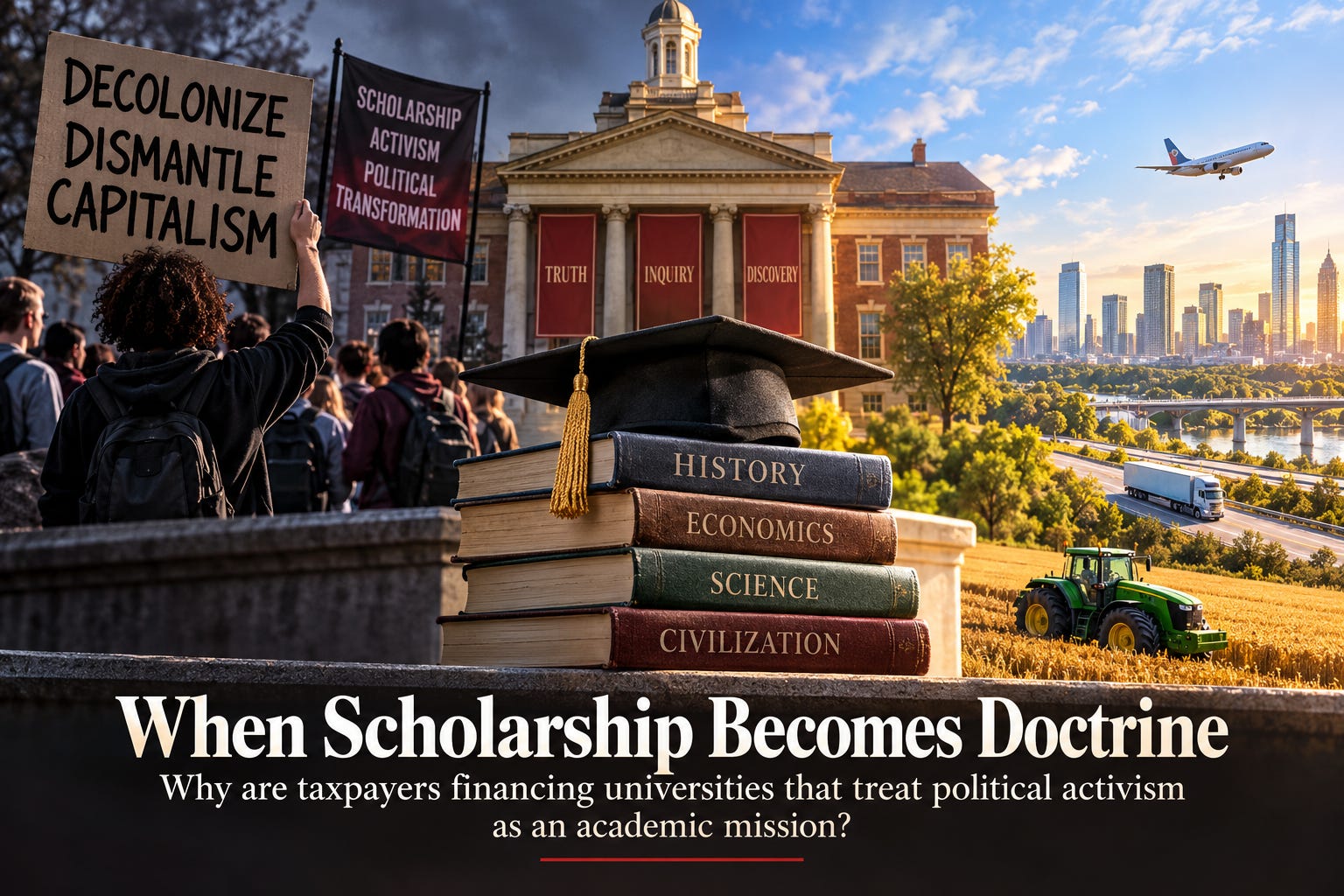
When Scholarship Becomes Doctrine
Why are taxpayers financing universities that treat political activism as an academic mission?
By Jim Reynolds | www.reynolds.com
October 23, 2026
I was looking through a website recently when I came across an organization called Critical Ethnic Studies (CES).
Its mission statement caught my attention. Not because it was particularly clear, but because it was so revealing.
CES describes its work as an “urgent political education project” intended to advance the “insurgent possibilities” of a field centered on critiques of “colonial racial capitalism.”
The organization invokes the revolutionary roots of ethnic studies and describes its mission in terms of political transformation. The related Critical Ethnic Studies Association explicitly connects scholarship, institution-building, and activism.
This is not a radical student club operating out of somebody’s garage. CES publishes an academic journal through the University of Minnesota Press. Its editors and board members have affiliations with established American universities.
I read the mission statement again.
Then a question occurred to me.
Are we allowed to question any of its basic tenets?
When the Answer Comes First
Universities are supposed to be places where ideas are examined, challenged, and sometimes discarded. That is how scholarship advances.
A scientist must be willing to abandon a theory when experiments contradict it. An economist must contend with evidence that undermines his model. A historian must reconsider an interpretation when new evidence emerges.
But what happens when an academic organization defines itself by its commitment to a particular political outcome?
Consider the phrase “colonial racial capitalism.”
Those three words combine colonialism, racial hierarchy, and an economic system into a single intellectual framework. The underlying theory argues that capitalism’s historical development has been inseparable from racial exploitation.
There is evidence of slavery, colonial exploitation, and racial discrimination throughout economic history. Nobody needs to invent these injustices.
But evidence that something happened in the past does not establish that it describes every society operating under capitalism today.
And it certainly doesn’t establish that the economic system itself is incapable of producing beneficial outcomes.
Would CES publish a carefully researched paper reaching favorable conclusions about capitalism? Would it welcome evidence contradicting its foundational assumptions?
I don’t know. What do you think?
Its mission statement doesn’t tell us.
Instead, it describes a political project with revolutionary roots and transformative objectives.
That sounds less like an invitation to investigate a question than a declaration of the answer.
🅱️ Bob: “In most classrooms, you’re supposed to learn the answer. Here, apparently, you’re supposed to arrive knowing it.”
History Hasn’t Stood Still
One feature of this intellectual framework deserves particular attention: its tendency to emphasize historical systems of oppression as explanations for contemporary society.
History matters. But history also changes.
The British Empire no longer governs India, much of Africa, or its former colonies across the globe. The Spanish Empire no longer rules Latin America. The Dutch colonial empire, which once controlled much of what is now Indonesia, has disappeared.
Their histories and consequences remain important. Their former systems of imperial government do not continue unchanged.
The United States offers an even more revealing example.
Slavery was a central institution of the Southern economy before the Civil War. Plantation owners depended on enslaved labor to produce cotton, tobacco, and other agricultural commodities. Northern merchants and industries also profited from commerce connected to slavery.
But slavery was never universally accepted by Americans.
Abolitionists organized against it. Religious movements condemned it. Millions of Northerners opposed its expansion. The Republican Party emerged in the 1850s with opposition to slavery’s expansion as a central principle.
When Southern states seceded to protect slavery, the nation went to war.
The Union’s initial objective was preservation of the country, but emancipation became an explicit war aim. Approximately 200,000 Black soldiers and sailors served the Union cause. Hundreds of thousands of Americans died in a conflict that ended with slavery’s constitutional abolition in 1865.
The country did not immediately become free of racial discrimination. Segregation and other injustices continued, provoking further struggles and reforms.
But consider what that history actually tells us.
America was not a nation whose people unanimously embraced slavery and racial hierarchy. It was a nation divided by these questions, ultimately fighting a devastating war that destroyed slavery as a legal institution.
That struggle is part of American history too.
An interpretation that acknowledges the original injustice but gives insufficient weight to the Americans who fought to correct it is incomplete.
History is not a photograph. It is a record of change.
🅱️ Bob: “Somebody should tell these historians that the British Empire has been out of business for quite a while. Apparently, the news hasn’t reached the faculty lounge.”
That distinction matters when historical arguments are used to justify contemporary political missions.
Let’s Examine Capitalism
CES identifies capitalism as a central object of its criticism. So let’s examine it.
If an economic system deserves condemnation, we ought to consider its historical record: what it has accomplished, how it operates, and what happened when societies adopted alternatives.
Capitalism is an economic system in which individuals and businesses own property, invest capital, produce goods and services, and compete for customers. Prices and profits help direct resources toward activities people value.
Its essential advantage is straightforward: It creates incentives to produce more useful things with fewer resources.
My cousin started a business in his garage that eventually grew into an enterprise worth hundreds of millions of dollars.
Decades ago, he explained his understanding of capitalism to me in one sentence: “If you can create value for your customer, you will be successful.”
He wasn’t offering an economic theory. He was explaining how he built his business.
That principle operates on a much larger scale. Consider American agriculture.
Two centuries ago, much of the population worked to produce food. Today, a small fraction of American workers feeds the country and supports substantial agricultural exports.
The difference is productivity.
Machinery, fertilizers, improved seeds, transportation, and technology allow fewer workers to produce vastly more.
The same transformation occurred in manufacturing, communications, transportation, and medicine. Ordinary Americans now enjoy goods, services, and conveniences that even wealthy people of previous centuries could scarcely have imagined.
Scientific discoveries became useful technologies through investment, engineering, and commercial development. Government-funded research frequently relied on independent organizations and private contractors to deliver results. Public infrastructure was often designed and built by competing private firms. Medical discoveries became widely available treatments through the investments required to develop, manufacture, and distribute them.
Government could finance or commission a project, but financing something and producing it are different activities. The market economy supplied much of the talent, investment, competition, and productive capacity that turned ideas and public expenditures into tangible improvements in everyday life.
Historical estimates compiled by Our World in Data suggest that approximately three-quarters of humanity lived in extreme poverty in 1820. Over the following two centuries, that proportion declined dramatically as economies became more productive.
That improvement was not achieved simply by redistributing existing wealth.
The world became capable of producing wealth that had never previously existed.
The Alternatives
Following World War II, Germany was divided into two countries. West Germany developed a market economy with substantial social protections. East Germany adopted centralized planning and state ownership.
By reunification in 1990, West Germany had achieved substantially higher productivity and living standards.
China offers another instructive example.
Beginning in 1978, its Communist government introduced market-oriented reforms, expanded opportunities for enterprise, encouraged investment, and opened the country to international trade.
According to the World Bank, nearly 800 million Chinese people escaped extreme poverty in the following decades.
China remained a Communist one-party state. Government investment and public policy played important roles. But expanding market activity helped transform its productive capacity.
Even Communist governments have found reasons to introduce market mechanisms when central planning failed to produce satisfactory economic results.
🅱️ Bob: “The Chinese Communists discovered that capitalism worked. They just weren’t about to let anybody vote on it.”
Of course, capitalism is imperfect. Fraud, monopoly, exploitation, and waste exist in market economies.
They also exist in socialist economies, particularly where governments control production and allocate resources.
Under capitalism, an inefficient business ordinarily risks losing customers, investors, and ultimately its ability to operate. Under centrally planned socialism, an inefficient state enterprise may continue operating because political authorities keep financing it.
The important distinction is not that one system produces virtuous people and the other produces villains.
It is how their institutions reward achievement, expose failure, and permit better alternatives to emerge.
That brings us back to universities.
When Failure Has No Consequences
The Hungarian economist János Kornai studied a problem common in centrally planned socialist economies. He called it the soft budget constraint.
When a business continually spends more than it earns, it eventually must improve, restructure, or close.
But state enterprises in centrally planned economies could often depend on government subsidies to remain open regardless of performance.
This weakened incentives to control costs, eliminate waste, and satisfy customers.
Kornai recognized that similar problems could arise outside socialist economies wherever organizations could rely on someone else to cover their losses.
Consider the university.
Academic work cannot be judged entirely by commercial standards. Fundamental research may take decades to yield practical benefits. History, literature, and philosophy have value that cannot be measured in sales.
But universities still consume resources. They employ people, maintain buildings, operate departments, and award credentials.
And they establish systems for determining professional achievement.
What happens when academic advancement depends on producing scholarship that reinforces a department’s founding assumptions?
An institution can publish papers, organize conferences, award degrees, and develop elaborate theories without establishing that its central propositions are correct.
Its members can cite one another, review one another’s work, and reward one another’s intellectual contributions.
The system can become self-reinforcing.
Peer review is supposed to protect scholarship from error. But when reviewers and authors share the same ideological commitments, it can also reinforce an established consensus.
And when institutions are insulated from meaningful external accountability, these practices may continue indefinitely.
This is the intellectual counterpart of Kornai’s economic problem.
What happens when an institution can continually reward its own output without demonstrating that the output has value beyond the institution itself?
🅱️ Bob: “In the real world, if nobody wants your product, you eventually go broke. At the university, you can apparently get tenure and teach other people how to make it.”
From Education to Activism
The modern American ethnic studies movement emerged from the campus upheavals of the late 1960s.
In 1968 and 1969, student activists at San Francisco State organized a prolonged strike demanding greater minority representation and the creation of ethnic studies programs.
The university established the nation’s first College of Ethnic Studies in 1969.
Some of the original concerns were legitimate. Important portions of American history had received inadequate attention, and universities had often overlooked the experiences of minority communities.
But ethnic studies also developed within an atmosphere in which academic reform and political activism were closely connected.
That connection remains explicit.
San Francisco State’s College of Ethnic Studies continues to identify student activism and community engagement among its founding principles.
Critical Ethnic Studies goes further by invoking revolutionary roots, insurgent possibilities, and political transformation.
The related association describes scholarship, institution-building, and activism as interconnected parts of its mission. It presents the university itself as a location for political struggle.
That is a remarkable conception of higher education.
Studying racial discrimination is scholarship. Studying colonialism is scholarship. Investigating the historical relationship between capitalism and slavery is scholarship.
Organizing academic work around an established political mission is something different.
The difference is not whether professors may hold radical views. Of course they may.
It is whether the institution exists to investigate questions or to advance predetermined answers.
And when these activities are conducted within publicly supported universities, taxpayers have a legitimate interest in the distinction.
Who Pays for This?
The question is not who pays to print the Critical Ethnic Studies journal.
The journal merely provides a revealing statement of the intellectual and political commitments of people working within this academic field.
The larger question concerns the universities that employ professors, maintain departments, award degrees, and provide institutional legitimacy to academic programs that explicitly embrace political activism.
Public universities receive substantial taxpayer support. Those institutions decide which departments to finance, which faculty positions to maintain, which programs to expand, and what kinds of academic work to recognize.
These are decisions about public resources.
A department’s existence does not establish its value. Publishing a paper does not prove its conclusions. And impressive academic terminology does not transform political advocacy into intellectual discovery.
Taxpayers support universities because education and research are supposed to contribute something valuable to society.
They are entitled to ask what they are receiving in return.
Universities should expose students to competing explanations of history, economics, and political life. They should teach students to examine evidence, challenge assumptions, and reach defensible conclusions.
When academic programs adopt political transformation as an institutional objective, the question becomes whether they are still providing that education or using the university to pursue political goals.
Academic freedom protects the right to question existing institutions. It does not establish an unlimited public obligation to finance every academic program organized around doing so.
Nor does establishing a department make its continued existence a permanent public responsibility.
If a program’s primary purpose has become political organizing rather than education, closing or reorganizing it is a legitimate question for the officials responsible for allocating public money.
Back to the Beginning
I began with a website describing an academic organization devoted to revolutionary political education and critiques of capitalism.
I wanted to know whether its foundational assumptions could be challenged.
We examined one of them.
Capitalism has serious defects, but its historical record includes enormous improvements in productivity, prosperity, technological innovation, and the reduction of extreme poverty.
We also examined the history of colonialism and slavery—real injustices, but not immutable descriptions of the modern world. Societies have changed, sometimes through extraordinary sacrifice.
Universities should be places where those changes can be studied, where competing interpretations are examined, and where conclusions remain subject to evidence.
Instead, we find academic organizations that openly describe scholarship as an instrument of political transformation, operating within a university system supported substantially by the public.
And we have reason to question whether public resources should sustain programs that substitute political missions for open inquiry.
So I return to my original question:
Why are we using public money to finance institutions whose stated purpose is to tear apart the society that supports them?
This is the brain-washing that we have all wondered about. It has been happening for quite some time. Teach them to think not what to think. Not much of that going on, apparently.
Back to the beginning. Great question. Society cruises along as long as it mainains the status quo. As in, I never gave it a second thought. Society will balance its own checking account in hopes of the economy remains strong. Finacial apathy eliminates the reason to doubt teaching institution sends your student home with a "New Attitude"! At that age you can hope they giive up the group think and choose free will. Heartbreaking for parents as well. At this point we can only hope Our Republic survives this latest barrage of lunacy. Mean while as a parent who coached kids, built a beautiful home while working insane over time can only pray everyday to right this ship! will another form of Noahs Arc arrive? Amen!