


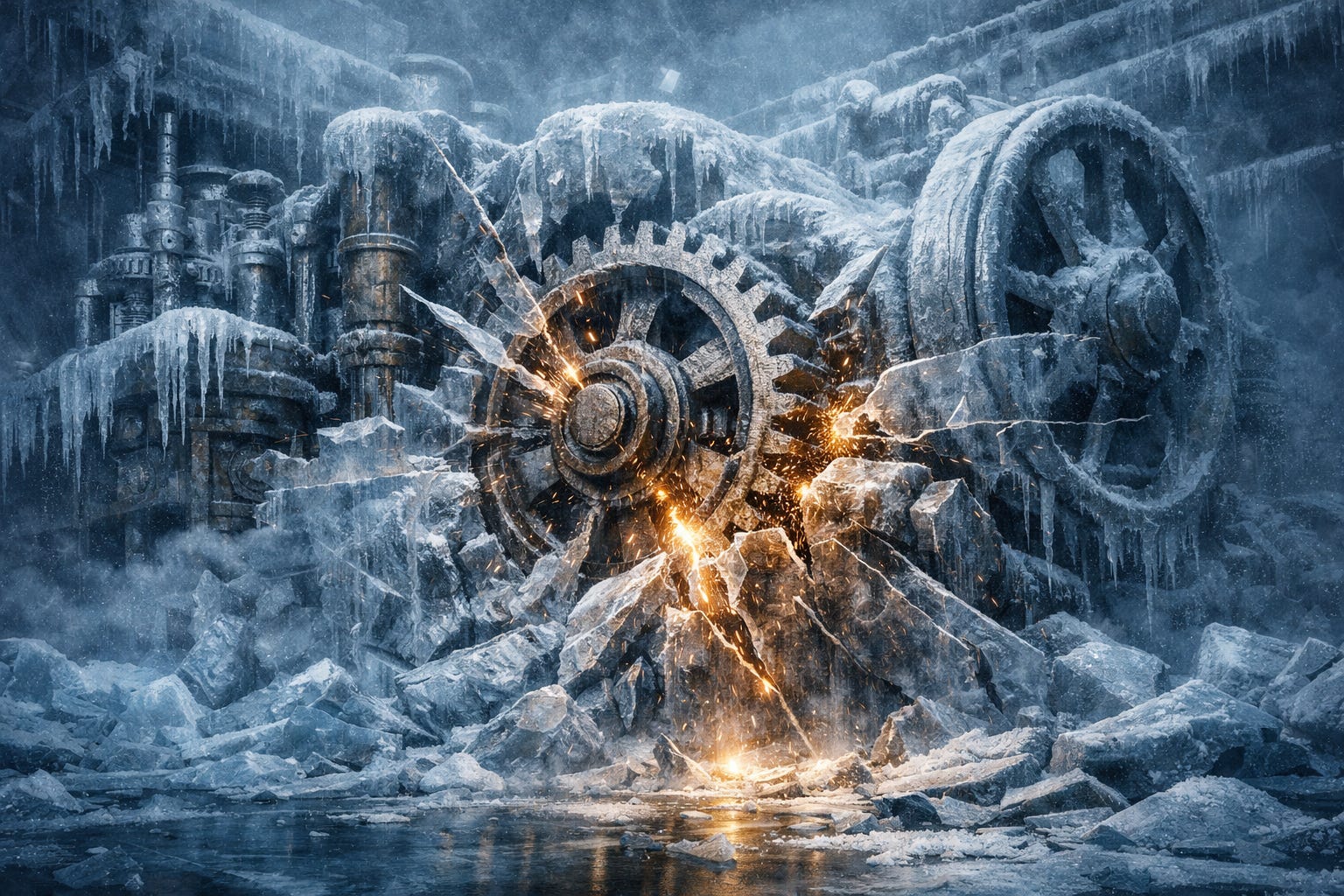
When the Ice Breaks
By Jim Reynolds | www.reynolds.com
Three recent essays at American Thinker—by J.R. Dunn, Mike McDaniel, and Andrea Widburg—approach the current moment from different directions. One looks at geopolitics, one at moral clarity, and one at the strange political divide inside America. Taken together, they suggest something larger may be happening.
Something that has less to do with politics than with momentum.
Because for most of the last half century the Western world has been living through a kind of strategic winter.
The same problems sat in place year after year, decade after decade, like machinery that had stopped moving but was still humming faintly in the background. Iran’s revolutionary theocracy. North Korea’s nuclear theatrics. The slow collapse of Venezuela. Drug cartels hollowing out large parts of North America. China gaining influence in the western hemisphere. Trade systems written in the ruins of 1946 but still shaping global markets seventy years later.
Everyone knew these things were problems.
Nobody expected them to be solved.
Instead they were studied.
Experts produced reports. Diplomats held conferences. International panels issued carefully worded statements that sounded impressive but changed nothing. Entire careers were built around managing conflicts that had quietly become permanent features of the landscape.
The modern governing class developed an odd specialty:
the management of unsolved problems.
The problems endured.
The conferences multiplied.
And the frozen world remained frozen.
Frédéric Bastiat described the deeper cost of this condition almost two centuries ago. He called it “the unseen.”
When resources are wasted or blocked, the real damage is not simply what you can measure. The real damage is everything that never happens.
The inventions never pursued.
The industries never born.
The opportunities quietly abandoned while energy is diverted into maintaining systems that no longer work.
For much of the last fifty years the Western world has been paying that hidden cost. Human effort that might have gone into building new systems was instead spent maintaining old ones.
But something else was happening beneath the surface.
Civilizations contain two very different kinds of institutions.
One group exists to build things.
The other exists to manage them.
Builders create value or they disappear. Markets are ruthless teachers. A business that fails to produce results loses customers, loses capital, and eventually disappears entirely. The system punishes failure quickly and without mercy.
Government systems operate under almost the opposite incentive.
Programs rarely vanish when they fail. Instead they expand. New funding appears. New committees are formed. The problem becomes the justification for the program’s continued existence.
A business that fails to solve problems goes out of business.
A government program that fails to solve problems often receives a larger budget.
Over time that difference produces a predictable shift. The parts of society that must constantly prove their value shrink in influence, while the parts that survive regardless of results expand.
The system fills with people whose job is not to fix problems but to explain them.
Committees replace construction.
Reports replace action.
Whole industries grow around the interpretation of problems that no one is expected to solve.
At that point the machinery of civilization does not collapse.
It freezes.
Frozen systems can last for a surprisingly long time. Problems accumulate slowly. Institutions grow comfortable. Entire generations begin to assume the frozen landscape is simply the natural order of things.
But pressure builds beneath the ice.
And when the ice cracks, the change can look sudden.
Consider space exploration.
In 1972 the United States cancelled the next phase of the Apollo program. The technology worked. The rockets existed. Engineers and scientists stood ready for the next stage of exploration.
But politically the moment had passed.
Space exploration was quietly reclassified as a luxury.
A more cynical observer might ask a different question: which constituency is being served by going to the moon? If the answer is unclear, then perhaps the money would be better spent on programs that create more reliable political support.
Apollo built rockets.
Government prefers programs that build voters.
For the next five decades the American space program drifted through a fog of committee projects and prestige exercises. The International Space Station orbited quietly above the planet while the larger possibilities of space remained suspended.
An entire solar system waited.
Now suddenly the dam has broken.
Private launch companies compete openly. Multiple spacecraft systems are under development. The moon—abandoned for half a century—is once again a destination.
What changed?
Not physics.
Not engineering.
Will.
The same pattern is now appearing across the geopolitical landscape.
Trade structures that stood untouched for seventy years are being dismantled.
Cartels once treated as law enforcement nuisances are being classified as strategic threats.
Iran’s revolutionary regime—long assumed to be an immovable fixture of Middle Eastern politics—is discovering that missile sites and command centers are not permanent assets.
For decades these problems were treated as permanent features of international life.
Now they are being attacked directly.
History occasionally has a sense of humor about such things. The figure pushing many of these changes forward is not a diplomat, not a professor of international relations, and not a committee chairman.
It is a real estate developer from Queens.
But the deeper story is not about personalities.
It is about motion.
Civilizations advance when builders dominate their institutions. Engineers, inventors, entrepreneurs, and problem solvers push systems forward because their work is measured by results.
Civilizations stagnate when managers dominate them. Analysts, regulators, and administrators multiply until explanation replaces action.
For much of the last half century the Western world was governed by the second class.
The result was a long strategic winter.
But winter does not last forever.
One of the most striking features of the current moment is the return of something the West once possessed in abundance.
Clarity.
The recognition that some regimes are hostile.
That some institutions are corrupt.
That some problems must be eliminated rather than managed.
When that clarity returns, the divisions inside a society become visible as well. Some people instinctively side with the survival of their civilization. Others seem reflexively hostile toward it.
That divide did not appear overnight. It grew slowly during decades of cultural drift and institutional stagnation.
But moments of pressure have a way of clarifying things.
Wars clarify.
Crises clarify.
Civilizations under stress rediscover what they actually believe.
Which brings us back to the ice.
For fifty years the Western system operated inside a frozen landscape. Problems accumulated but remained untouched.
Energy built quietly beneath the surface while institutions grew comfortable managing the status quo.
Now the ice is beginning to break.
The geopolitical landscape is shifting.
Technological momentum is accelerating.
The moral fog that obscured many of the West’s debates is thinning.
What comes next is impossible to predict in detail.
But history offers a clue.
When long periods of stagnation finally end, the release of human creativity can be explosive. New industries emerge. New technologies transform daily life. Entire ways of thinking that once seemed settled suddenly look obsolete.
The Renaissance followed centuries of stagnation.
The Industrial Revolution reshaped societies that had changed little for generations.
Moments like these begin quietly.
A few problems get solved.
A few obstacles disappear.
And then, almost without warning, the machinery of civilization begins to move again.
When that happens, the most important question is not what wars were fought or which governments held power.
The most important question is what people do with the freedom that follows.
Because once the ice breaks, history accelerates.
And civilizations that remember how to build rarely stay frozen for long.
⸻
Terry, it is up to us to sustain it.
True. Which is why some of us occasionally try doing something different. I think i get it.