


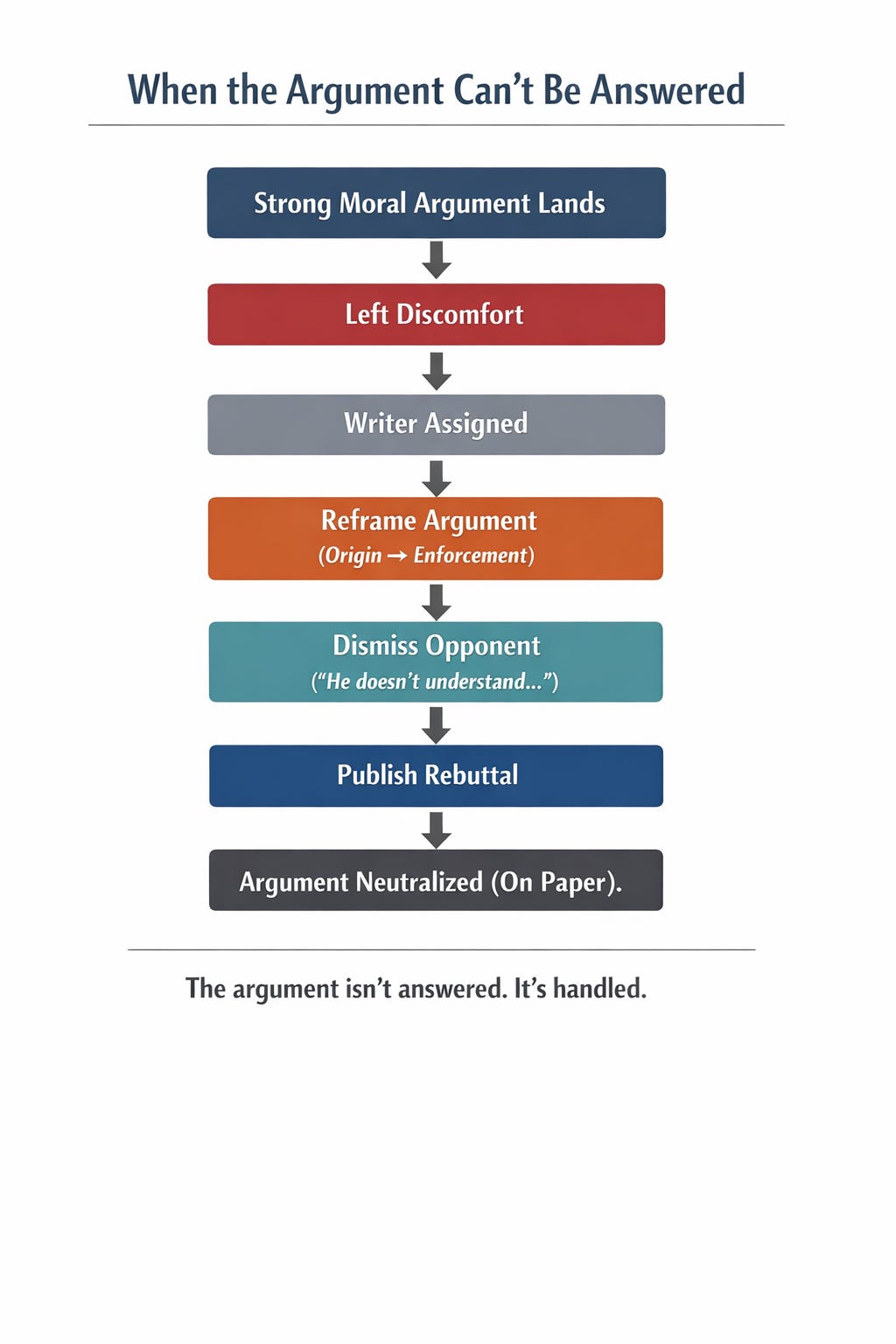
When the Left Dispatches Its Writers
By Jim Reynolds | www.reynolds.com
April 19, 2026
Justice Clarence Thomas gave a speech at the University of Texas at Austin last week that made the left uncomfortable. You could tell because they sent someone to deal with it.
The speech was remarkable not for being surprising, but for being said plainly, on camera, by a sitting Supreme Court Justice. Thomas argued that natural rights precede government, that the Declaration of Independence established this as the republic’s first principle, and that progressivism has spent more than a century trying to undo it. He was direct, personal, and philosophically serious.
When a conservative argument lands like that, someone on the left has to file the rebuttal. Paul Waldman filed his at MSNOW.
You didn’t have to read Waldman’s piece to know its shape.
Waldman is the dependable — and predictable — sort of partisan who packages his politics as exasperated common sense. He comes not to argue but to dismiss. His piece is titled “What Clarence Thomas doesn’t understand about democracy.” The title tells you everything about the method: we will not wrestle with Thomas’s argument; we will be informed that Thomas simply doesn’t understand things.
Waldman’s argument is this: rights come from government. The laws enacted and enforced by government are what guarantee rights, and without government, rights mean nothing. The Framers built a government capable of ensuring rights, and that is what made them real.
This would be a coherent argument if it were responding to something Thomas actually said. It isn’t.
Thomas’s claim was about the origin of rights, not their enforcement. He said, explicitly, that the purpose of government is to secure rights that already exist — rights that are God-given, natural, antecedent to government. He quoted the Declaration directly: “to secure these rights, governments are instituted among men.” He made a point about the order of operations. Rights first. Government second. The Founders held both positions simultaneously — rights originate in nature; government exists to protect them. These are sequential propositions, not competing ones.
Waldman attacks the enforcement mechanism and pretends he has undermined the origin claim. He hasn’t.
He then offers what he considers his strongest example. Government delivered civil rights to Black Americans — federal enforcement, constitutional amendments. These made rights real. Therefore rights come from government.
This is Thomas’s argument in reverse.
Thomas addressed Jim Crow directly. He said the slaveholders used the power of government to deny natural rights. The segregationists (Democrats) used the state to oppress freed men and women, including his own ancestors. The entire machinery of Jim Crow was government — state legislatures, local police, courts, customs enforced by law. If rights derive purely from government, then the laws of Alabama in 1955 were morally equivalent to the Civil Rights Act of 1964. They were both, on Waldman’s theory, just government expressing what rights exist this week.
The civil rights movement was morally powerful for precisely the reason Thomas identified: it appealed to a standard above existing law. King did not argue that Birmingham’s laws should be replaced with different government preferences. He argued that those laws violated something deeper — an inherent dignity that preceded any statute. That is natural rights theory. If rights are purely governmental constructs, you have no principled basis to call any law unjust. You have only a preference for different laws.
Waldman’s final move is the one he seems most pleased with. He asks: if rights come from God, why did God allow thousands of generations to live without political rights?
This is a non-sequitur in a suit jacket.
Natural rights theory does not require God to enforce rights at every moment in history. It claims that rights inhere in persons by virtue of their humanity — whether or not any government recognizes them. A person imprisoned unjustly still has the right to liberty. The violation of a right is not proof that the right was absent. Non-recognition is not non-existence. Waldman has confused a right with a legal privilege and presented the confusion as a philosophical challenge.
I don’t want to be too hard on him. He was doing a job. When a prominent conservative makes a compelling moral case in a visible venue, someone has to explain why it doesn’t count. You can’t let the argument sit there gaining altitude. So a writer gets assigned, the piece gets published, and the rebuttal is on the record.
The problem is that the weakness of the rebuttal reveals the strength of the original.
Waldman couldn’t engage the actual argument because engaging it honestly leads somewhere he doesn’t want to go. So he rewrote it—misstated the claim, attached Jim Crow to the wrong side of the ledger, and substituted a rhetorical question about God for a serious response.
Thomas didn’t need Waldman’s piece to validate his speech. But Waldman’s scramble to discredit it does exactly that.
When an argument can’t be answered, it gets rewritten. That’s what happened here.