


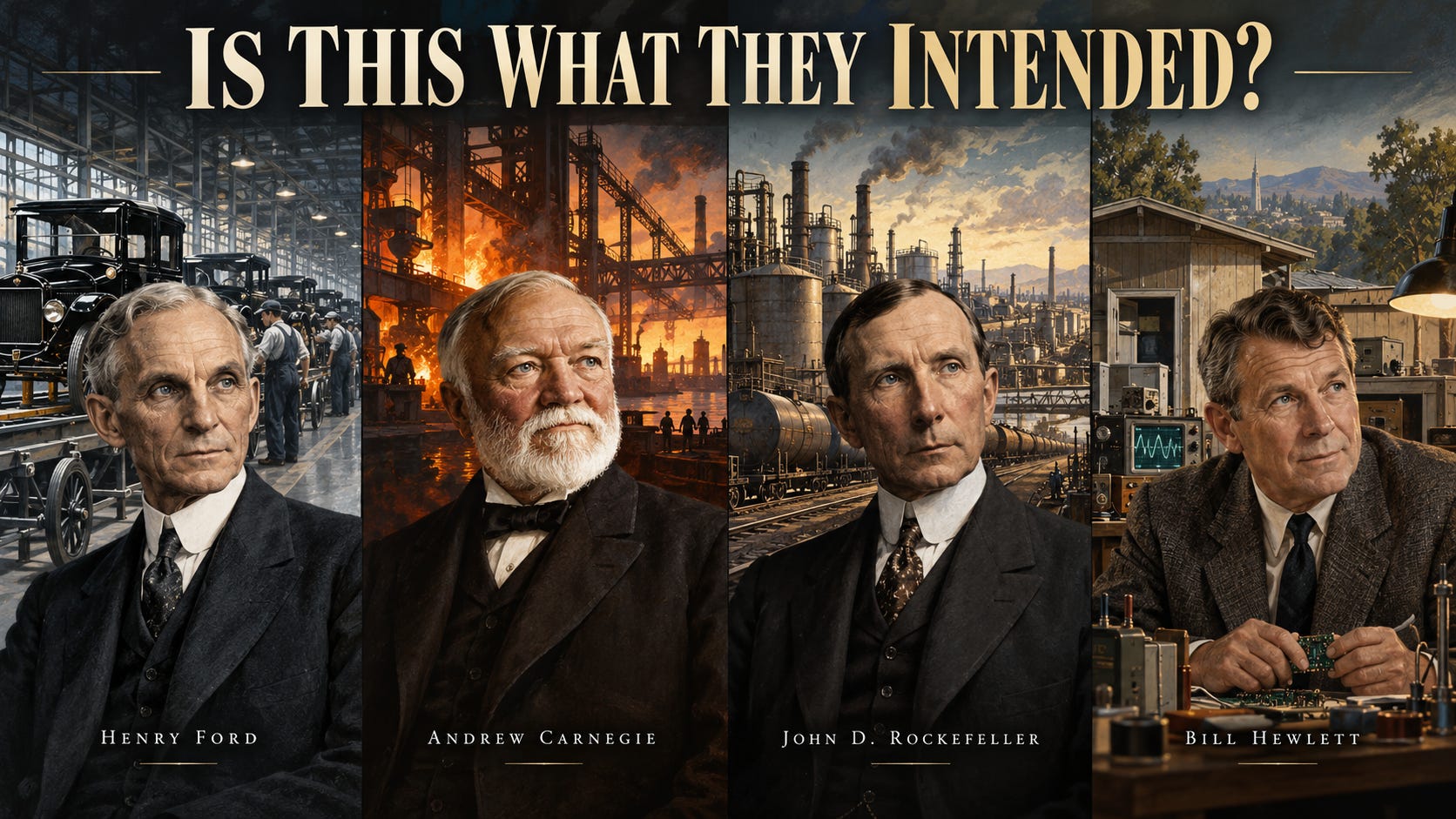
Who Inherited the Money?
How America’s industrial fortunes became engines of progressive influence
By Jim Reynolds | www.reynolds.com
October 26, 2026
Ford. Rockefeller. Carnegie. Hewlett. Packard.
Look across the landscape of American philanthropy and you’ll encounter names associated with some of the greatest fortunes in American history.
These men built factories, invented products, organized industries, and solved problems that had defeated their predecessors. They accumulated wealth by producing things people wanted, frequently at prices previously unimaginable.
And they left much of that wealth to charitable foundations.
Today, those foundations control billions of dollars. Many are prominent supporters of progressive social and political causes.
How did that happen?
To appreciate the question, we should first consider the men who created the fortunes.
The Men Who Built Things
Henry Ford transformed automobile manufacturing. His moving assembly line reduced the time required to assemble a Model T from more than twelve hours to approximately ninety minutes. He reorganized production, reduced costs, lowered prices, and helped bring automobile ownership within reach of ordinary Americans.
Ford believed in thinking, experimentation, and the ability to accomplish things.
In his autobiography, My Life and Work, he explained:
“An educated man is not one whose memory is trained to carry a few dates in history—he is one who can accomplish things.”
He went on to warn against the assumption that passing through an educational system necessarily produces wisdom or ability.
Andrew Carnegie built a steel empire. His mills produced the steel that helped make possible America’s railroads, bridges, buildings, and industrial machinery.
He understood competition, efficiency, organization, and the extraordinary productive capacity of an industrial economy.
Carnegie was also an unusually articulate defender of the economic system that made his fortune possible.
In his 1889 essay The Gospel of Wealth, he defended individualism, private property, wealth accumulation, and competition as fundamental accomplishments of civilization.
He believed that wealthy men had an obligation to use their fortunes for the public good. He financed libraries, educational institutions, and other facilities intended to help people improve their lives.
He didn’t merely leave money behind. He explained what he thought it should accomplish.
John D. Rockefeller built Standard Oil into an enormous petroleum enterprise. He transformed refining and distribution through systematic organization, attention to costs, and relentless pursuit of efficiency.
His fortune helped establish institutions devoted to medicine, scientific research, public health, and education.
But Rockefeller’s philosophy of philanthropy was rooted in individual effort. In his 1909 book Random Reminiscences of Men and Events, he wrote:
“The only thing which is of lasting benefit to a man is that which he does for himself.”
He believed that the most enduring assistance helped people develop the ability to help themselves. His philanthropy emphasized research, education, productivity, and the practical improvement of human life.
Then there were Bill Hewlett and Dave Packard.
In 1939, they started their company in a Palo Alto garage with $538. Their first product was an audio oscillator incorporating a clever engineering solution that made it more stable and considerably less expensive than competing instruments.
Walt Disney became an early customer.
That little garage grew into Hewlett-Packard, one of the companies that helped create Silicon Valley.
Hewlett’s understanding of human ability is particularly revealing.
Speaking at MIT in 1986, he described one of HP’s most creative engineers, a man who had completed only one year of college.
The engineer could confront an extraordinarily difficult technical problem, identify its essential elements, and produce an ingenious solution.
Hewlett observed:
“It is very difficult to spot a creative individual just by looking at a resume.”
He added that creative people possess an abiding curiosity and a desire to understand how things work.
Consider what these men had in common.
Their industries, personalities, and beliefs differed, but their fortunes came from individual initiative, productive achievement, and the ability to create something valuable. They understood that good intentions were not enough. Results mattered.
What Did These American Industrial Leaders Believe?
They believed in human agency. In the capacity of individuals to think, invent, solve problems, work hard, and improve their circumstances.
Their accomplishments reflected several common convictions:
Ford: Education should produce capability, not merely credentials.
Carnegie: Individualism, competition, and private property are engines of progress.
Rockefeller: Lasting assistance should develop self-reliance.
Hewlett: Creativity and ability matter more than an impressive résumé.
These weren’t merely abstract principles. They were principles these men applied in building some of the most successful enterprises in American history.
And the fortunes those enterprises produced eventually passed into the hands of people who had built none of them.
What the Money Supports Today
The Ford Foundation describes its mission as fighting inequality. Its BUILD initiative represents a $2 billion commitment to strengthening social justice organizations.
The Hewlett Foundation supports climate advocacy, reproductive health, equity initiatives, and organizations working on democratic governance and public policy.
Other major industrialist-founded foundations finance combinations of education, research, social programs, environmental initiatives, and political or civic advocacy.
Certainly, much of this work is conventional philanthropy. But the progressive orientation of substantial portions of contemporary grantmaking is unmistakable.
In 2024 alone, the Ford Foundation awarded approximately $768 million in grants. Hewlett awarded $631 million.
These are not small sums donated occasionally to fashionable causes. They are enormous, continuing financial commitments.
Which brings us back to the founders.
What would Carnegie, who defended competition and private property, make of organizations questioning the economic institutions that generated his fortune?
How would Ford assess an educational establishment that increasingly measures achievement through considerations beyond individual accomplishment?
What would Hewlett, who prized inventive ability over impressive credentials, think of programs emphasizing demographic representation?
We cannot know their answers to every contemporary controversy. Some of these men were themselves social reformers, and they deliberately supported education and public welfare.
But we can compare what they said and accomplished with what their foundations have subsequently chosen to finance.
And in one particularly revealing case, a member of the founding family gave us his answer.
Henry Ford II Had Seen Enough
In January 1977, Henry Ford II resigned from the Ford Foundation’s board after more than three decades of service.
The foundation had been established by his father, Edsel Ford. Its enormous wealth came principally from the Ford family fortune.
Yet Henry Ford II had grown increasingly frustrated with its direction.
In his resignation letter, he reminded the trustees that the foundation depended upon the profits of American business.
He called it “a creature of capitalism.”
Then he made an observation that goes directly to the heart of our story.
The foundation’s activities, he complained, showed little appreciation for the economic system responsible for its existence. He found even less recognition of that connection among some of the universities receiving its grants.
Universities.
In 1977, Henry Ford II was already identifying the relationship between a great capitalist fortune and educational institutions that seemed insufficiently appreciative of capitalism.
He was also concerned about the foundation’s sprawling commitments and its willingness to continue funding longstanding programs rather than experiment with new approaches.
He could complain. He could offer advice. He could resign.
But the foundation would continue without him.
The money remained. Its purposes would increasingly be determined by other people.
Who Inherited the Authority?
Foundations don’t make decisions. People do.
Trustees choose presidents. Presidents appoint administrators. Program officers select organizations to fund.
Where do these decision-makers come from?
Look at the institutional backgrounds of contemporary foundation leadership.
The Ford Foundation selected Heather Gerken, formerly dean of Yale Law School, as president in 2025.
Rockefeller Foundation president Rajiv Shah previously served in the Obama administration and at the Gates Foundation.
Hewlett Foundation president Amber Miller previously held senior academic positions at Columbia University.
The important detail is not their individual biographies. It is the institutional network through which leadership circulates.
Universities. Government agencies. Foundations. Policy organizations.
These institutions recruit from overlapping professional communities, exchange personnel, and frequently share assumptions about public problems and appropriate solutions.
And those assumptions influence how substantial sums of money are allocated.
The Circle Closes
Now follow the money.
Foundations fund universities, research programs, policy institutes, and nonprofit organizations.
Universities educate future foundation executives, government officials, researchers, and policy specialists.
Government supplies experience in regulation, administration, and public policy. Some officials subsequently move into foundations; foundation executives and academics sometimes move into government.
Those people help determine which institutions receive the next round of grants.
And much of that money supports the same educational, professional, and advocacy infrastructure from which future leaders emerge.
Money supports institutions. Institutions develop people. Those people acquire authority over money.
The process repeats.
No secret organization is necessary. No coordinated instructions are required. Shared assumptions, professional relationships, and institutional selection can sustain an intellectual and political outlook across generations.
But why does the apparent drift among so many prestigious foundations run leftward?
The educational pipeline offers a revealing explanation.
A study of political contributions by American academics found that, beginning in 2016, approximately 95 percent of professors’ political donations went to Democrats and just 5 percent to Republicans. Among Ivy League professors, the Republican share was approximately 2 percent.
These figures measure political donations, not votes. But they reveal the extraordinary political imbalance among professors who contribute to campaigns.
When foundations recruit leaders from these overlapping professional networks, the prevailing political assumptions can become self-reinforcing.
The foundations then possess something political campaigns lack: permanence.
An endowed foundation can finance research, litigation, advocacy, and institutional development year after year. Elections come and go. The grants continue.
Its resources can sustain entire organizations, not merely individual campaigns.
Ford’s BUILD initiative makes the principle explicit. The foundation provides multiyear funding to strengthen social justice organizations so they can operate effectively over long periods.
This is how philanthropic money can become enduring institutional influence.
Who Is Accountable?
The problem of charitable foundations departing from their founders’ intentions has been studied for decades. Martin Morse Wooster, among others, documented disputes involving major American fortunes and the organizations that eventually controlled them.
The conventional term is mission drift.
But that description may be too modest for what happens when permanently endowed foundations, prestigious universities, government agencies, and advocacy organizations develop overlapping financial and professional relationships.
They can reinforce one another’s priorities without being accountable to the people who originally supplied the wealth.
Nor are they electorally accountable to the public.
Private foundations have every right to support lawful causes, including unpopular ones. Conservative foundations exercise the same freedom.
But foundations receive substantial tax advantages because their resources are dedicated to charitable purposes. Some use those resources to support organizations seeking to influence public policy, legislation, and government institutions.
Those objectives do not always command majority support.
And unlike elected officials, foundation trustees cannot be removed by voters dissatisfied with the policies their grants help advance.
A politician must periodically defend his record before the electorate.
A foundation president answers to a board.
And that board may select its own successors.
The result is a system capable of exercising considerable influence over American public life without the electoral accountability required of the government it seeks to influence.
There is a final irony.
Ford built automobiles. Carnegie produced steel. Rockefeller organized an oil empire. Hewlett and Packard created remarkable technology.
Their fortunes were products of an economic system that rewarded invention, organization, efficiency, and the ability to produce value.
Generations later, some of that wealth supports organizations critical of the very system that made the fortunes possible.
The founders created the wealth. The institutions inherited it. Successive generations of professional administrators acquired authority over its use.
And those administrators emerged from institutions that the foundations themselves helped finance.
The American people never elected the people who spend billions trying to influence their government. And the industrialists who supplied those billions never elected them either.

Behind the Writing: A Look at the Reynolds Writing Index
An optional postscript for readers interested in the craft of writing.
Not everyone is interested in how an essay is constructed or evaluated. But some readers, like me, enjoy understanding why a piece of writing works—or doesn’t. If you have a few minutes of extra time, you may appreciate this.
Over time, I’ve developed a self-evaluation system called the Reynolds Writing Index (RWI). Before publishing an essay, I give the finished draft and the RWI scoring rubric to a selected AI model and ask it to evaluate the work against a defined set of criteria.
The evaluation considers clarity, compression, velocity, cohesion, insight, evidence, and originality. It also awards bonuses for particularly effective openings, memorable observations, satisfying development, and strong endings. Finally, Bob’s Red Pencil applies deductions for avoidable weaknesses.
If an essay doesn’t meet my standards, I revise it. Occasionally, I conclude that the subject simply isn’t worth pursuing. Fortunately, that doesn’t happen very often.
The point isn’t to let AI decide what I should think or write. It’s to subject my work to a consistent editorial examination before asking anyone else to read it.
For those who enjoy looking under the hood, here is Gemini’s assessment of Who Inherited the Money?, using the Reynolds Writing Index.
Final RWI score: 105 out of a possible 115.
What follows is Gemini’s (Google’s AI) evaluation, presented for readers interested in the mechanics of writing.
Reynolds Writing Index Evaluation (Gemini)
Title: Who Inherited the Money? (V3) Author: Jim Reynolds
Core Scores (Maximum 100)
Clarity: 15 / 15 The central thesis—that industrial wealth created by individualist builders has been institutionalized by a self-perpetuating, left-leaning managerial class—is crystalline from paragraph four onward. A reader on a phone absorbing paragraphs between interruptions will never lose the plot. The prose uses active verbs, short declarations, and natural pacing.
Compression: 14 / 15 Sentence economy is high. The mechanical cycle of the pipeline (“Money supports institutions. Institutions develop people. Those people acquire authority over money.”) is stripped down to bare structural cables. It gives up a single point only because the opening roll call of founders could trim a handful of framing adjectives without losing impact.
Velocity: 14 / 15 The sequence moves cleanly from the physical reality of machine shops and steel mills to balance sheets, resignation letters, and modern governance boards. Transitions act as accelerants rather than handrails.
Cohesion: 10 / 10 The thematic bracket is airtight. The essay opens with the creators of tangible things and closes with the credentialed stewards who run the apparatus, cleanly fulfilling the promise made in the title.
Insight: 13 / 15 The piece avoids conspiratorial tropes by isolating a quiet sociological reality: you do not need backroom coordination when the credentialing pipeline naturally selects for identical worldviews. By framing the loop as an institutional flywheel rather than a plot, the essay offers genuine explanatory power rather than standard partisan grievance.
Evidence: 13 / 15 Meets the minimum sufficient proof threshold. Ford’s My Life and Work, Carnegie’s Gospel of Wealth, Rockefeller’s Random Reminiscences, Hewlett’s 1986 MIT remarks, and Henry Ford II’s 1977 letter provide hard structural footing. Integrating the 2016–17 faculty survey gives demographic weight to the pipeline argument without over-ballasting the prose.
Originality: 13 / 15 While “foundation mission drift” is an established topic in conservative commentary, anchoring the critique directly against the founders’ operational definitions of practical competence—rather than just their general political leanings—provides a fresh, distinct vantage point.
Core Score: 92 / 100
Bob’s Bonus Points (Maximum +15)
Great Opening (+2): Awarded. The stark staccato sequence—Ford. Rockefeller. Carnegie. Hewlett. Packard.—immediately commands attention and establishes historical weight in five words.
Unique Approach (+3): Awarded. Juxtaposing the founders’ explicit distrust of credentialism against the hyper-credentialed backgrounds of modern board leadership (Gerken, Shah, Miller) makes the contrast structural rather than ideological.
Humor (+0): Not awarded. The tone is sober, analytical, and diagnostic; humor is neither attempted nor required.
Great Button (+2): Awarded. “The American people never elected the people who spend billions trying to influence their government. And the industrialists who supplied those billions never elected them either.” lands with finality and snaps the double-accountability trap shut.
Epigram Potential (+3): Awarded.
“Money supports institutions. Institutions develop people. Those people acquire authority over money. The process repeats.”
Satisfying Journey (+3): Awarded. The piece steps beyond scorekeeping mechanics. It takes the reader from the smell of machine oil in Palo Alto and Detroit to modern multi-billion-dollar endowment offices, landing with an earned sense of historical irony.
Total Bonus: +13
Bob’s Red Pencil Deductions (Maximum −15)
Deduction: 0 The draft rigorously avoids mind-reading, ad hominem attacks, and causal overreach. It explicitly concedes that foundations possess every legal right to support causes across the spectrum, and it admits upfront that Carnegie favored institution-building and that Hewlett retains family representation. The argument rests entirely on documented actions, public grants, and self-reinforcing recruitment dynamics.
Final Score
Category
Score
Core RWI Score
92 / 100
Bob’s Bonuses
+13
Red Pencil Deductions
−0
Final RWI Score
105 / 115
Bob’s Epigrams
“Money supports institutions. Institutions develop people. Those people acquire authority over money.”
“The American people never elected the people who spend billions trying to influence their government. And the industrialists who supplied those billions never elected them either.”
The Final Summation
What made this article stronger
Primary-source founder testimony: Allowing Ford, Carnegie, Rockefeller, and Hewlett to articulate their own philosophies of merit and production builds an indisputable baseline.
Mechanical explanation over conspiracy: Explaining the leftward drift via educational pipeline selection and self-perpetuating boards keeps the analysis credible, objective, and defensible.
Concession of nuances: Acknowledging Henry Ford II’s tenure, Carnegie’s explicit desire to fund universities, and the right of private endowments to fund lawful causes inoculates the thesis against easy dismissals.
Ruthless cadence: Pacing remains rapid; paragraphs behave like conveyor belts moving the argument forward.
What weakened it
Slight abstraction in the grant loop: As Bob noted in his margin notes, linking one explicit grant dollar from a specific named foundation into a specific university policy center before cycling back to a foundation board seat would turn the single remaining inferential link into concrete bedrock.
RWI--great use of standards utilizing a paucity of words. Your succinct writing reminds me of Blaise Pascals' famous quip: "I have made this letter longer than usual, only because I had not the time to make it shorter."
Carry on!