


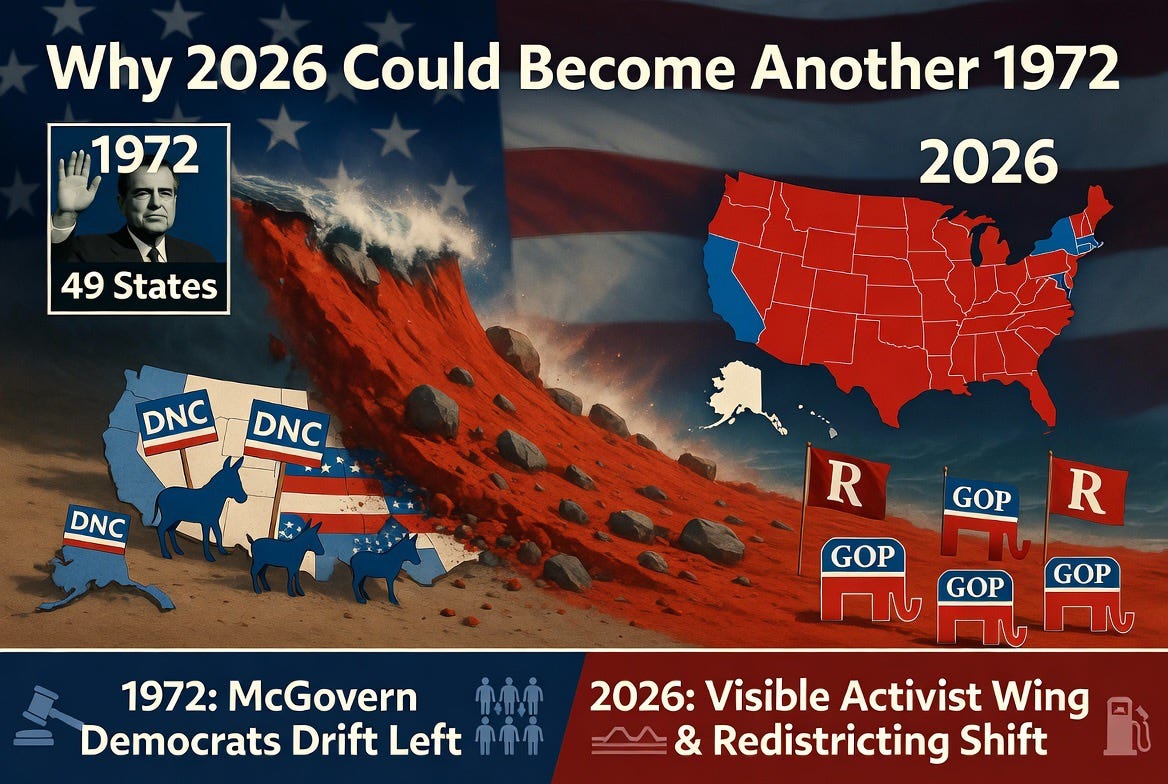
[The pieces are aligned—and visible. A 1972-style realignment in 2026?]
Why 2026 Could Become Another 1972
By Jim Reynolds | www.reynolds.com
May 4, 2026
Author’s Note
In 1972, Richard Nixon delivered one of the most decisive landslides in American presidential history. He won 49 out of 50 states (Massachusetts was the lone holdout for George McGovern) and carried the District of Columbia. In the Electoral College, Nixon took 520 votes to McGovern’s 17—more than 96% of the total. In the popular vote, Nixon captured 60.7% (roughly 47.2 million votes) to McGovern’s 37.5% (29.2 million), a margin of nearly 18 million votes—the largest absolute popular-vote margin in U.S. history.
The outcome was not a surprise. Pollsters and the press had seen it coming for months. What stunned observers was the scale: how completely the visible drift of the Democratic Party had alienated the broad center of the country.
Landslides don’t happen by accident. They happen when perception breaks faster than leadership can repair it.
This essay argues that a similar dynamic—not an exact repeat, but a clear historical rhyme—is reemerging in 2026. The conditions are different. The information environment is radically different. But the central problem is the same: one party increasingly seen as out of step with the instincts and priorities of ordinary Americans, with no effective leadership to rein it in.
What follows is the case for why 2026 could become another 1972.
———
The Democrats are walking into a wipeout.
Not because every variable lines up perfectly—but because the central condition that produced 1972 is back: one party is visibly out of step with the instincts of ordinary Americans, and it no longer has the leadership or narrative control to hide it.
That is the thesis.
Everything else is evidence.
In 1972, George McGovern became the face of a Democratic Party that many Americans believed had drifted too far—culturally, politically, and temperamentally. The party looked radical, disorganized, and disconnected from normal life. Nixon didn’t need universal support. He just needed to look more grounded than the alternative.
That dynamic is reappearing.
Not in reverse. Not as a mirror image. As a rhyme.
The key difference is exposure.
In 1972, the average voter saw the Left through a narrow media funnel: three networks, a handful of newspapers, and a press corps that leaned left and knew it. There was no Rush Limbaugh. No talk radio counterweight. No Fox. No X. No Substack. No distributed ecosystem putting receipts in front of voters by dinner.
Today, that shield is gone.
The legacy press still leans left, but it no longer controls the frame. Its influence is diminished. Its credibility is contested. It cannot suppress what millions of people can now see for themselves.
And what they are seeing is the machinery.
They can see the fake protests.
They can see the professional activist class.
They can see the funding streams.
They can see the same signs, same slogans, same chants, same organizational fingerprints.
They can see “grassroots democracy” being assembled like IKEA furniture by people with foundation money and ideological agendas.
And increasingly, they are not buying it.
Because once you see the script, you can’t unsee the performance.
That is where this turns dangerous for Democrats.
Not because most Democrats are communists. They aren’t. That’s precisely the point. The median Democratic voter is not looking to abolish capitalism, dissolve borders, or chant slogans imported from faculty lounges.
But the activist wing keeps dragging the brand there anyway.
That creates a rupture—between the party’s voters and its most visible voices.
The Democrats’ problem is not that radicals exist. Radicals always exist. The problem is that the party no longer has the leadership strength to tell them no.
Not Hakeem Jeffries.
Not Chuck Schumer.
Certainly not the headline chasers and backbench performers who generate noise but not authority.
That is the leadership gap.
A political party can survive having extremists at the edge. It cannot survive letting the edge become the face.
And right now, the edge is very visible.
There is no unifying national cause pulling young voters into a single movement. What exists instead is a scattered carnival of grievances—anti-ICE, anti-police, anti-border, anti-capital, anti-normal.
That may energize activists.
It does not build a majority.
It builds a spectacle.
The middle of America does not want revolution.
It wants groceries.
It wants gas prices that make sense.
It wants safe streets.
It wants schools that work.
It wants a border that means something.
It wants leaders who don’t seem embarrassed by their own country.
That is why the protest-industrial complex matters.
Not because it exists—but because it is now visible.
The more visible it becomes, the more ordinary voters see not compassion, but contempt. Not justice, but theater. Not democracy, but coercion with better fonts.
Bob: Turns out “Workers Over Billionaires” hits different when billionaires paid for the banners.
Now add the structural pressures.
First, media.
Unlike 1972, there is now a full counter-ecosystem capable of amplifying, documenting, and challenging the dominant narrative in real time. The Left still has major platforms, including strong reach among younger audiences, but it no longer has the ability to filter what the public sees.
Back then, the story was curated.
Now the story leaks.
And leaks beat narratives.
Second, the map.
Florida has already added four reliable Republican seats. That’s baked in. But the bigger shift just landed.
In Louisiana v. Callais (April 29, 2026), the Supreme Court ruled 6–3 that Louisiana’s map—drawn to create a second majority-Black district—was an unconstitutional racial gerrymander. More importantly, the Court sharply narrowed how Section 2 of the Voting Rights Act can be used in redistricting.
That is not a technical adjustment. It is a structural change.
For decades, the Gingles framework allowed plaintiffs to challenge maps by showing minority vote dilution. Now, the bar is much higher. Plaintiffs must not only satisfy traditional districting principles, but also account for political factors like incumbency—and prove that voting patterns cannot be explained by partisanship rather than race.
In plain terms:
states now have far more room to draw maps that favor their party—and defend them as partisan rather than racial.
The immediate effect is already visible.
Louisiana likely reverts to one majority-Black district instead of two.
And across the South—Alabama, Georgia, South Carolina, Tennessee, Florida, Texas—legislatures are preparing or already moving to redraw maps under the new rules.
The implications are not theoretical.
Analysts estimate that 5 to 12 Democratic-leaning House seats—many currently held by Black Democrats—could flip or become significantly more vulnerable. Dozens more at the state and local level could follow.
This builds directly on earlier decisions like Shelby County. The trend line is clear: fewer constraints on mapmaking, fewer guaranteed districts, and more exposure for Democratic incumbents.
This is not a campaign issue.
This is the board changing under the pieces--mid-game.
Third, election mechanics.
Mail-in voting is being tightened in several jurisdictions. That doesn’t guarantee outcomes, but it reduces the ability to offset enthusiasm gaps with process advantages.
Fourth, energy and economics.
Trump’s Hormuz move is not just geopolitical—it’s economic. By reopening shipping lanes under a humanitarian frame backed by hard power, he is setting conditions for increased supply from friendly Middle East producers.
In the meantime, tankers from around the world aim toward the Gulf of America.
If that translates into lower oil prices, the political effect is immediate. Gas is not abstract. It is a daily referendum.
Fifth, accountability.
If cases against key figures begin to produce real filings—names, charges, timelines—that changes the national conversation. Suspicion becomes documentation. That matters.
Now—discipline.
Not all of this is guaranteed.
What is known:
The Democratic brand is drifting left of the median voter.
The activist wing is increasingly visible.
The party lacks a strong, disciplining national leader.
The legacy media no longer controls narrative flow.
The protest apparatus is organized, funded, and increasingly obvious.
What may become decisive:
Redistricting outcomes.
Election-law changes.
Oil prices.
Foreign policy stability.
Legal proceedings.
Visible activist overreach.
Internal Democratic course correction—or failure to do so.
And yes—this can go off the rails.
Republicans could overreach.
The economy could stumble.
Energy prices could stay high.
Foreign policy could turn messy.
Legal cases could fizzle.
Democrats could pivot to the center.
Weak Republican candidates could lose winnable races.
That is the counter-case.
But absent those corrections, the trajectory is clear.
This is not about policy detail.
It is about posture.
Policies can be adjusted.
Posture is identity.
And right now, the Democratic posture—fairly or not—reads as ideological, performative, and detached from normal life.
That is the 1972 echo.
McGovern didn’t lose because every Democrat was radical. He lost because enough voters believed the party had been captured by people who didn’t like the country as it was.
That perception is returning.
Only now, it travels faster.
In 1972, the press could blur the edges.
In 2026, the edges have their own livestream.
They think they are shaping the narrative.
They are actually revealing it.
That is why this could become a landslide.
Not because it’s guaranteed.
Because the pieces are aligned—and visible.
Bob: “The first rule of revolution is don’t let normal people see the planning committee.”
Hey. Don’t go too hard on the coastal people. I’m at our Orange County house now. Remember that California has more republicans than any other state. We just don’t count. If you get captured by a tribe then you will find that tribal logic trumps normal logic every time. It is a survival trait. Or at least, it once was. Nobody wants to be left outside the gates when the tigers show up.
Remember, hope is not a strategy. I certainly hope you are correct. I read and listen to
Fox News and Breitbart. I am too annoyed to listen to the other "news"sources. So what I read and hear is political biased. Yes Mabel, even the right wing press delivers biased news. I like to think that it doesn't take a Harvard degree to be discriminatory when listening to the news. And mostly I believe this is a legitimate pattern...being aware of absurdities and recognizing legitimate accomplishments. Unfortunately I see things like Mandami and Newsom and Walz getting elected and re-elected. Maybe it's living close to water that addles the brains of voters.