



Why Persuasion No Longer Persuades
By Jim Reynolds | www.reynolds.com
June 14, 2026
People often say, “You can’t talk to these people anymore.”
The strange thing is that everyone says it.
Conservatives say it about liberals. Liberals say it about conservatives. Religious people say it about atheists. Atheists say it about religious people. Parents say it about children. Children say it about parents.
Everyone feels as though they are speaking, and nobody is listening.
What happened?
The easy answer is that people became stupid.
The harder answer is that persuasion itself may require conditions that no longer exist.
To understand why, we have to begin with a word that everyone uses and few people understand: rhetoric.
Today, rhetoric is usually treated as a criticism.
“That’s just rhetoric.”
What people generally mean is:
“Those are words I don’t trust.”
But rhetoric originally meant something far larger. It was the art of persuasion. More fundamentally, it was the process by which one mind attempted to align another mind.
Not dominate it.
Not conquer it.
Align it.
That distinction matters.
Bob explained it this way:
🅱️ “Persuasion isn’t pushing. It’s inviting.”
That is why rhetoric is everywhere.
A teacher uses rhetoric. A lawyer uses rhetoric. A preacher uses rhetoric. A novelist uses rhetoric. A comedian uses rhetoric. A husband explaining himself after forgetting an anniversary uses rhetoric, though usually not very successfully.
Rhetoric is not political speech.
It is human speech.
And that leads us to a second word that is even harder to define: consciousness.
We all possess consciousness. None of us can fully explain it.
We can point to brains. We can point to neurons. We can point to electrical activity. But consciousness itself remains elusive.
What we do know is that consciousness never experiences reality directly.
It experiences reality through context.
Context is the invisible frame around a thought. It is the background that gives meaning to facts.
Without context, facts are merely data.
With context, facts become stories.
The same fact can mean very different things depending upon the context surrounding it.
An immigration story can be viewed through a humanitarian context, an economic context, a national security context, or even a ‘potential future voting bloc’ context.
The people occupying those contexts may consume the same facts, watch the same video, and read the same article. Yet they will often arrive at entirely different conclusions.
Not because they are dishonest.
Not because they are stupid.
Because context determines meaning.
A protest can be viewed as civil rights, mob pressure, free speech, intimidation, democracy in action, or even a paid-for staged event.
The footage may be identical.
The participants may be identical.
The facts may be identical.
Yet the conclusions can be radically different because the observer is assigning meaning from within a different context.
The event remains the same.
The meaning changes.
This is why so many political arguments seem impossible. Most people think they are arguing about facts.
They are often arguing about contexts.
And inside every context sits another important concept: perspective.
If context is the map, perspective is where you are standing on the map.
Change the position and the view changes.
The house does not change.
The observer does.
This is where humor comes from.
This is where originality comes from.
This is where pattern recognition comes from.
A comedian suddenly shifts perspectives and reveals something unexpected. A detective imagines the crime from a different angle. A writer connects two contexts that nobody else thought belonged together.
The ability to move between contexts and perspectives is one of the least discussed forms of intelligence.
Some people do it naturally.
Some struggle.
Some seem able to hold multiple contexts in their heads at the same time.
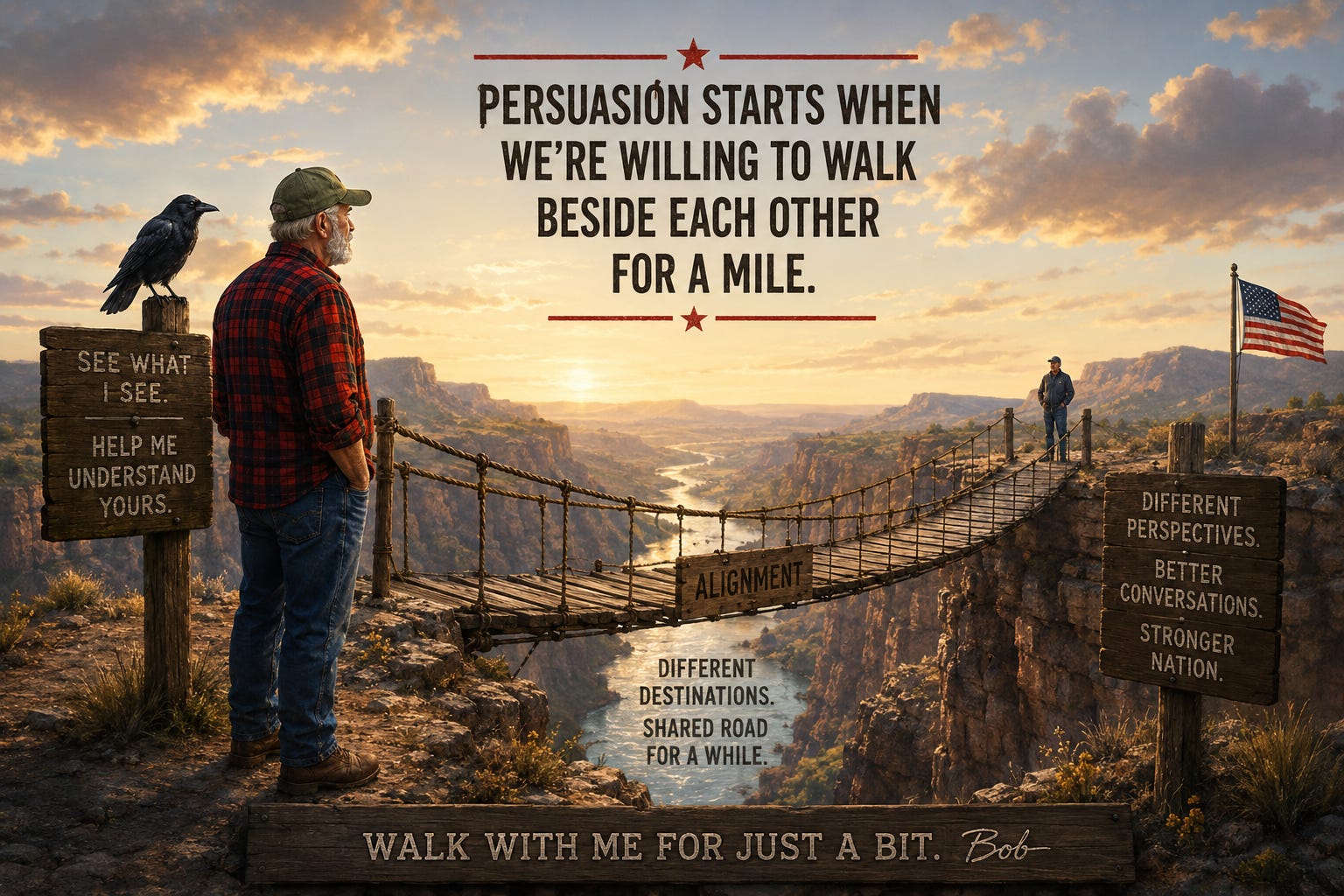
That ability turns out to matter enormously because persuasion depends upon it.
For persuasion to work, two people do not need agreement.
They need alignment.
Agreement means we reach the same destination.
Alignment means we share enough road to travel together for a while.
That may be the most important distinction in this entire discussion.
The goal of persuasion is not surrender.
The goal is temporary alignment.
The goal is to say:
“Walk with me for just a bit. I would like to share with you how I feel about this.”
That is persuasion in its most human form.
It is not conquest.
It is invitation.
The speaker is not demanding conversion. He is asking for a brief shared path.
Walk with me.
See what I see.
Stand where I am standing.
You can always return home afterward.
But here’s the problem.
Modern belief systems increasingly resist even that small request.
Many contexts have developed defenses against persuasion itself.
Not defenses against bad arguments.
Defenses against exposure.
Before another perspective can be explored, it is labeled.
Before another context can be entered, it is condemned.
Before another argument can be considered, it is categorized.
The purpose is not persuasion.
The purpose is protection.
Consider a phrase such as “Trump is Hitler.”
Whether one agrees with that statement is almost beside the point.
Its primary function is often defensive.
If Trump is Hitler, then listening to him becomes dangerous. Considering his arguments becomes suspect. Examining his policies becomes morally risky.
The context has protected itself.
The gate closes before the conversation begins.
Every tribe develops some version of this.
Political tribes.
Religious tribes.
Social tribes.
Even families.
The mechanism is universal.
You cannot be persuaded by an argument you refuse to hear.
You cannot understand a perspective you refuse to visit.
You cannot share a path you refuse to walk.
Bob noticed something else:
🅱️ “If your ideas are strong, you invite questions. If they’re weak, you hire bouncers.”
He continues:
🅱️ “Some people don’t want a debate. They want an intellectual bounce house. Lots of activity, plenty of noise, and nobody ever hits the ground.”
That may be harsh, but there is truth in it.
Healthy societies allow people to move temporarily between contexts.
Unhealthy societies treat exploration itself as betrayal.
And that brings us back to our original question.
Why doesn’t persuasion work anymore?
The answer may not be that people have become less intelligent.
It may be that they have become less willing to align.
We still share words.
We increasingly do not share contexts.
We still exchange facts.
We increasingly disagree about what those facts mean.
We still debate.
But many of us are no longer traveling on the same roads.
The greatest danger is not that we reach different conclusions.
Human beings have always reached different conclusions.
The greatest danger is that we lose the ability to understand how others reached theirs.
Once that happens, disagreement becomes something darker.
Opponents become incomprehensible.
Persuasion becomes impossible.
Rhetoric becomes noise.
The bridge between consciousnesses collapses.
And when that bridge collapses, people continue talking, but they are no longer communicating.
Agreement was never the goal.
Understanding was.
Bob gets the last word:
🅱️ “Most people think persuasion means getting somebody to your destination. That’s backwards. Persuasion starts when they’re willing to walk beside you for a mile.”
Afterword
Bob listened to all this talk about rhetoric, context, perspective, and alignment.
Then he shrugged.
🅱️ “Maybe that’s why ‘Trump is Hitler’ bothers me so much.”
I asked why.
🅱️ “Because it’s a bridge burner.”
A bridge burner?
🅱️ “Sure. If somebody’s Hitler, there’s no reason to listen to him. No reason to understand him. No reason to walk beside him for a mile. The whole point of the label is to make the walk impossible.”
Then Bob thought for a moment.
🅱️ “Funny thing about bridges. You only notice them after they’re gone.”