


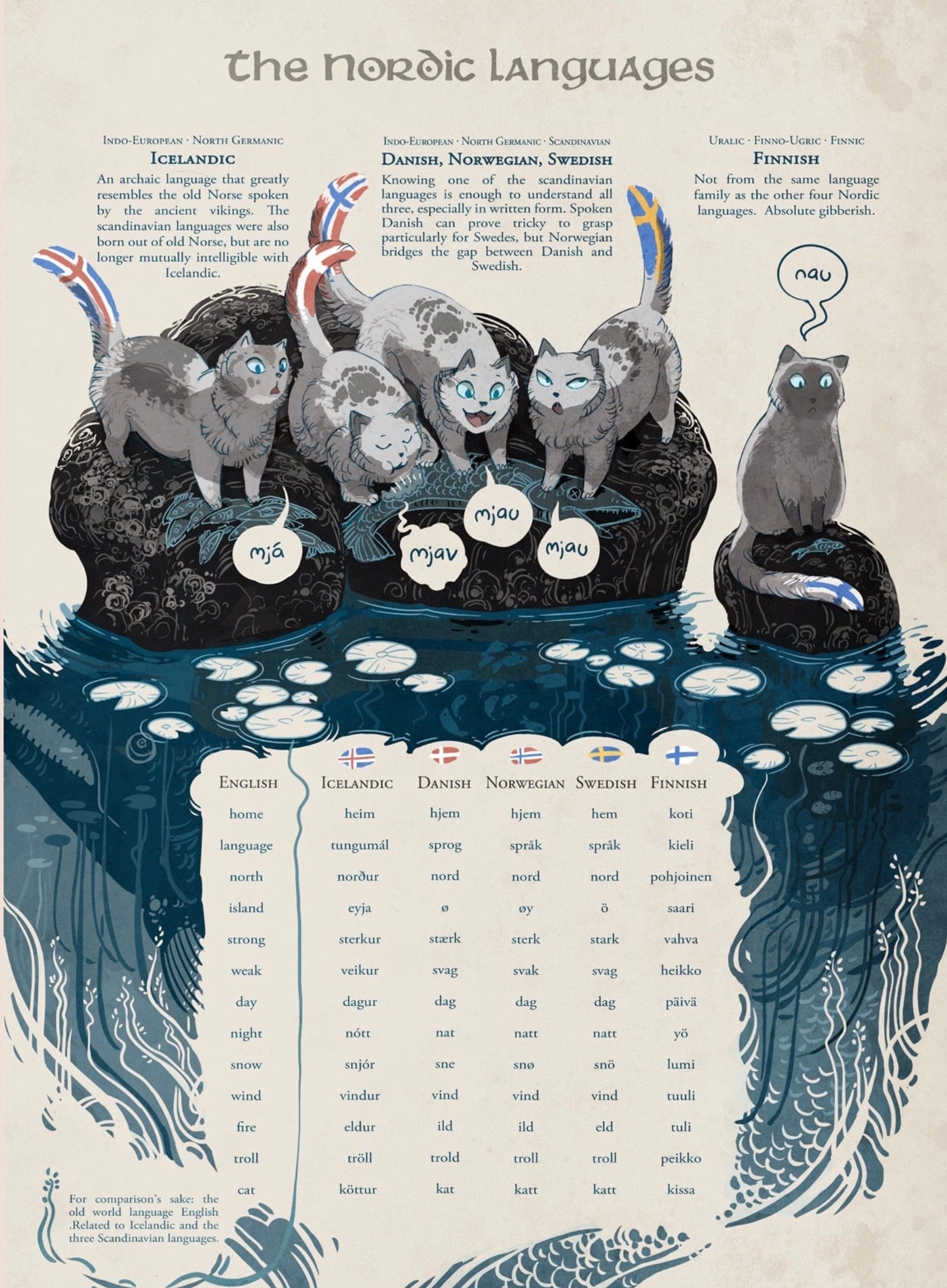
Graphic supplied by Susan Peterson
Why the World Works in English
And Not Finnish
By Jim Reynolds | www.reynolds.com
October 15, 2026
A picture of the Nordic languages got me thinking about where languages come from—and where they are going. Danish, Norwegian, and Swedish were grouped together. Icelandic stood a little apart. Finnish sat off by itself, represented by a cat apparently saying something none of the others could understand.
I recognized the situation. I am half Finnish. All my aunts and uncles on that side of the family came from Ashtabula, Ohio. They spoke Finnish, but they did not pass it down to us. We never understood what they were saying—and that was on purpose! Finnish gave the adults a private channel with the children sitting right there.
Actually, it was mainly the aunts who conspired together in this unintelligible language. The uncles — a consortium of Irish, Cornish, and Finns — were off to the side playing cards.
That generation is gone now. The language they shared did not make the trip into ours.
The picture explains why Finnish seemed so foreign even among its neighbors. Danish, Norwegian, and Swedish belong to the North Germanic branch of the Indo-European language family. Icelandic belongs there too, although it has preserved more of the older language. English is a more distant Germanic relative. Finnish comes from a different family altogether: Uralic.
Its ancestry leads east. The precise homeland and timetable remain subjects of research, but one reconstruction from the University of Helsinki traces the early spread of Uralic languages from western Siberia toward the Volga and the Baltic roughly 4,000 years ago. Finnish eventually developed within the Finnic branch. Its linguistic family extends across northern Europe and into Russia, well beyond the Nordic neighborhood. [1]
Across the Gulf of Finland, Estonian makes the family resemblance easy to see. Hungarian takes more explaining. It is a distant relative, separated from Finnish by thousands of years of development.
Compare a few ordinary words:
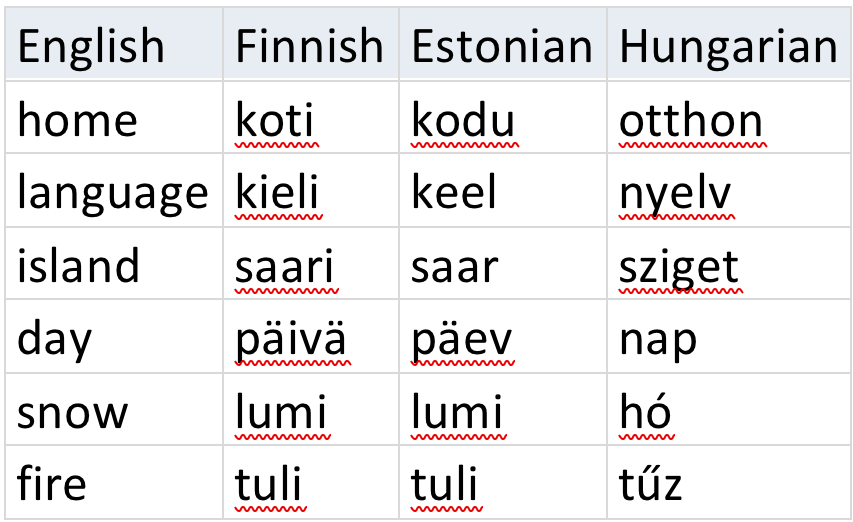
You do not need to be a linguist to spot Finnish and Estonian. Hungarian requires more than a glance. A shared ancestor does not mean the descendants can understand one another, any more than knowing English equips you to read Icelandic.
But now move from islands and snow to automobiles and computers. The pattern changes.
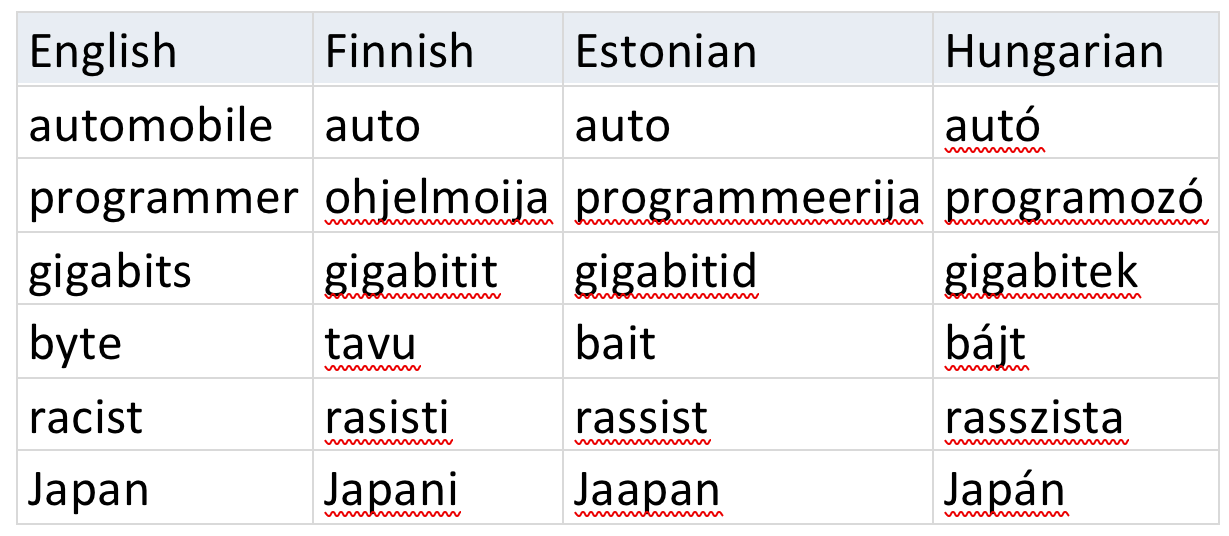
Suddenly an English reader has some footholds. The words have acquired local spelling and endings, but many are recognizable.
Some of these words traveled through other languages: automobile and racist have histories involving French, and Japan is a country name shared internationally. Others were coined locally. Finnish calls a computer a tietokone, an information or knowledge machine. Estonian uses arvuti, derived from calculating; Hungarian has számítógép, a calculating machine. Finnish even has its own word for byte: tavu. The result is a mixture of homegrown words and an increasingly familiar international vocabulary.
“Racist” offers an interesting clue: Finland’s language institute first records the related borrowing rasismi in its collections in 1969. Finnish already had a term for racial discrimination; the imported word was new. Perhaps an American export. Probably not one of our better ones.
The larger convergence happens when their speakers need to work together. A Finnish engineer and a Hungarian engineer do not have to make their native languages more alike. They can conduct the meeting in English.
Technology makes that choice particularly useful. English connects research papers, software documentation, technical standards, and international development teams. Every additional person who uses that shared language increases its usefulness to the next person. An engineer can keep speaking Finnish at home while acquiring an English working vocabulary that connects him to colleagues around the world.
The same arrangement extends into pharmaceuticals and banking. The European Medicines Agency identifies English as its official working language and says the pharmaceutical industry operates globally in English. It translates important information for patients, while some technical material is provided only in English. The international work and the local conversation can proceed in different languages. [2]
In Basel, Switzerland, the Bank for International Settlements brings central banks together from around the world. It identifies its working language as English. A common language reduces the number of translations needed whenever people from different countries have business to conduct. [3]
British imperial reach and American economic, scientific, and technological power helped establish its position. Once a shared language is widely installed, however, practical incentives help keep it there. You learn it because the people, publications, and tools you need are already using it.
And then there are programming languages.
C, Pascal, BASIC, Fortran, Python. They differ considerably in design and age, but their commands draw heavily on English. Across these languages you encounter if, then, else, for, while, begin, end, return, and import. These are words that tell the computer what to do.
The connection is especially clear in Python. A programmer can write comments in Finnish or Russian and choose names from his own language for variables. But the language still requires its prescribed keywords. If stays if. While stays while. Return stays return. Translate those into the local language and the program no longer means the same thing to Python. [4]
A beginner does not need fluent English to learn those commands. He can start by treating them as symbols. Even so, part of his introduction to programming is an introduction to English words, reinforced every time he writes another program.
Russian programmers use Python too. The Python project announced Russian documentation in August 2026. Volunteers translated the explanations so more people could learn the language. The keywords remained the same. [5]
People can preserve the languages of their families while using a common language to build something together. English becomes part of the equipment.
My aunts and uncles could switch to Finnish when they wanted a conversation the children could not follow. A programmer seeking collaborators has the opposite problem: he needs people in other countries to understand what he has written.
Even Russians use Python.

Sources
[1] University of Helsinki. Dramatic events in demographics led to the spread of Uralic languages.
https://www.helsinki.fi/en/news/culture/dramatic-events-demographics-led-spread-uralic-languages
[2] European Medicines Agency. Languages on this website.
https://www.ema.europa.eu/en/about-us/about-website/languages-website
[3] Bank for International Settlements. About the BIS, guided visitor tours.
https://www.bis.org/about
[4] Python documentation. Lexical analysis, keywords.
https://docs.python.org/3/reference/lexical_analysis.html#keywords
[5] Python Insider, August 22, 2026. The Python documentation is now available in Russian.
https://blog.python.org/2026/08/the-python-documentation-is-now-available-in-russian/