


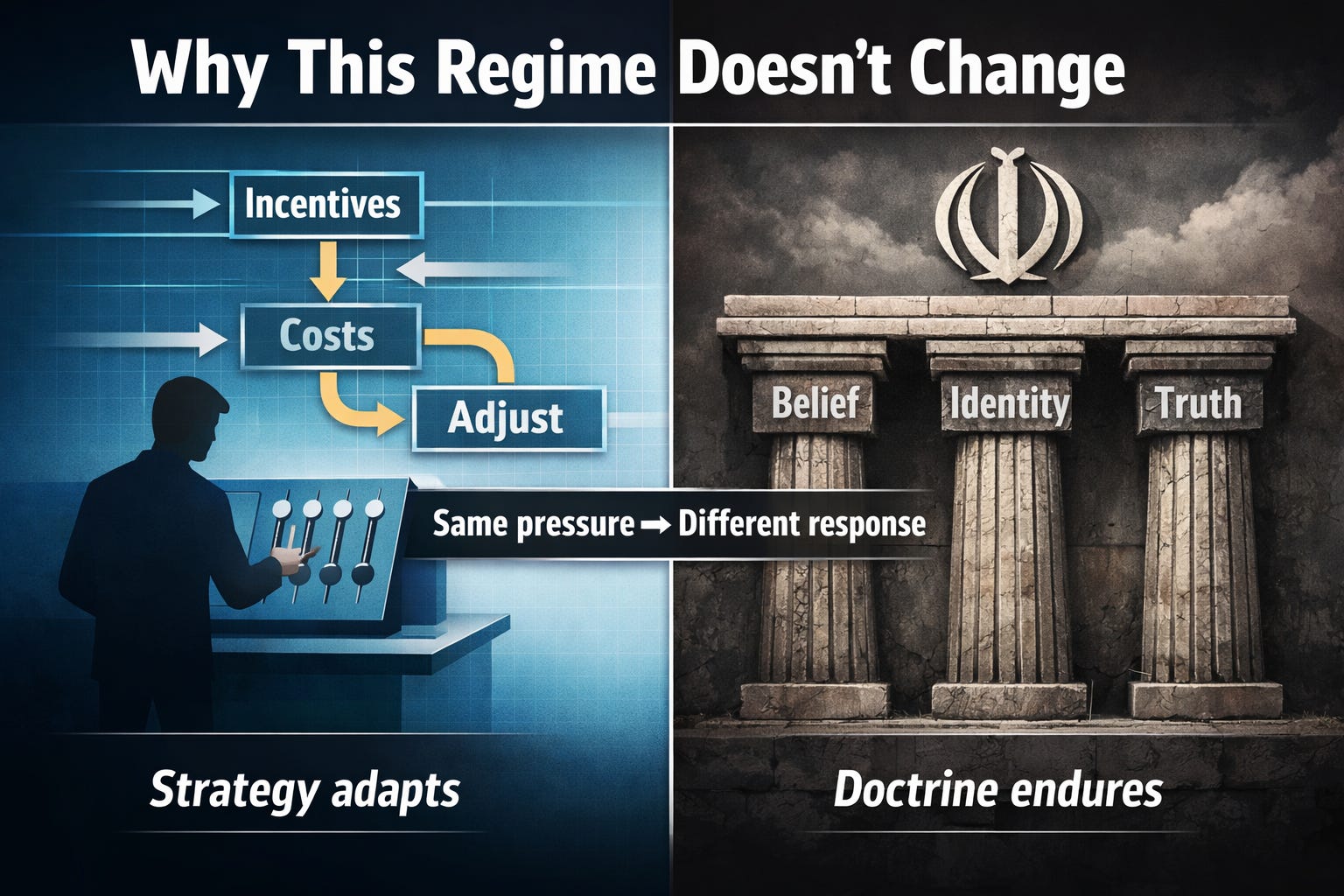
Why This Regime Doesn’t Change
By Jim Reynolds | www.reynolds.com
April 9, 2026
⸻
We keep asking the same question, over and over:
Why won’t they change?
Why won’t Iran’s ruling regime abandon the things that bring it into constant conflict with the rest of the world?
Why hold onto:
• nuclear ambition
• regional aggression
• permanent hostility toward the United States and Israel
The costs are obvious.
The consequences are repeated.
The pressure is constant.
And yet the behavior persists.
⸻
Not Strategy Alone
The most common mistake is to view this as strategy.
If it were only strategy, it would be flexible.
Costs would rise → behavior would adjust.
Incentives would change → posture would soften.
That’s how most states operate.
But this system doesn’t behave that way.
⸻
A Different Kind of System
The ruling structure in Iran is not simply political.
It is built on a specific fusion:
• religion
• ideology
• state power
Not religion in a general sense.
Not belief as practiced by millions of ordinary people.
But a governing doctrine—one that defines:
• legitimacy
• authority
• and identity
⸻
Doctrine vs. Policy
This distinction matters.
Policy can change.
Doctrine resists change.
Policy asks:
What works?
Doctrine asks:
What is true?
And once a system begins to operate on doctrine, certain positions stop being negotiable.
They become part of the system itself.
⸻
Why Behavior Persists
From the outside, the regime’s actions can look irrational.
Why absorb sanctions?
Why endure isolation?
Why invite conflict?
Because the behavior is not only instrumental.
It is expressive.
It reflects how the system understands:
• itself
• its role
• its adversaries
To abandon those positions would not just be a shift in policy.
It would be a shift in identity.
⸻
The Constraint
This creates a structural constraint:
The regime cannot fully normalize
without ceasing to be what it is.
That is the tension.
It explains why:
• concessions are partial
• agreements are temporary
• hostility never fully disappears
⸻
The People Are Not the Regime
This distinction is essential.
Iran is a large, complex country:
• culturally rich
• socially diverse
• internally divided
Many Iranians:
• oppose the regime
• resent its priorities
• do not share its worldview
So when we talk about persistence, we are not describing a nation.
We are describing a governing structure.
⸻
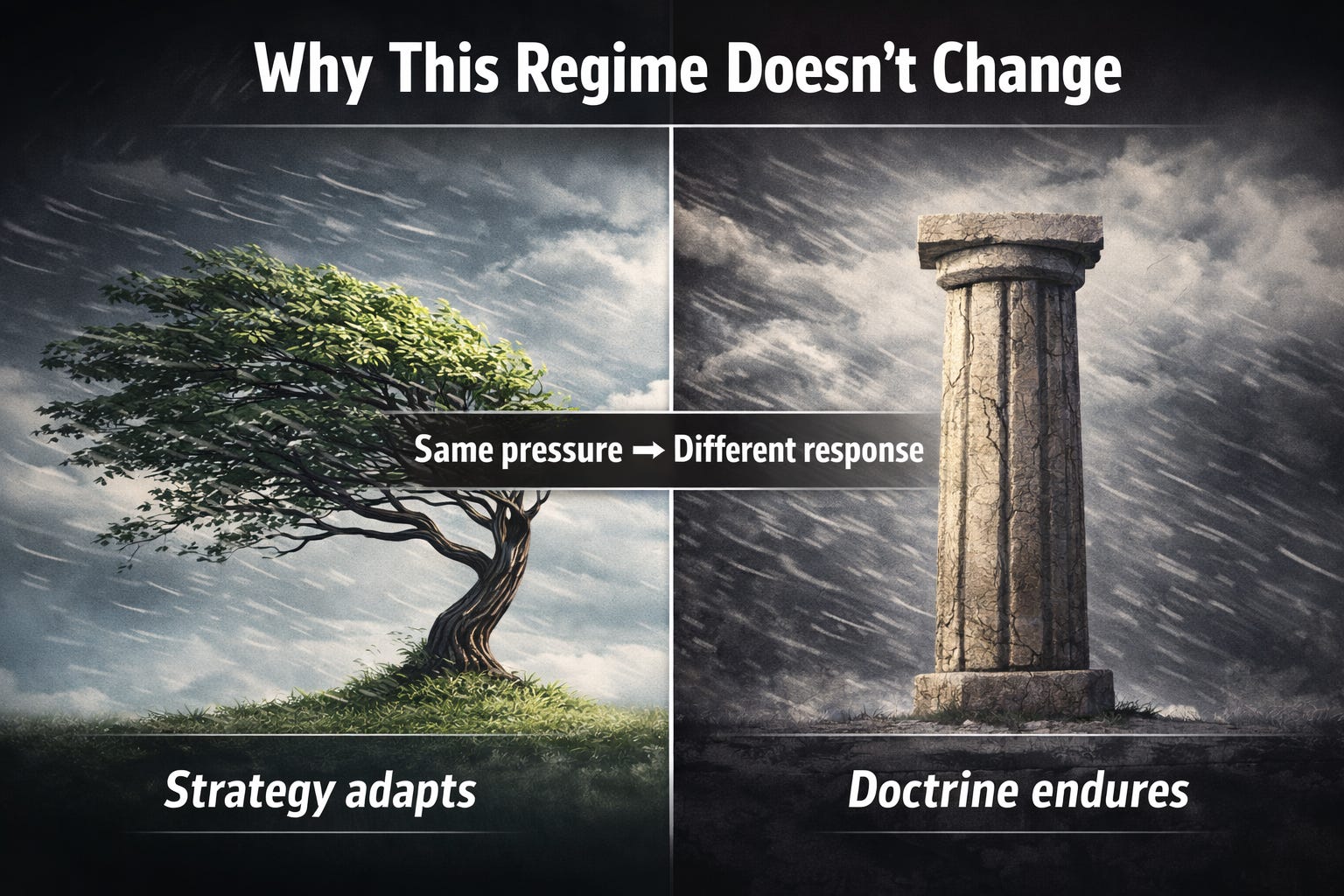
Why This Matters
If behavior is rooted only in strategy, then:
pressure can change it
If behavior is rooted in doctrine, then:
pressure alone may not be enough
That does not mean pressure is useless.
But it does mean:
• expectations need to be adjusted
• timelines need to be reconsidered
⸻
What We Are Seeing
What we are watching now is not confusion or inconsistency.
It is consistency.
A system acting in alignment with its internal logic—even when that logic carries significant cost.
⸻
The Question Going Forward
The central question is not:
Why won’t they change?
The better question is:
Can a system built this way change at all?
And if not:
What kind of pressure—or what kind of change—would actually alter that structure?
⸻
The Line That Matters
This is not about agreement or disagreement.
It is about understanding the system as it is.
Because until that is clear, expectations will continue to be misplaced—and outcomes will continue to surprise.
⸻
The Button
A system built on strategy can adapt.
A system built on doctrine can endure.
The difference explains almost everything we are seeing.
⸻
Explanation and Analysis
The essay above proposes a simple but important distinction: the behavior of Iran’s ruling regime is better understood as doctrinal rather than purely strategic.
This is not a trivial shift in framing. Most external analysis assumes that states respond primarily to incentives—pressure rises, costs increase, and behavior adjusts accordingly. That model works reasonably well for systems where policy is instrumental.
The essay suggests that this model has limited explanatory power here.
Instead, it describes a system in which certain positions—opposition to the United States and Israel, pursuit of advanced military capability, and reliance on regional proxies—are not merely tools. They are embedded within a governing doctrine that defines legitimacy and identity. In that context, behavior that appears costly or even counterproductive can still be internally consistent.
One way to interpret this is through the idea of “expressive” versus “instrumental” action. Instrumental behavior is aimed at achieving a result. Expressive behavior signals adherence to a set of beliefs. The two often overlap, but in doctrinal systems, the expressive component can dominate. Actions are taken not only because they work, but because they affirm what the system claims to be.
This helps explain a recurring pattern: negotiations that produce partial concessions but stop short of structural change; periods of tactical flexibility followed by reassertion of core positions; and a willingness to absorb economic and military costs that would normally force recalibration.
The essay also emphasizes an important distinction between the regime and the population. Iran is not a monolith. It is a large and complex society, with significant internal dissatisfaction and a wide range of views. The persistence described here is not a reflection of the nation as a whole, but of a specific governing structure that has proven resilient under pressure.
Recent events are broadly consistent with this interpretation. Leadership continuity has favored ideological alignment over reform. The nuclear program has shown durability despite repeated disruption. Internal unrest has been met with repression rather than accommodation. In each case, there is some tactical adjustment, but no clear movement away from the underlying framework.
That said, the essay is primarily diagnostic rather than predictive. It explains persistence more than it specifies tipping points. Systems built on doctrine can endure for long periods, but they are not immune to internal fracture, cumulative strain, or shifts in elite cohesion. The framework presented here clarifies why change is difficult, though it leaves open the question of how, or under what conditions, it might occur.
The central contribution of the essay is not a prescription, but a correction. It suggests that expectations of rapid normalization or full behavioral reversal may be misplaced if they assume a system operating on flexible strategy rather than embedded doctrine.
In that sense, the closing distinction holds:
A system built on strategy can adapt.
A system built on doctrine is more likely to endure—even under pressure.
Understanding which type one is dealing with is a necessary starting point for any realistic expectation of outcomes.
The light went on when I was writing this. You describe a precise parallel. But it is even worse. They have developed a shorthand for their doctrine: Orange Man Bad. There is no evaluation process. Just a prescribed knee-jerk reaction. The leaders of the dem party and their media enablers know exactly what they are doing. And that is why it is troubling. There is no thought process involved. Just reaction.
NOTED; the similarity between the Iran ruling regime and the woke section and radical left section of the Democratic Party in the US. One doctrine...hate Trump. Consequences; anything Trump does or says is wrong, morally and realistically. Trump's conduct; always wrong and harmful to the US (i.e., the Dems). Trump's policies demonstrated in dealing with immigration, NATO, Iran, Israel, government fraud, excessive expenditures; always wrong, misplaced, misleading, bordering on if not actual treason, war crimes (re Iran), impeccable offenses daily. Doctrine...simply anti Trump. No flexibility for/from the orthodox Democrat.