


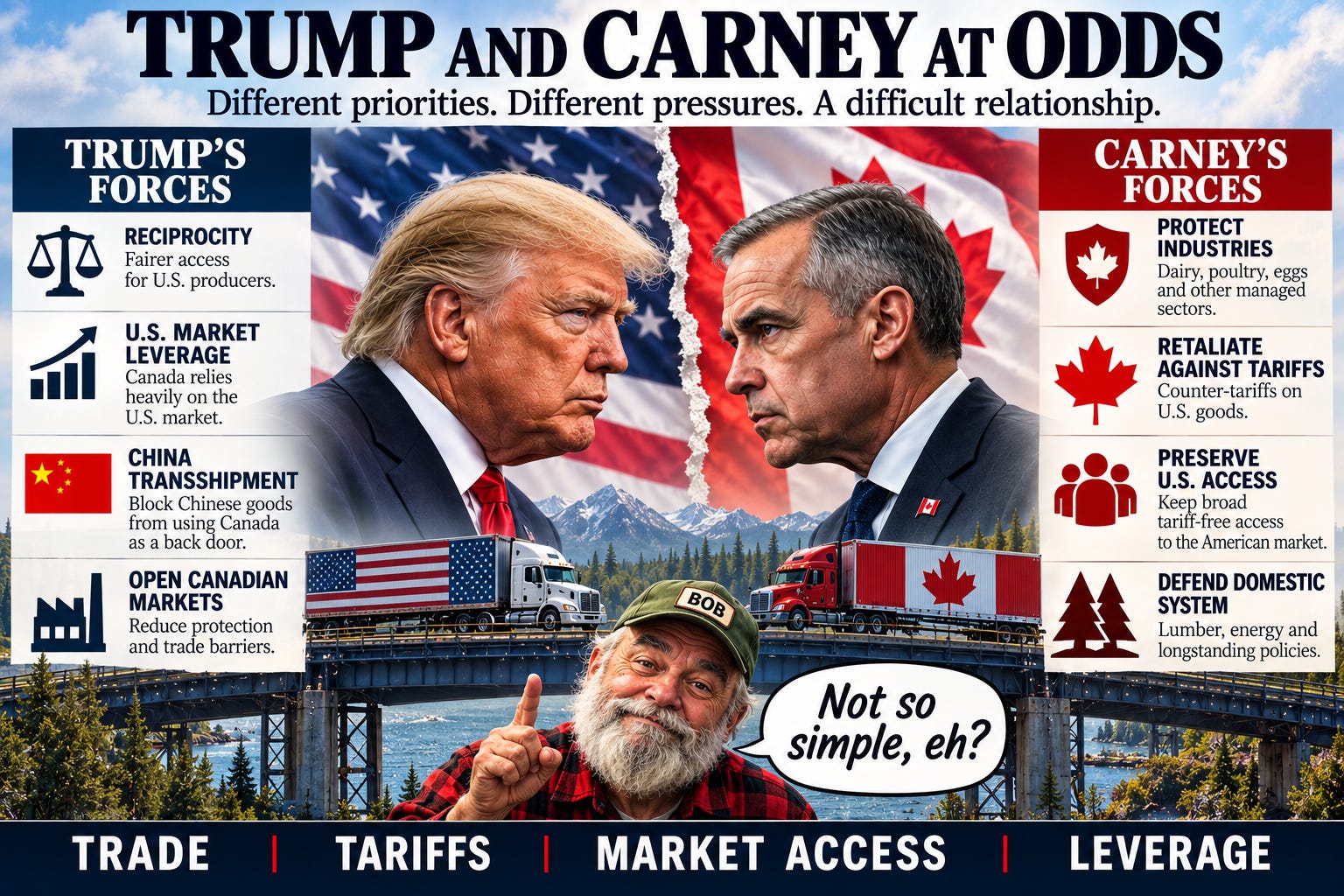
Why Trump Is Fighting Canada
Forget the rhetoric. Look at the trade relationship.
By Jim Reynolds | www.reynolds.com
September 26, 2026
Most Americans do not have time to understand tariff-rate quotas, countervailing duties, provincial marketing boards, rules of origin, stumpage fees, and the hundred other devices governments use to manage international trade.
Donald Trump understands that. His explanation is much simpler: Canada has been taking advantage of the United States for years, and he wants the relationship made fair.
That produces the usual argument. Trump supporters agree. Critics call it another excuse for tariffs.
There is a better way to look at it.
Forget the rhetoric for a moment. Look at what Canada actually does, why it does it, and what happens when someone threatens to change arrangements that have existed for decades.
Start With Dairy
Canada operates a supply-management system covering dairy, poultry and eggs. Domestic production is controlled, imports are limited through tariff-rate quotas, and imports beyond those quotas can face extremely high duties.
The OECD says some Canadian dairy tariff-rate quotas carry average protection of about 223 percent above the quota. It also says the system raises domestic prices, distorts trade, reduces responsiveness to market conditions, and can discourage innovation. (OECD)
🅱️ Bob: Does that mean the price of my omelette just doubled?
American dairy farmers have been complaining about this for years.
And this is not simply a Trump complaint. The Biden administration challenged Canada’s administration of dairy quotas under USMCA. In 2022, a dispute panel agreed with the United States that Canada had improperly reserved much of the available quota for Canadian processors, limiting the access American producers were supposed to receive. (United States Trade Representative)
Canada changed its system, and a later challenge went largely Canada’s way.
That tells us something important. Not every American complaint is automatically correct. But neither is the Canadian dairy dispute something Trump invented. It is a long-running argument over access to an intentionally protected industry.
Then There Is Lumber
Softwood lumber has generated disputes between Canada and the United States for decades.
Much Canadian timber is harvested from provincial government land. American producers have long argued that the fees Canadian mills pay for timber amount to a subsidy because they do not reflect true market prices. Canada disputes that characterization.
In 2017, however, the U.S. International Trade Commission determined that Canadian softwood lumber imports were materially injuring American producers after the Commerce Department found the lumber was subsidized and sold in the United States below fair value. Duties followed. (U.S. International Trade Commission)
Canada fought back through the trade-dispute system, as it had before.
Again, the point is not that every American calculation is beyond dispute. The point is that this fight was old long before the current confrontation began.
🅱️ Bob: You mean Trump didn’t start it? Haven’t heard that one before.
Not Every Canadian Barrier Is the Same
This is where the story gets muddled.
Some Canadian protections are longstanding domestic policies. Others are responses to recent American tariffs.
Canada imposed large counter-tariffs in 2025 after the United States placed tariffs on Canadian products. Most of those Canadian measures were later removed, but tariffs on steel, aluminum and automobiles remained. Canada subsequently added new targeted counter-tariffs in 2026 as the dispute escalated. Canada explicitly describes them as retaliation for American measures. (Canada)
Prime Minister Mark Carney’s government argues that Washington disrupted an existing free-trade relationship and that Canada is defending industries threatened by U.S. tariffs. Carney has also said that Canada’s goal is to preserve broad tariff-free access to the American market while reducing U.S. tariffs on strategic Canadian industries. (Canada.ca)
So we should keep the categories straight.
Canada has protected industries.
Canada has also retaliated against American tariffs.
Those are not the same thing.
The Protective Bubble
Now we get to the larger economic problem.
Canada is perfectly entitled to choose its own domestic economic model. Canadians can impose whatever taxes, regulations, environmental requirements, labor rules, subsidies and industry protections their political system will tolerate.
But those choices have costs.
The OECD says Canada’s productivity has lagged peer countries for years and identifies weak competitive pressure, regulatory barriers, foreign-investment restrictions and internal trade barriers as important parts of the problem. (OECD)
Suppose government policies steadily increase the cost of producing something domestically. Eventually somebody pays.
Consumers can pay more. Companies can accept lower margins. Government can subsidize producers. Imports can replace domestic production.
Or government can protect domestic companies from outside competition.
That final step is where domestic economic policy becomes an international trade issue.
Canada can build a protective bubble around an industry. The trouble is that the world outside the bubble still exists.
A producer in China, Mexico, the United States or somewhere else does not have to duplicate Canada’s cost structure. It merely has to produce something consumers want at a competitive price.
That is one of capitalism’s great disciplines.
A country can regulate costs upward at home. It cannot regulate the world price upward with them.
🅱️ Bob: When Trump sees a bubble he has a natural reaction: pop it.
Why Nobody Wants the Old System Changed
There is another reason these fights become so intense.
If an arrangement survives long enough, businesses stop treating it as government policy and start treating it as reality.
Farmers borrow money based on it. Companies build factories around it. Workers build careers around it. Assets acquire values because everybody assumes the rules will continue.
Canada’s dairy quotas are an obvious example. Quota itself has economic value. Liberalizing the system would not merely change the price of next year’s milk. It could reduce the value of assets farmers bought under the existing rules.
Then someone arrives and says the rules are going to change.
Of course there is resistance.
This is one reason supposedly “fairer” trade can create tremendous turmoil. The existing system may contain distortions, but businesses have already adapted to those distortions. Correcting them creates winners and losers all over again.
The status quo has a constituency.
🅱️ Bob: Amazing how quickly an old government rule becomes somebody’s property right.
What Competition Could Do for Canada
There is another side to this.
Protection can preserve an existing industry, but it can also protect that industry from the forces that normally make businesses more productive.
Opening markets further could be painful for some Canadian producers. They might face lower prices, tighter margins and stronger American competition.
Other Canadian companies could benefit from cheaper inputs, simpler supply chains, fewer retaliatory barriers and more reliable access to the enormous American market.
The OECD has been telling Canada something similar domestically: reduce barriers, increase competition and improve productivity. (OECD)
That is the trade-off.
Protection preserves what exists.
Competition forces adaptation.
China and the Transshipment Problem
Then there is the issue most discussions barely mention: transshipment.
This is where China matters.
Suppose the United States places a tariff on a Chinese product. If that product can simply be shipped to Canada, relabeled, minimally processed and then sent across the border as Canadian, the American tariff means very little.
That does not mean every Canadian product containing Chinese components is illegitimate. Modern manufacturing crosses borders constantly. USMCA has detailed rules for determining when a product genuinely qualifies as North American.
The issue is deliberate circumvention.
The Trump administration has imposed an additional 40 percent duty on goods that Customs and Border Protection determines were transshipped through Canada to evade applicable U.S. duties. The rule specifically targets tariff evasion rather than legitimate Canadian production. (The White House)
Canada itself has imposed tariffs on certain Chinese steel and aluminum products, citing China’s non-market policies and the danger that subsidized Chinese production could undermine Canadian industry. (Canada)
In other words, Canada understands the problem.
If Chinese goods can use Canada as a back door into the United States, tariffs on China become largely performative. Rules of origin therefore matter as much as the tariff itself.
🅱️ Bob: I don’t care if it crosses the border wearing a Mountie hat. If it’s Chinese merchandise being routed through Canada to dodge a Chinese tariff, tariff it.
Now Look at the Leverage
This may be the easiest part of the entire argument to understand.
In 2025, 71.7 percent of Canadian merchandise exports went to the United States. Canada increased exports to the rest of the world by 17.2 percent, which sounds impressive until you notice the denominator. (Statistics Canada)
If roughly 28 percent of your exports go everywhere else and that portion rises 17 percent, you have moved it to roughly one-third on the same illustrative base.
Helpful? Certainly.
A replacement for the American market? Not remotely.
Canada can diversify around the edges. Geography and arithmetic make it much harder to diversify away from the United States.
That does not mean the United States is unaffected by a trade fight. American manufacturers use Canadian parts and materials. The United States buys enormous amounts of Canadian energy. Automobile production crosses the border repeatedly. American companies and consumers can be hurt too.
The point is asymmetry.
Canada depends far more heavily on access to the American market than the United States depends on access to Canada’s.
That is called leverage.
🅱️ Bob: When your customer buys three-quarters of what you sell, he gets a seat at the negotiating table.
What Trump Is Trying to Change
Viewed this way, the dispute becomes much less mysterious.
Trump is challenging arrangements that businesses and governments on both sides have spent decades learning to live with. His administration’s position is that access to the American market should increasingly depend on reciprocity, tighter enforcement and fewer protected arrangements.
Canada’s answer is that much of the existing relationship already works, that many recent Canadian barriers are retaliation for American tariffs, and that suddenly rewriting the rules damages companies that built their businesses around the old ones.
Both arguments explain the intensity of the fight.
This is not simply a story about tariffs.
It is a collision between an entrenched economic system and an American administration determined to change the terms in the name of reciprocity.
Canada built significant parts of its economy around the old rules.
Trump has decided those rules are negotiable.
Now everybody gets to find out what the old arrangements were really worth.
