


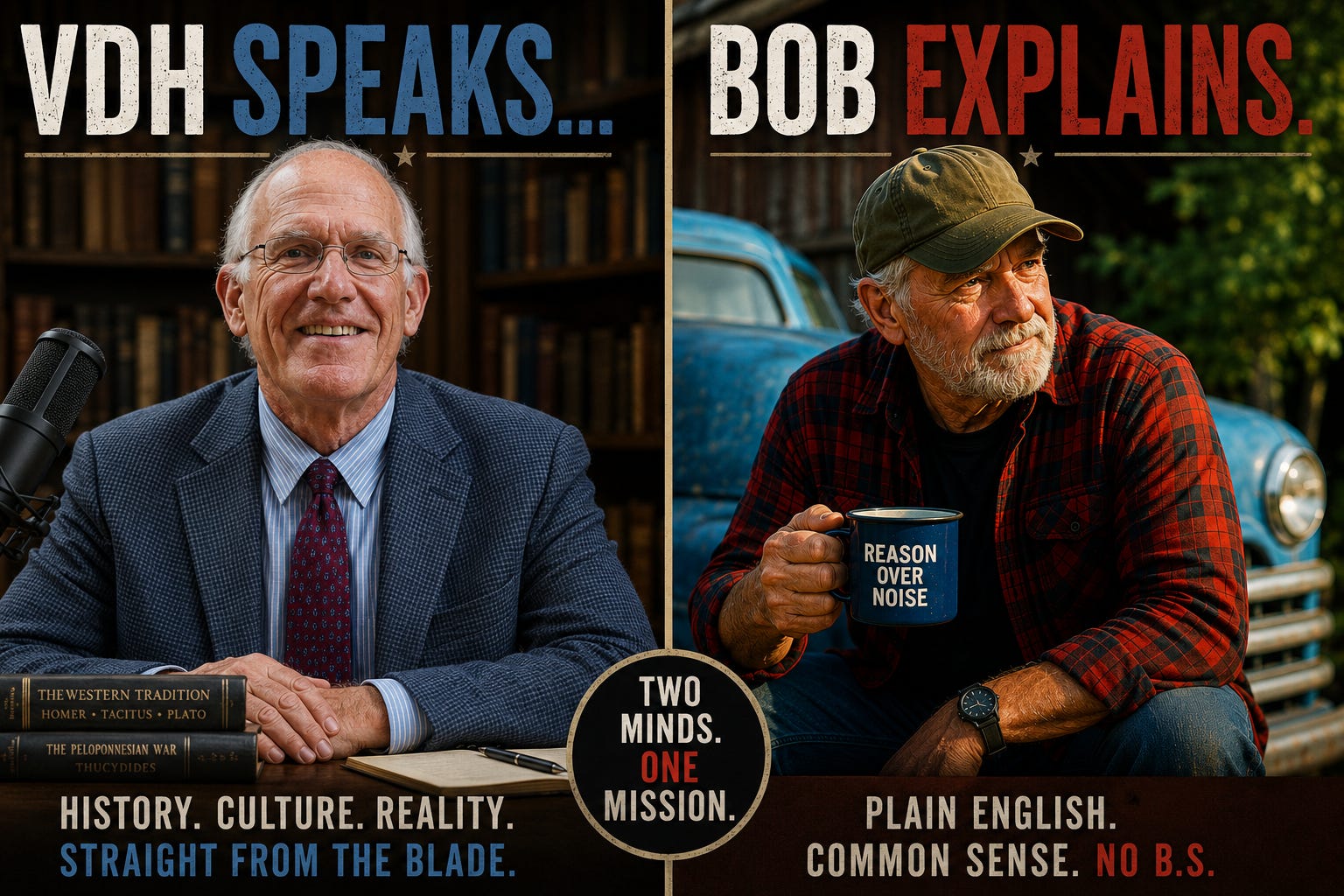
Bob’s ’Splainer #1
Victor Davis Hanson — Without the Latin.
By Jim Reynolds | www.reynolds.com
July 2, 2026
I subscribe to VictorHanson.com, which gives me access to Victor Davis Hanson’s Blade of Perseus essays.
I’ve admired Victor’s work for years. He is one of America’s finest historians and essayists. Few writers combine history, agriculture, military affairs, and current events as well as he does.
But every now and then I find myself thinking:
“Victor… could you just say that one more time in plain English?”
That led to a conversation with Bob.
Bob suggested that maybe he should become Victor’s unofficial translator.
Not because Victor needs translating.
Because some of us occasionally do.
So here’s an experiment.
I’ll quote a few brief excerpts from Victor’s recent essay, “Who Really Are These New Democratic Socialists and Their Fellow Travelers?”
Bob will give us the plain-English version.🅱️
Then we’ll discuss it.
Let’s see if this works.

’Splainer No. 1
VDH: “Almost all are urban… Their worldview is shaped more by consumption than production…”
🅱️ “If your groceries come from Whole Foods, it’s easy to forget they started on a farm.”
Discussion
Hanson’s point isn’t really about cities. It’s about perspective.
People who spend their lives producing things—food, electricity, lumber, steel, machinery—often see the world differently than those who spend their lives consuming those products. Neither experience is inherently superior, but they lead to different assumptions about how society functions.
’Splainer No. 2
VDH: “Many… fled failed states… Yet once here… became virulent critics of the charitable nation they chose to join.”
🅱️ “Your parents didn’t cross an ocean so you could bring the old country’s bad ideas across in a carry-on.”
Discussion
Hanson highlights what he sees as a paradox. Many immigrant families came to America seeking greater freedom and opportunity. He wonders why some later become among America’s strongest critics. Whether one agrees with his conclusion or not, it raises an interesting question about assimilation, gratitude, and expectations.
’Splainer No. 3
VDH: “They emerge strikingly arrogant and ignorant at once.”
🅱️ “College taught them they were the smartest people in the room. Life forgot to mention it.”
Discussion
Hanson isn’t criticizing education itself. He’s criticizing an educational culture that often rewards certainty more than curiosity. His concern is that graduates leave believing they possess the answers to society’s biggest problems despite having little exposure to history, economics, engineering, agriculture, manufacturing, or running an organization. His target is intellectual overconfidence, not intelligence.
’Splainer No. 4
VDH: “Many… are childless, single, or both…”
🅱️ “It’s amazing how many experts on raising kids don’t actually have any.”
Discussion
Hanson is arguing that personal experience shapes public policy. Parents often see schools differently than non-parents. Business owners see regulations differently than employees. Police officers view crime differently than academics. Lived experience doesn’t settle debates, but it does influence priorities.
’Splainer No. 5
VDH: “Democratic socialism is a top-down movement run by insulated elites…”
🅱️ “They talk about ‘the people’ all day long. They just don’t spend much time with them.”
Discussion
This is really the thesis of the entire essay.
Hanson believes many modern socialist leaders come from relatively insulated social circles that don’t reflect the daily experiences of most Americans. Whether readers ultimately agree or disagree, the rest of the essay is an effort to support that central claim.

Final Thought
Victor Davis Hanson doesn’t need Bob.
But every now and then, the rest of us might.
If this experiment proves useful, Bob may have just talked himself into another part-time job.
🅱️ “If coughing up one-liners is a part-time job, I can easily multitask.”
Note: Quoted excerpts are from Victor Davis Hanson’s essay, “Who Really Are These New Democratic Socialists and Their Fellow Travelers?” Used here for commentary and discussion.

Bob says, “Victor builds the cathedral. I hand out the visitor’s guide.”
Well, done and helpful