


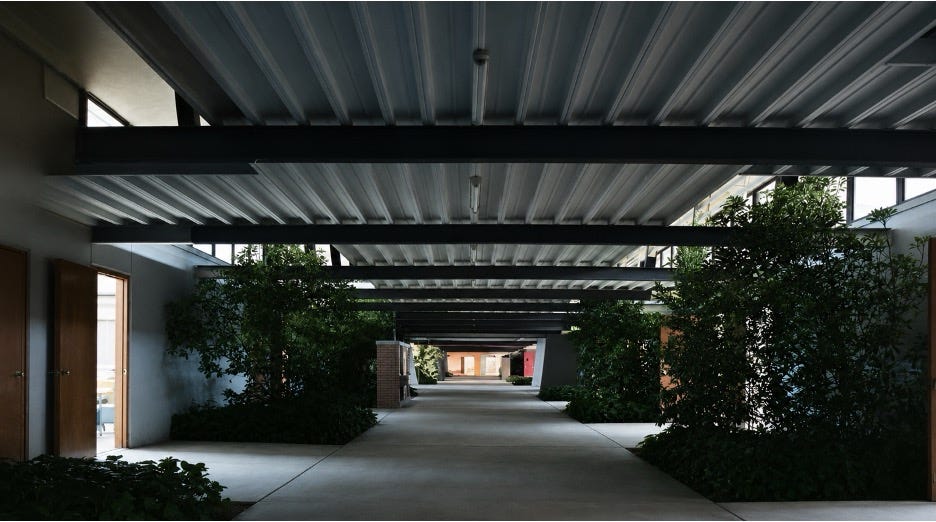
[C Wing: The Rebel Band, led by the cheer squad and followed by the Rebelettes, noisily marched down these halls during 7th period on home game days. 60 years ago. Imagine all the drum sounds reverberating off the metal ceiling. Admin building at the end of the hall. ]
The Cadence
By Jim Reynolds
May 8, 2026
I can still hear it.
I’d walk past the band room after school at South High and hear an unbelievable racket coming from inside. Drumsticks sharply attacking snare drums. Tenor drums being pounded with unusual gusto. The thundering sound of a couple big guys striking bass drums. Maybe even a cowbell. Cadences colliding into each other. Starts and stops. Corrections. Laughter. Beautiful, loud, cacophonous, synchronized noise — orchestrated yet somehow primordial.
It sounded glorious.
I’d poke my head in and see fifteen or sixteen drummers packed into the room learning the same cadences that would later become embedded in my own memory for life. The trombones march up front. That’s what I played. The drum lines are someplace midway back in our 100-piece marching band. But I heard and internalized every lick.
The remarkable part is that our band director was not even a drummer. He was a clarinet player. But he was in the room, making sure that the collective tonal product did not turn into overenthusiastic sloppiness. The precision and power of the cadence is what propelled the South High Rebel band forward.
The older drummers already knew the cadences from the previous years. The younger guys gradually joined in when they felt comfortable enough to keep up. Nobody held a seminar on “identity formation.” Nobody processed “systems.” Nobody discussed “frameworks.” In fact, there was no written sheet music. It was all done by listening, learning, and feel.
They played.
They listened.
They repeated.
They improved.
They synchronized.
That was the culture.
And it worked.
South High had built something larger than a music program. It had built continuity. Tradition. Standards. Pride. The drum section reproduced itself almost organically. Older students taught younger students simply by participating. The culture carried itself forward.
That is one of the deepest educational truths I have ever witnessed.
Years later, when I became a teacher myself, I found myself in a very different situation. I was building a band program from scratch. There was no inherited drum culture waiting for me. No older students passing down the rhythms.
So I reached backward into memory.
I resurrected the cadences I had absorbed during those afternoons at South High decades earlier. Cadences that had somehow remained embedded in my nervous system even though I was never a drummer myself.
And I taught them the exact same way I had learned them.
After school.
In the band room.
Loudly.
Repeatedly.
By example.
Because where else are you going to do it?
You are not going to rehearse drum cadences during regular band class. You are not going to unveil an unprepared drum line on the football field during halftime and hope enthusiasm compensates for chaos. Every marching band director who ever lived understood this instinctively.
You put the students in a room after school and work the rhythms until they become collective muscle memory.
That is not ideology.
That is practical wisdom accumulated over generations.
And there was something electric about it.
Especially on the day of a big home game.
By seventh period the drum cadences would reverberate through the hallways as we marched down E hall, turned back up D Hall, made a final twist through the C Hall — all the time listening to those pounding drums and occasionally striking up the school fight song. We even marched right by the admin building! The sound traveled through the buildings like a pulse. It gave you goose bumps. It still does.
But it was not just the Rebel band. It was also the 80-strong Rebelettes taking up the rear guard, a precision girls’ marching group—flags, hats, boots and all.
And here is what strikes me most sixty years later:
the drum line at South High was completely integrated.
My best friend played snare right beside a black student, and four-year percussion buddy, who could absolutely fly across the drum with precision and enthusiasm. Nobody cared about categories. Nobody cared about frameworks. What mattered was whether you practiced, whether you could play, whether you stayed in rhythm, whether the group moved together as one.
The rhythm itself unified us.
That may sound simplistic to modern educational theorists, but it happens to be true.
Shared effort creates bonds that ideological language often cannot.
A good drum line teaches discipline, timing, accountability, repetition, leadership, and mutual dependence more effectively than entire bureaucracies writing documents about “structural consciousness.”
And the beautiful thing is that none of us fully realized we were learning those lessons at the time.
We just knew the room felt alive.
That’s what real educational culture feels like:
alive.
Not administered.
Not processed.
Not theorized into abstraction.
Alive.
Sometimes I wonder whether those cadences are still being played at the school where I later taught. Maybe some kid standing in a noisy band room after school is learning rhythms that traveled invisibly from one generation to another through memory, repetition, and example.
If so, that would not be the result of a committee framework.
It would be the result of culture doing what healthy culture has always done:
passing forward something worth keeping.
What’s In A Name?
Years after those cadences echoed through the halls of South High, the district quietly retired the Rebel mascot altogether. Rebels and Rebelettes — names carried proudly by generations of students — disappeared into the modern administrative language of rebranding, sensitivity reviews, and updated institutional values.
What struck me was not simply the name change itself, but how casually institutions can discard deeply lived memories that once bound communities together.
To administrators, perhaps it was merely a symbol requiring correction.
To us, it was football games under the lights. Drum cadences reverberating through E Hall and D Hall during seventh period before a big home game. It was marching formations, after-school rehearsals, crowded band rooms, brass sections warming up, the Rebelettes in full formation, and the electric feeling of belonging to something larger than yourself.
We had Johnny and Jodie Rebel mascots. Our school newspaper was called the Rebel Yell. They rang the Rebel Victory Bell when we infrequently scored touchdowns. I think we had a light blue and gray Rebel Pickup Truck. And a white horse for our mascot.
That’s a lot of school tradition.
I am quite certain the original mascot was chosen innocently enough. We were South High. “Rebels” simply sounded natural. North High became the Stars. East High were the Blades — a name that sounds considerably more threatening to me even now — while upstart West High remained the Vikings, an historically enthusiastic collection of marauders and conquerors. Bakersfield High proudly remains the Drillers for obvious local geologic reasons.
But the Rebels are gone.
What replaced them was perhaps the final irony.
South High became the Spartans — a society historically sustained through conquest and brutal systems of slavery imposed upon defeated neighboring populations. History, as always, refuses to cooperate neatly with modern simplifications.
And life itself was always more human and complicated than the theories suggest.
During my own junior year, Johnny Rebel — elected by the student body, proudly wearing the ceremonial Rebel costume, riding a white horse around the track, and carrying the sword at football games — happened to be black. He was also one of the funniest students in the school.
Nobody found this strange at the time. Possibly, a bit humorous, as I am sure he did.
Because real life inside schools rarely organized itself according to ideological categories. What mattered was personality, talent, friendship, humor, effort, participation, and shared experience.
That was the real culture.
And perhaps that is what feels most difficult to explain today to people who analyze institutions primarily through abstract frameworks and retrospective theories. They often see symbols. We remember human beings.
We remember sounds.
We remember hallways.
We remember rhythms.
We remember goose bumps.
And we remember belonging.
I’ll leave it there.
Schools and even college and pro sports team have lost a lot that bound people together. We have lost a lot more than just team names. We’ve lost communal identity. C
Brought back memories of my high school teaching years.....drums go with football....
my son played the snare drum....the rhythm and cadence brought feelings of belonging, having a purpose, a driving force......oh yo hear those again!! God bless..R. Abney