


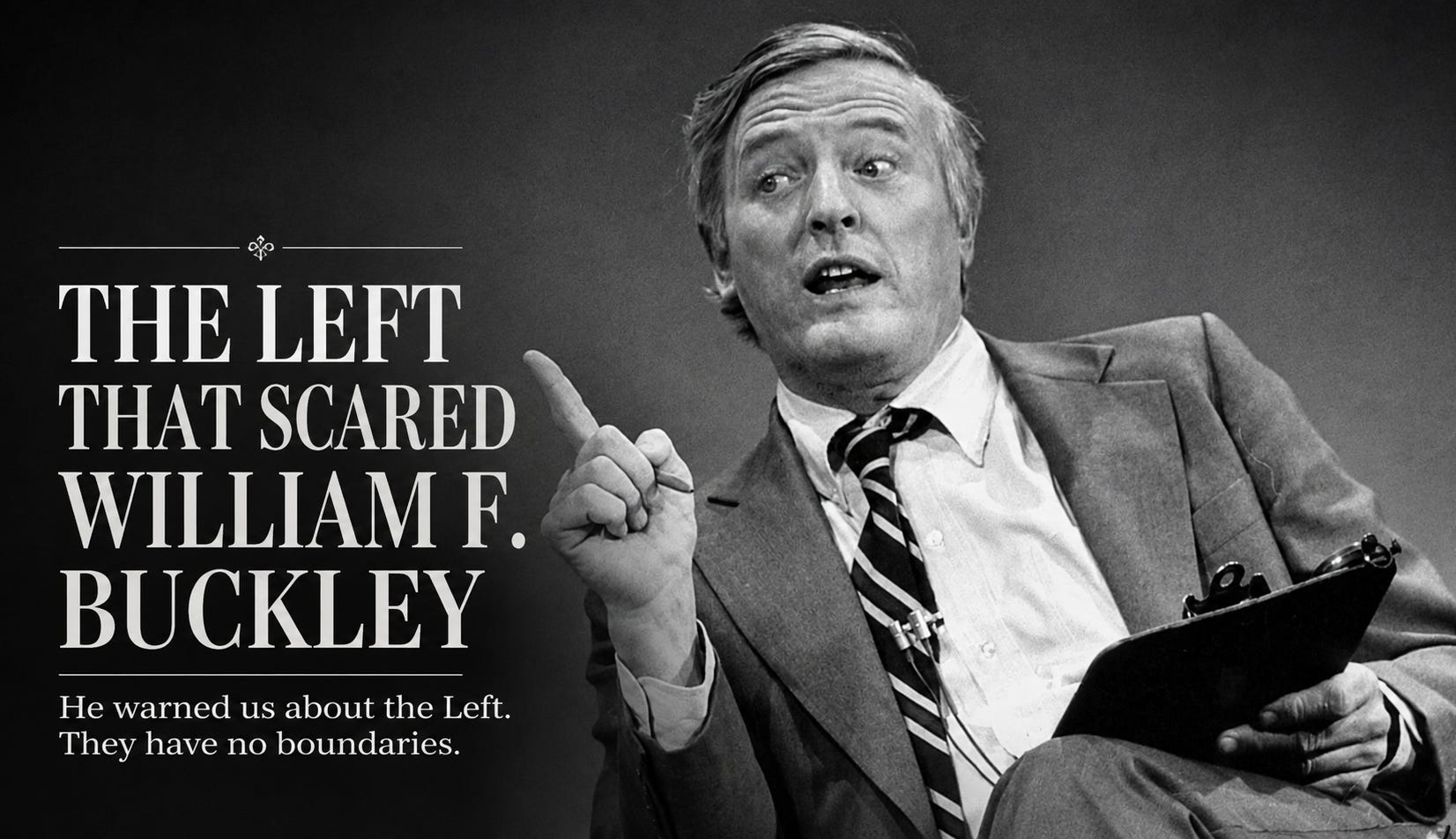
The Left That Scared William F. Buckley
By Jim Reynolds | www.reynolds.com
August 18, 2026
Prelude
I first noticed William F. Buckley Jr. when I was still a pre-teen, on a black-and-white television.
I doubt I had any clear idea what separated conservatives from liberals. To me, they were mostly politicians, and politicians were something adults seemed to understand.
My mother called Buckley “the smartest man on television.”
My father seemed to agree.
So I watched.
I had never heard anybody talk like him. Not on television. Not anywhere.
What struck me, even then, was the peculiar way he made other people uncomfortable. His guests were often accomplished, important, thoroughly accustomed to being listened to. But Buckley questioned them as though no one had ever quite gotten around to doing it before.
And he never raised his voice.
I think I noticed that.
There was no pounding of the table, no theatrical outrage, no attempt to overpower the other man. Buckley would wander toward his point—sometimes so leisurely you wondered where he was going—with those enormous words appearing along the way.
But the big words were never decoration.
They were doing work.
Then, somehow, the wandering stopped.
There was the conclusion.
And the knife was in.
Usually delivered with that friendly, slightly mischievous smile, almost as though Buckley himself were pleased that he had managed to arrive at exactly the right place without broadsiding his intellectual opponent to get there.
Only later did I understand the scale of what he had undertaken. This man felt strongly enough about what was happening to the country that he founded a magazine essentially devoted to telling the Left:
Stop.
Then he went on television and spent more than thirty years doing much the same thing on Firing Line.
Thirty years of asking the question the other fellow had hoped nobody would ask.
And doing it unrehearsed.
I was too young to understand the politics.
But I understood the presence.
And I never forgot it.

Years later, I found him again.
I started watching old William F. Buckley clips on YouTube almost by accident, and within a few minutes I was hooked all over again.
It wasn’t simply what he believed. It was the man himself: the posture, the half-smile, the impossible vocabulary, the long sentences that wandered through three subordinate clauses, paused for an obscure reference, insulted somebody along the way, and somehow landed exactly where he intended.
Buckley was funny without telling jokes, combative without shouting, arrogant without quite becoming unbearable. He had the rare ability to make an insult sound almost like a compliment. Nobody talks like this anymore, certainly not on television.
After watching enough of him, though, another question began to bother me.
What, exactly, had William F. Buckley so worked up?
Here was this enormously gifted man devoting much of his adult life to opposing liberalism. He emerged nationally with God and Man at Yale in 1951, founded National Review four years later, and eventually became the unmistakable television face of intellectual conservatism on Firing Line. His mission was famously described as standing athwart history, yelling Stop.
So I went back and looked at the history he was yelling at.
And something strange happened.
The Left that scared William F. Buckley didn’t look all that scary anymore.
At least not from here.
Welcome to Buckley’s Nightmare
What bothered him?
Universities were becoming too liberal. Professors were replacing religious tradition and individualism with secularism, collectivism and faith in government planning. Washington was becoming too powerful. The welfare state was expanding. Intellectual elites increasingly treated their own political assumptions not as ideology, but simply as the conclusions enlightened people reached.
And Buckley worried constantly about communism and about the tendency of Western intellectuals to underestimate or excuse the radical Left.
That was the emergency.
Liberal professors. A bigger federal government. Secularization. Government-managed equality. An intellectual class increasingly convinced it knew what was best for everyone else.
Seventy years later, you almost want to put your arm around Bill.
You poor bastard.
You had no idea.
Except that, in a way, he did.
Direction, Not Destination
This is the part worth lingering over.
Buckley was not predicting the precise destination. He was noticing the direction.
The mainstream liberal of Buckley’s prime was not today’s democratic socialist. Not remotely.
John F. Kennedy was patriotic, aggressively anti-communist and comfortable defending American power abroad. He also pushed for major reductions in marginal income-tax rates. Hubert Humphrey was a leading civil-rights liberal and an equally committed Cold Warrior. The AFL-CIO represented millions of working-class Democrats who wanted better pay and working conditions, not the abolition of capitalism.
Mainstream liberals accepted private property, constitutional government, national borders and the basic legitimacy of the American experiment. Religion remained an ordinary part of public life. Patriotism was normal. Biological sex was not a political controversy. Merit was generally understood as something that ought to be opened to people who had historically been denied a fair chance to compete.
Even the great civil-rights argument was framed largely as a demand that America live up to its own principles.
There was, of course, a radical Left, especially by the late 1960s. Buckley confronted it directly. But there was still a recognizable boundary between mainstream American liberalism and the revolutionary Left.
That boundary matters, because Buckley was looking at a comparatively restrained liberal establishment and yelling:
Stop.
Why?
Because he saw movement.
Buckley as Yardstick
That is what makes Buckley so useful now. He gives us a fixed reference point.
Put William F. Buckley in 1960. Put the American Left across from him. Mark the spot. Then move forward sixty-five years and ask a simple question: what happened to the tendencies that bothered him?
Universities did not become less liberal. The federal government did not become smaller. The administrative state did not quietly surrender authority. Government efforts to correct inequality did not stop with equality before the law. The intellectual class did not lose confidence in its ability to improve society from above, and secularization did not reverse itself.
Whatever judgment one makes about each of those developments, the direction is hard to miss.
It kept going.
That was Buckley’s deeper concern. Not merely what liberalism was in 1960, but what it might become if nothing inside it ever said: this far, no farther.
Now Try the Same Experiment With Conservatives
Conservatives changed too. Of course they did.
A conservative dropped into modern America from Buckley’s early adulthood would find plenty that was unfamiliar. Gay men and lesbians live openly in ordinary American life. Same-sex marriage is broadly accepted. Interracial marriage, once fiercely controversial, is now completely unremarkable. Women occupy positions in business, government, law, medicine and the military that would have been unusual in Buckley’s youth.
A great deal of private behavior once subjected to public condemnation is now generally treated as private behavior.
Conservatives accommodated those changes. Sometimes willingly, sometimes reluctantly, and sometimes after losing the argument.
But move underneath those cultural changes and examine the philosophy.
Individual liberty. Private property. Free enterprise. Religious freedom. Personal responsibility. Constitutional restraint. National sovereignty. Federalism. Family and civil society. Suspicion of concentrated government power. The belief that markets usually work better than planners. The belief that America, although imperfect, remains a country worth preserving.
Buckley would recognize the conversation immediately.
But the philosophical structure would be familiar.
Conservatives changed their minds about quite a few things. They changed their underlying philosophy about remarkably few.
And that may be the great asymmetry.
Conservatives became more accepting of cultural change while remaining anchored to recognizable first principles. The Left changed much more fundamentally in what it believed society itself ought to become.
Where Is the Stop Sign?
Consider the progression.
Equality before the law became equality of opportunity. Equality of opportunity became concern over unequal outcomes. Unequal outcomes became evidence of inequity.
Tolerance became acceptance, and acceptance increasingly became affirmation.
Nondiscrimination gave way in some quarters to explicit group remedies. Free speech began competing with claims of harm and psychological safety. Sex became increasingly detached from biology. Merit, once demanded as the answer to discrimination, became suspect whenever unequal outcomes persisted.
Reasonable people can argue about each individual step. That is not really the point.
The more interesting question is: what principle says Stop?
Where is the limiting principle? At what point does progressive politics say that enough equality has been achieved, enough redistribution attempted, enough restructuring completed, enough disparities corrected, enough inherited institutions revised?
At what point does it say:
We have arrived.
Buckley suspected there was no such moment.
That is what makes his old complaints seem less quaint than they first appear.
The Fortune Teller
Buckley could not see the future. He would not have understood half the political vocabulary of 2026.
But he understood direction.
You do not need to know exactly where a river ends to know which way the water is flowing.
Buckley saw liberalism flowing toward greater centralization, greater secularization, greater egalitarianism administered by government, greater confidence in intellectual elites and greater suspicion of inherited institutions. He objected while those tendencies were still comparatively modest.
That is why watching him now produces such a strange sensation.
The things that alarmed him can seem almost harmless to us. Yet most of them did not disappear.
They expanded.
He wasn’t standing at the destination.
He was standing upstream.
The Great Asymmetry
The conservative of 2026 would surprise William F. Buckley culturally, but he would not be incomprehensible to him philosophically.
The modern progressive Left presents almost the reverse problem. Buckley would recognize many of the intellectual strains. What would astonish him is how far some of them traveled.
That is the asymmetry.
Conservatism changed substantially in what it was willing to accept, but comparatively little in its basic philosophical roots.
The Left kept moving.
Buckley spent his life standing athwart history yelling Stop. For decades, the line sounded theatrical, perhaps even a little ridiculous.
But that judgment depends entirely on where you think the road was headed.
We now have seventy years of road behind us.
The remarkable thing is not that William F. Buckley knew exactly where it would lead.
It is that he noticed, very early, that there were no brakes.
Very kind words. Much appreciated.
Thank you, Jim. For me, this was one of your best. Buckley was the guy that started me down the conservative road and gave me that solid foundation. I never realized how much he did for me and my thought processes until I read your article. God Bless.