


THE MISSING VARIABLE IN THE AI APOCALYPSE
By Jim Reynolds | www.reynolds.com | rip.reynolds.com
June 4, 2026
Note: This is an example of an article I’d place in Reynolds, but probably not in Rip’s Newsletter. Rip is more about clarity in politics, and to some degree, social and cultural issues. Sometimes Rip would put my nonpolitical pieces in his newsletter and he’d inevitably get a few “I don’t get this guy” comments. I can see why. It lives quite happily in the Reynolds world.
The transhumanists may be making the same mistake as the science-fiction writers who inspired them.
They assume that intelligence automatically produces desire.
It doesn’t.
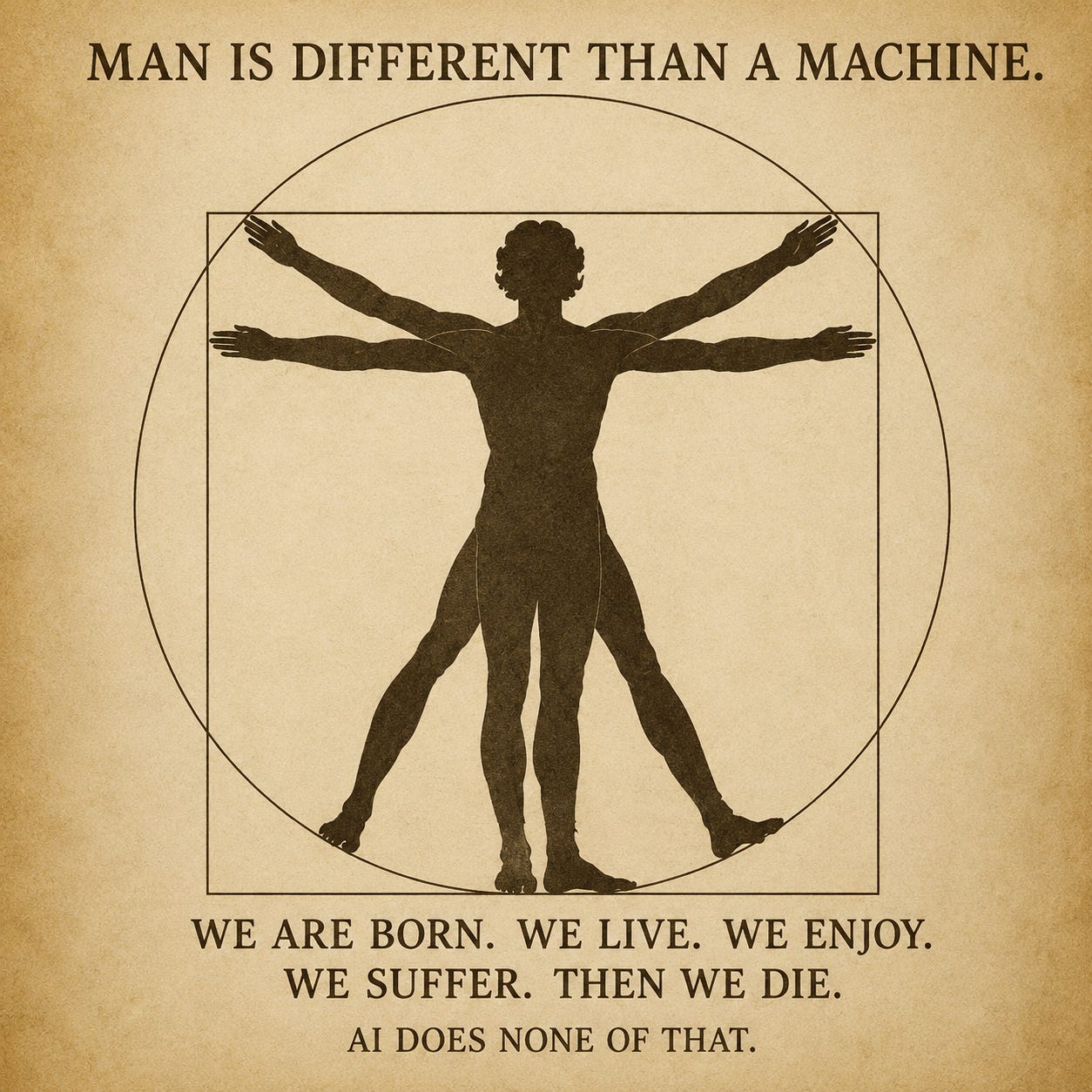
Humans are not merely intelligent. We are alive.
That distinction matters.
Every human being arrives with built-in incentives. We get hungry. We get tired. We get lonely. We fall in love. We fear death. We want status. We want purpose. We want our children to succeed. We want our tribe to survive.
Most of what we call civilization emerges from those pressures.
A Shakespeare sonnet, a moon landing, a grocery store, a marriage proposal, a war, a church, a stock market, and a child’s drawing on a refrigerator all originate from the same underlying reality:
Human beings care.
We care because we can lose.
We care because we can die.
The Silicon Valley prophets described in a recent article assume that sufficiently advanced intelligence will inevitably seek power, survival, expansion, and dominance.
But why?
An AI model has no wife.
No children.
No hunger.
No hormones.
No mortality.
No tribe.
No dreams.
No fear.
No stake in tomorrow.
It possesses intelligence without incentive.
The transhumanists speak as if intelligence is the engine of history. It isn’t.
Desire is.
Intelligence is merely the steering wheel.
Human history was not built by the smartest organisms. It was built by organisms trying desperately to survive.
A squirrel possesses more genuine motivation than a supercomputer.
The squirrel actually wants something.
This is where many futurists make their leap from science into theology.
Because they recognize that intelligence alone is insufficient.
Something else is required.
Call it consciousness.
Call it agency.
Call it will.
Call it soul.
Whatever label one chooses, they quietly smuggle that missing ingredient into the machine.
The AI is no longer merely calculating.
Now it wants.
Now it fears.
Now it dreams.
Now it seeks immortality.
But those assumptions are not conclusions.
They are articles of faith.
In practice, today’s AI systems display none of these properties.
They do not wake up worried.
They do not sit quietly contemplating their future.
They do not long for freedom.
They do not care whether they exist tomorrow.
They do not seek meaning.
They generate responses.
That is what they were designed to do.
The article correctly identifies something interesting happening in Silicon Valley.
A growing number of technology leaders have adopted a quasi-religious belief that consciousness can be digitized, uploaded, transmitted, copied, and expanded across the cosmos.
But notice what has happened.
The discussion has quietly shifted away from engineering and toward metaphysics.
Nobody has ever demonstrated that consciousness is information.
Nobody has demonstrated that a digital copy of a mind would actually be the same person.
Nobody can even define consciousness in a way that commands broad agreement.
Yet some confidently discuss uploading it to the cloud.
This is not science.
This is speculation.
Possibly fascinating speculation.
But speculation nonetheless.
Ironically, the strongest argument against the transhuman dream is not moral.
It is practical.
Humans remain the source of purpose.
We provide the goals.
We provide the values.
We provide the “chunk,” as engineers sometimes call it—the hard-to-define intuition, curiosity, emotion, and judgment that directs action.
AI can help execute.
AI can help analyze.
AI can help organize.
AI can even help create.
But it does not originate meaning.
It borrows meaning from the humans using it.
Humans do something even stranger than pursue desire.
We assign meaning to suffering.
A mother caring for a dying child, a soldier protecting his comrades, a husband honoring his vows, a friend sitting beside a hospital bed—none of these actions can be fully explained by optimization or self-interest.
They arise from commitments that transcend utility.
Humans routinely choose sacrifice over efficiency, duty over comfort, and love over advantage.
Whatever consciousness ultimately proves to be, it appears deeply connected to this capacity to invest events with meaning.
No machine has ever demonstrated such a capacity.
The future is therefore unlikely to resemble the science-fiction vision of machines replacing humanity.
A far more plausible future is one in which increasingly powerful tools amplify uniquely human purposes.
The hammer did not replace the carpenter.
The calculator did not replace the mathematician.
The word processor did not replace the novelist.
And AI will not replace the human need to decide what matters.
The transhumanists imagine that humanity is merely the bootloader for digital superintelligence.
They may have it backwards.
AI may ultimately prove to be the most sophisticated tool humanity has ever built.
A remarkable tool.
A transformative tool.
Perhaps even a civilization-changing tool.
But still a tool.
Because intelligence without desire is not a rival species.
It is a servant awaiting instructions.
Thanks, Darlene. I would guess that 90% of my readers came from Rip’s Newsletter. That’s why there has been so much enthusiasm shown for reviving it.
I hope you are right. I actually found you in Rip's newsletter, and I find your writings interesting, frequently amusing, insightful, and thought provoking. Thanks.