


Using AI to Analyze the Guthrie Crime
By Jim Reynolds | www.reynolds.com
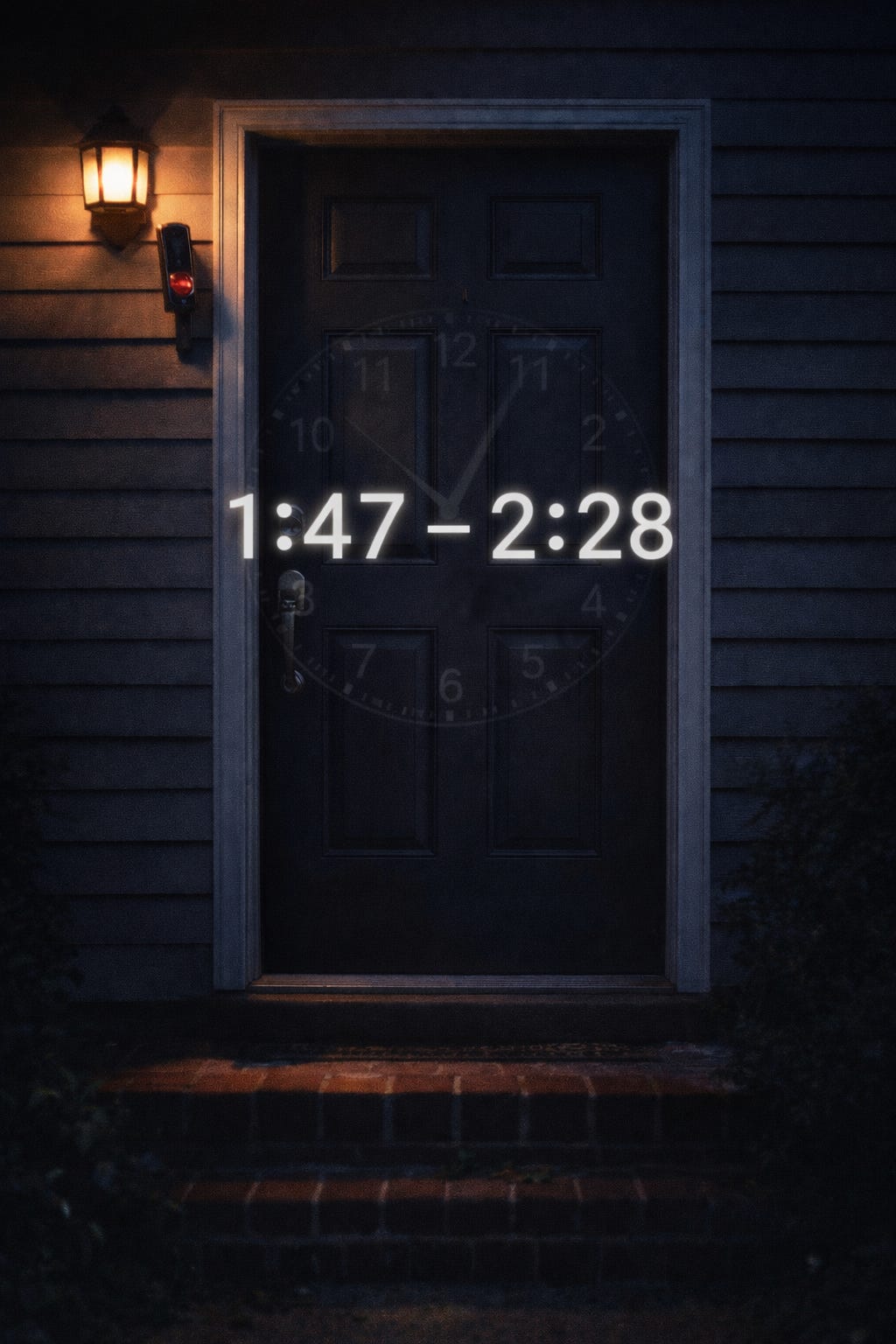
At 1:47 a.m., someone walked up to Nancy Guthrie’s door with a plan.
Masked. Gloved. Armed. Backpack on.
He didn’t knock and hope.
He went straight for the camera.
By 2:28 a.m., the doorbell camera was gone. Blood was at the entrance. Her pacemaker had disconnected from her phone. Nancy was gone.
That 41-minute window is the entire story.
This wasn’t a confused 84-year-old wandering off.
This wasn’t a medical episode in the kitchen.
This was a confrontation at the door.
And it was planned.
Investigators don’t say that lightly. You don’t arrive masked, gloved, and equipped to disable cameras unless you’ve thought about it beforehand. Someone knew enough about the house to approach with confidence. Someone knew enough about Nancy to believe she was vulnerable.
The searches matter. The property research matters. The public knowledge of her daughter’s profile and income matters.
Money is the cleanest motive in the room.
But here’s where it bends.
If this were a textbook ransom kidnapping, we’d have structured demands. Timelines. Negotiation signals. Controlled communication.
Instead, we got a hoaxer demanding Bitcoin — and getting arrested.
That tells you something.
It tells you the crime scene made people think “money,” but the execution didn’t follow through like a professional extortion job.
And then there’s the blood.
Blood at the threshold means something went wrong fast.
A struggle. A fall. A weapon displayed. Panic in a frail body under stress. The timeline is tight — too tight for a prolonged standoff inside the house. Whatever happened, happened quickly.
Which leads to the theory most professionals are circling:
This began as a financially motivated crime — robbery, coercion, short-term extortion leverage — and escalated.
It was supposed to be controlled.
It wasn’t.
If Nancy was injured severely at the door, the plan changed instantly. A clean leverage operation turns into liability. A ransom strategy collapses under media heat. The window to negotiate safely disappears once federal attention explodes.
And federal attention exploded fast.
That shifts the probability.
No sustained ransom communication.
No structured negotiation.
No public proof-of-life cycle.
The longer that silence stretches, the more the working assumption hardens: this likely ended in homicide, not hostage management.
That doesn’t mean certainty.
It means odds.
The family has been publicly cleared. Law enforcement is looking outward, not inward. DNA testing is ongoing. A glove has been recovered. That could take months. If it hits on a known offender, this snaps into focus quickly — likely someone with burglary or robbery history who escalated beyond control.
What would change the odds?
A vehicle tied to the window.
Digital evidence connecting the property searches to a suspect.
Credible ransom communication.
A DNA match.
Until then, the most coherent narrative remains this:
Someone targeted the house deliberately, likely for financial leverage connected to perceived wealth. They prepared just enough to feel confident. Something at the door went wrong. The crime escalated. The offender removed Nancy in a narrow window and abandoned any clean extortion framework.
A bad plan collided with reality.
And reality won.
Bob would stay quiet longer on this one.
Then he’d say:
“Most crimes aren’t masterminds. They’re amateurs who didn’t plan for the moment things stop going their way.”
And after a beat:
“Forty-one minutes. That’s the difference between a plan and a disaster.”
That’s the story.
No theatrics.
No overreach.
Just the weight of what those 41 minutes likely mean.
What we don’t know is why she would open the door at 2AM?
Another reader suggested that the backpack contained a body bag. That sounds fairly ominous and controversial — but makes sense given what we now know. Blood at the door and nowhere else. The truth is that we know nothing. We can only speculate. But there was that backpack. And it was full of something.