


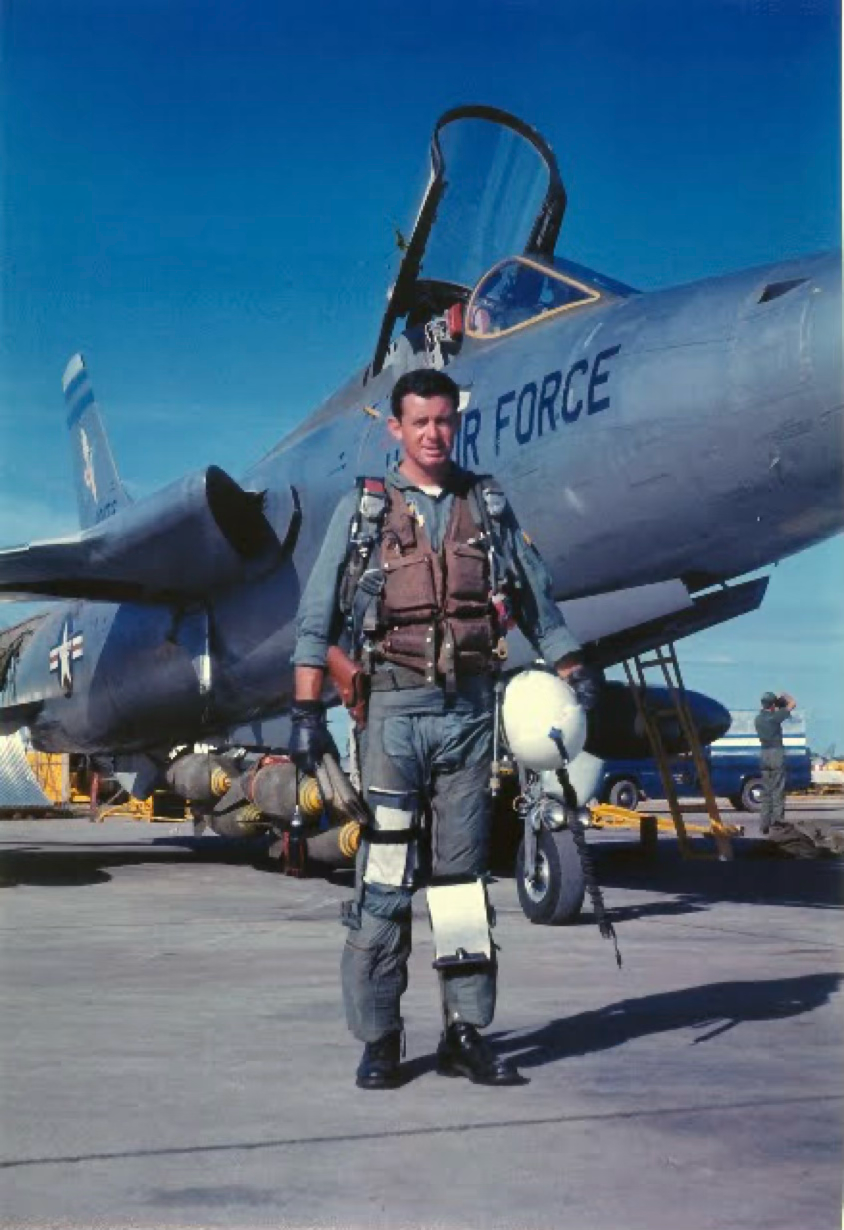
Gary Barnhill, Captain, USAF, with a Republic F-105
Note: Gary is one of my very early original subscribers.

When “Downtown” Meant Hanoi
By Jim Reynolds | www.reynolds.com
September 16, 2026

Every war develops its own language.
In Vietnam, American fighter pilots had a particularly ominous word for Hanoi:
Downtown.
The name came from Petula Clark’s 1964 hit, Downtown — one of the brightest, happiest pop songs of the era.
For the men flying combat missions over North Vietnam, that was precisely what made it funny.
And terrible.
Captain Gary Barnhill was one of those men.
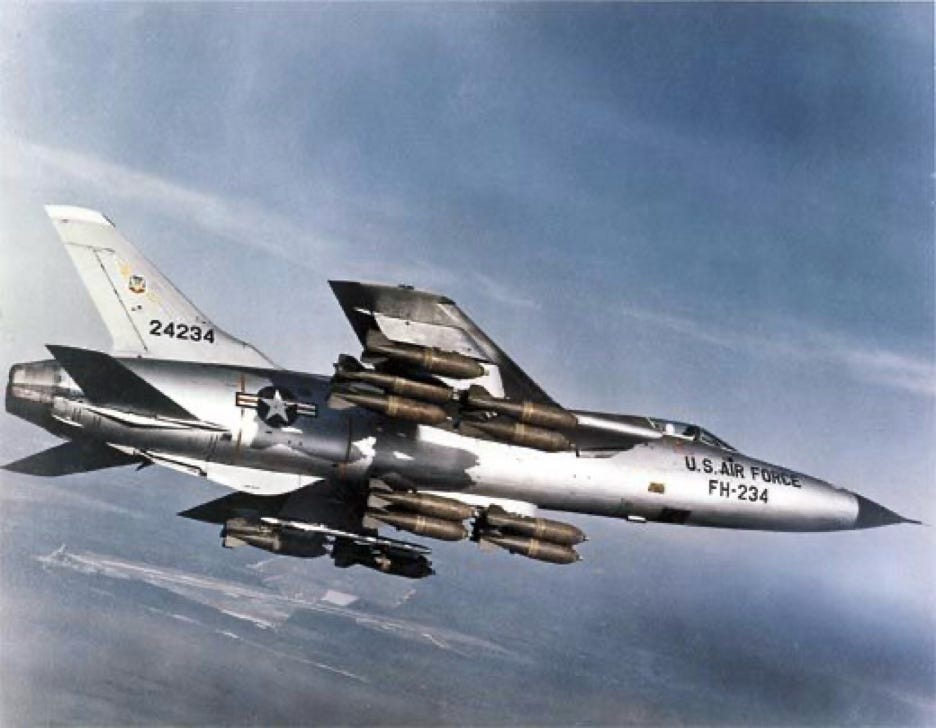
In 1965, at age 29, he was flying the F-105 Thunderchief — the famous “Thud” — out of Takhli Royal Thai Air Force Base.
The F-105 was a remarkable airplane: one engine, one seat, one pilot. It could carry a heavy bomb load and had the range necessary to strike targets deep inside North Vietnam.
The Thuds were based in Thailand because South Vietnam did not have room for all of them. Two squadrons went to Korat. Two went to Takhli.
Korat at least had a town nearby.
As Gary remembers it, Korat had restaurants, bars and all the traditional amenities required by young men attempting to win a war.
Takhli had, in his description, “jack-shit.”
The pilots slept on cots in open-bay barracks, 25 men together under mosquito nets, eating three meals a day from metal trays while sitting on picnic benches.
Officers even paid a $55 monthly surcharge for the privilege of eating on those “officers only” benches.
Gary remembers the paradox with particular affection.
“We fuckin’ loved it. A chance to do ‘our thing’ with guns and bombs. I volunteered.”
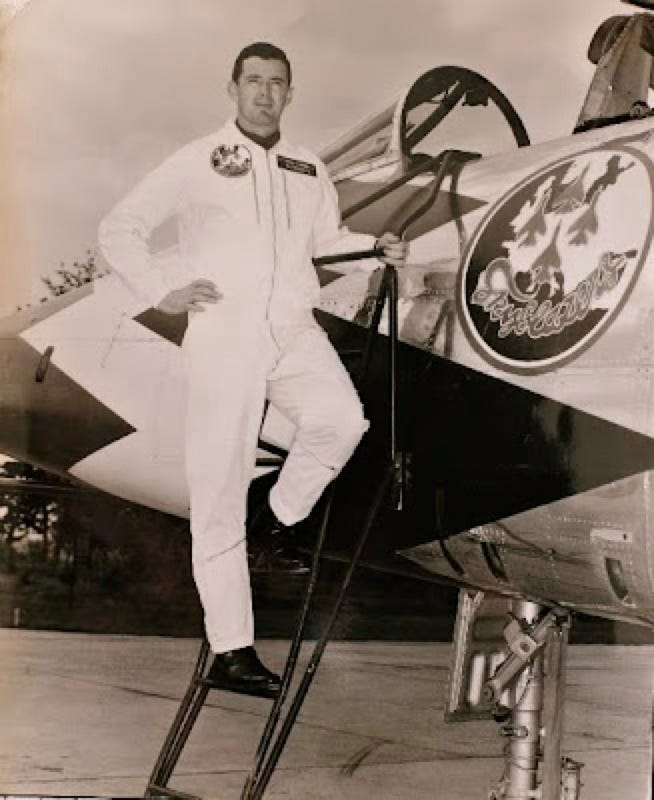
Gary with his F100C Skyblazer at Bitburg Air Base, 1961
Then came North Vietnam.
And the arithmetic changed.
The men discovered very quickly that the enemy was formidable. Hanoi and the surrounding target areas were protected by antiaircraft artillery, surface-to-air missiles and MiG fighters.
For the Thud pilots, flying North was not remotely abstract.
Each mission could end three ways.
The pilot could be killed.
He could be shot down and captured.
Or he could make it home, get drunk, sleep, and try his luck again the next day.
Fighter pilots could also do the math.
Gary remembers the fatalistic slogan that circulated among them:
“There ain’t no way” to get through this tour alive.
And then there was the Officers Club jukebox.
One afternoon, Thud pilot John Morrissey walked into the Korat club and found a technician with the jukebox torn apart.
“What are you doing, pal?”
The technician told him he could not figure out what was wrong with the machine.
It kept playing the same song.
Over.
And over.
And over.
The song was Petula Clark’s “Downtown.”
To civilians, it was an infectious pop song.
To Thud pilots, it was practically prophecy.
Hanoi was Downtown.
And suddenly the lyrics had acquired an entirely different meaning.
When Clark sang about going downtown when you were alone, a Thud pilot could hear the joke immediately.
The F-105 had one seat.
You really were alone.
When she sang about the lights being brighter there, the pilots heard antiaircraft fire and missiles lighting up the sky.
When she promised that everything was waiting for you downtown, they knew exactly what was waiting:
AAA.
SAMs.
MiGs.
And perhaps a North Vietnamese prison camp.
The relentlessly cheerful optimism of the song became perfect gallows humor.
🎵 Things will be great when you’re downtown. 🎵
Maybe.
If you survived.
🎵 Everything’s waiting for you. 🎵
It certainly was.
Years later, Gary and other Thud pilots came to believe something even darker: advance notice of upcoming targets had sometimes reached Hanoi through diplomatic channels, giving North Vietnamese defenses time to prepare.
Whatever the exact path of that information, from the cockpit the result often seemed unmistakable:
They were waiting.
The song became, in Gary’s words, their:
“lament, requiem, elegy, jubilation, destiny and anthem — all wrapped into one song.”
That may be the part people who did not experience the exhilaration of combat have difficulty understanding.
Human beings can attach an extraordinary amount of meaning to something completely ordinary.
A smell.
A photograph.
An engine sound.
A song.
For everyone else, Downtown became a wonderfully durable artifact of the 1960s.
For these pilots, it became something else entirely.
Gary did not hear the song for many years.
Then, decades later, he played it again.
He cried.
Not politely.
Not nostalgically.
He says he “cried like a baby.”
The events were more than sixty years old.
The men were young again.
The Thuds were sitting on the ramp.
The missions were waiting.
And Petula Clark was still telling them, with impossible cheerfulness:
🎵 So go Downtown. 🎵
Gary puts it better than anyone else could:
“The song triggers emotions tied to events 61 years ago, which are undeniable, unforgettable and unexplainable.”
Perhaps they are unexplainable.
But now, when you hear Downtown, you know a little more about what some young American pilots heard.
They weren’t thinking about city lights.
They were thinking about Hanoi.