


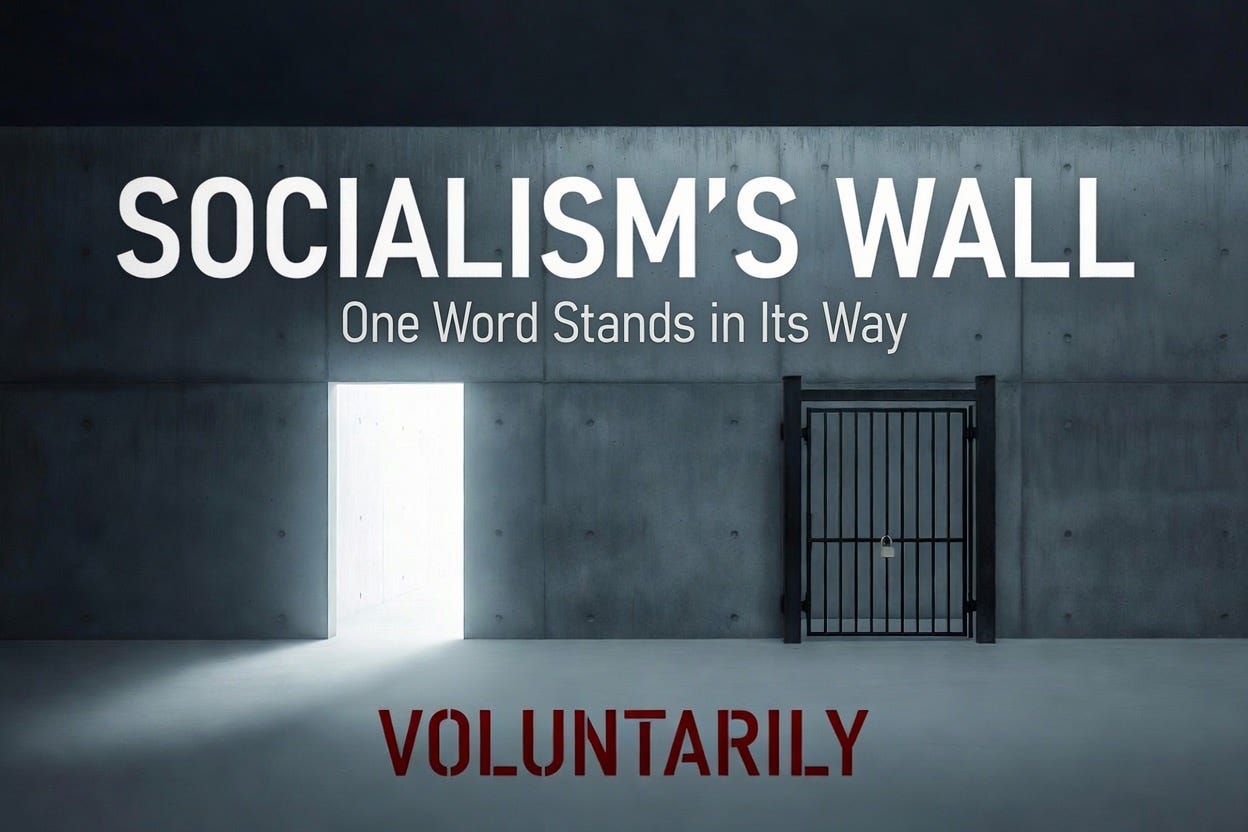
Why Socialism Will Never Work Voluntarily
Human Nature Is the One Wall It Can Never Climb
By Jim Reynolds | www.reynolds.com
August 4, 2026
Most arguments against socialism begin with economics.
Mine begins with a single word.
Voluntarily.
That word does almost all the work.
Suppose a society adopted socialism and every citizen remained completely free.
Free to work or not.
Free to invest elsewhere.
Free to move.
Free to start a business.
Free to leave the state.
Free to leave the country.
Would socialism remain stable?
I do not believe it would.
Not because people are evil.
Because people are human.
The Voluntary Test
Every political philosophy should be able to survive one simple test.
Remove the penalties.
Remove the police.
Remove the requirement to participate.
Then ask:
Would people still choose it?
If the answer is no, the problem is not with the people.
The problem is with the system.
🅱️ “If people have to be talked into staying, you’ve got a movement. If they have to be prevented from leaving, you’ve got a problem.”
Human Nature Does Not Negotiate
Human beings share certain characteristics that transcend culture, religion and politics.
We seek opportunity.
We avoid unnecessary hardship.
We compare ourselves with others.
We imitate success.
We protect our families.
We respond to incentives.
Milton Friedman spent much of his career explaining that people naturally seek lower friction. Water flows downhill. Capital flows toward higher returns. Workers move toward better opportunities. Families move toward safer neighborhoods and better schools.
There is another characteristic that is just as universal, though we rarely notice it because it seems so ordinary.
Human beings are not naturally lazy.
They are naturally economical.
If two paths lead to the same destination, most of us will eventually choose the one requiring less effort.
That is why we invented the wheel.
The washing machine.
The elevator.
The tractor.
The computer.
Civilization itself is largely the story of reducing unnecessary effort.
Now apply that same principle to economics.
If working hard and working less produce the same rewards, many people will gradually choose to work less.
Not because they have become immoral.
Not because they suddenly dislike work.
Because the incentives have changed.
Over time, behavior follows incentives just as surely as water follows gravity.
A society can encourage generosity.
It cannot indefinitely ask millions of ordinary people to ignore the incentives placed before them.
This is not capitalism.
This is anthropology.
Any political philosophy that depends upon people behaving differently than they naturally do begins the game at a disadvantage.
America Is the Worst Place to Attempt It
If someone wished to design the least suitable nation on Earth for a voluntary socialist experiment, it would look remarkably like the United States.
Americans move.
Businesses move.
Capital moves.
Retirees move.
Information moves even faster.
Unlike societies isolated by geography or censorship, Americans compare themselves constantly.
California is compared with Texas.
Illinois with Tennessee.
New York with Florida.
Fifty states become fifty competing laboratories.
When people see another state offering greater opportunity, lower taxes or a friendlier business climate, many simply pack the moving truck.
No passport required.
The Leaks Begin
Every redistributive system depends upon a productive base that continues producing.
But people are not stationary assets.
They leave.
An entrepreneur relocates.
A manufacturer builds the next factory elsewhere.
A physician retires early.
An investor shifts capital.
A young engineer accepts a better opportunity in another state.
Each decision is rational.
Collectively, they become a problem.
The tax base shrinks.
The remaining taxpayers shoulder a larger burden.
The incentives to leave become even stronger.
The cycle feeds itself.
🅱️ “Governments tax money because they think it stands still. It doesn’t. It owns a suitcase.”
Bob stares into space for a moment.
🅱️ “No… that’s not it.”
Another pause.
🅱️ “Capital doesn’t vote. It packs.”
Plugging the Leaks
When voluntary participation declines, governments rarely conclude that the underlying incentives should change.
Instead, they often try to reduce the leakage.
Higher taxes.
More regulations.
Capital restrictions.
Price controls.
Rent freezes.
Rules intended to discourage mobility or increase dependence.
Each policy is usually defended on its own merits.
Together, they have another effect.
They make leaving harder.
The more difficult it becomes to persuade people to remain, the greater the temptation to make departure more expensive.
The Forgotten Word
Most discussions of socialism revolve around equality.
I believe the more important word is fairness.
Not equality of outcomes.
Reciprocity.
Human beings are remarkably generous.
We help neighbors after floods.
We donate blood.
We volunteer.
We support churches, charities and community organizations.
We willingly help those who genuinely cannot help themselves.
But voluntary cooperation rests upon an unwritten rule.
Those who are able are expected to carry part of the load.
The moment enough people conclude that the burden is no longer being shared fairly, something changes.
Not first in the economy.
In the human heart.
Resentment replaces generosity.
The question changes from:
“How can I help?”
to:
“Why am I carrying him?”
That question has ended more communes than any economics textbook.
🅱️ “A commune usually ends about fifteen minutes after somebody discovers he’s doing all the dishes.”
Human Nature Always Wins
Socialism is often presented as a superior economic arrangement waiting to be implemented correctly.
I see it differently.
It is a continuous contest between political design and human nature.
Human nature seeks freedom.
Human nature seeks opportunity.
Human nature responds to incentives.
Human nature recognizes reciprocity.
Human nature possesses a powerful instinct for fairness.
Those instincts cannot be legislated away.
They cannot be shamed away.
They cannot be educated away.
At best, they can be suppressed.
For a while.
Eventually, they reappear because they are not political opinions.
They are human characteristics.
🅱️ “Human nature has outlived every five-year plan ever written.”
The Final Test
Political systems come and go.
Human nature remains.
That is why socialism can sometimes be imposed.
It can sometimes be enforced.
It can sometimes survive for years under increasing levels of control.
But a system that depends upon people ignoring their deepest instincts about freedom, opportunity and fairness cannot remain voluntary forever.
Sooner or later, it faces a choice.
Restore freedom…
or reduce it.
That is why I do not believe socialism will ever work voluntarily.
Not because human beings are selfish.
Because they are human.

Bob appreciated your comments.
Human nature is what we often call "common sense". Why should I exert myself greater than another if not for greater rewards? I will endure hardship if there is a reward at the end. And it is I who determines the worth of the reward. During WWII the Germans incentivized prison workers to perform at a higher level by offering cigarettes as an inducement. Even under prison conditions of minimum subsistence, incentives worked.