


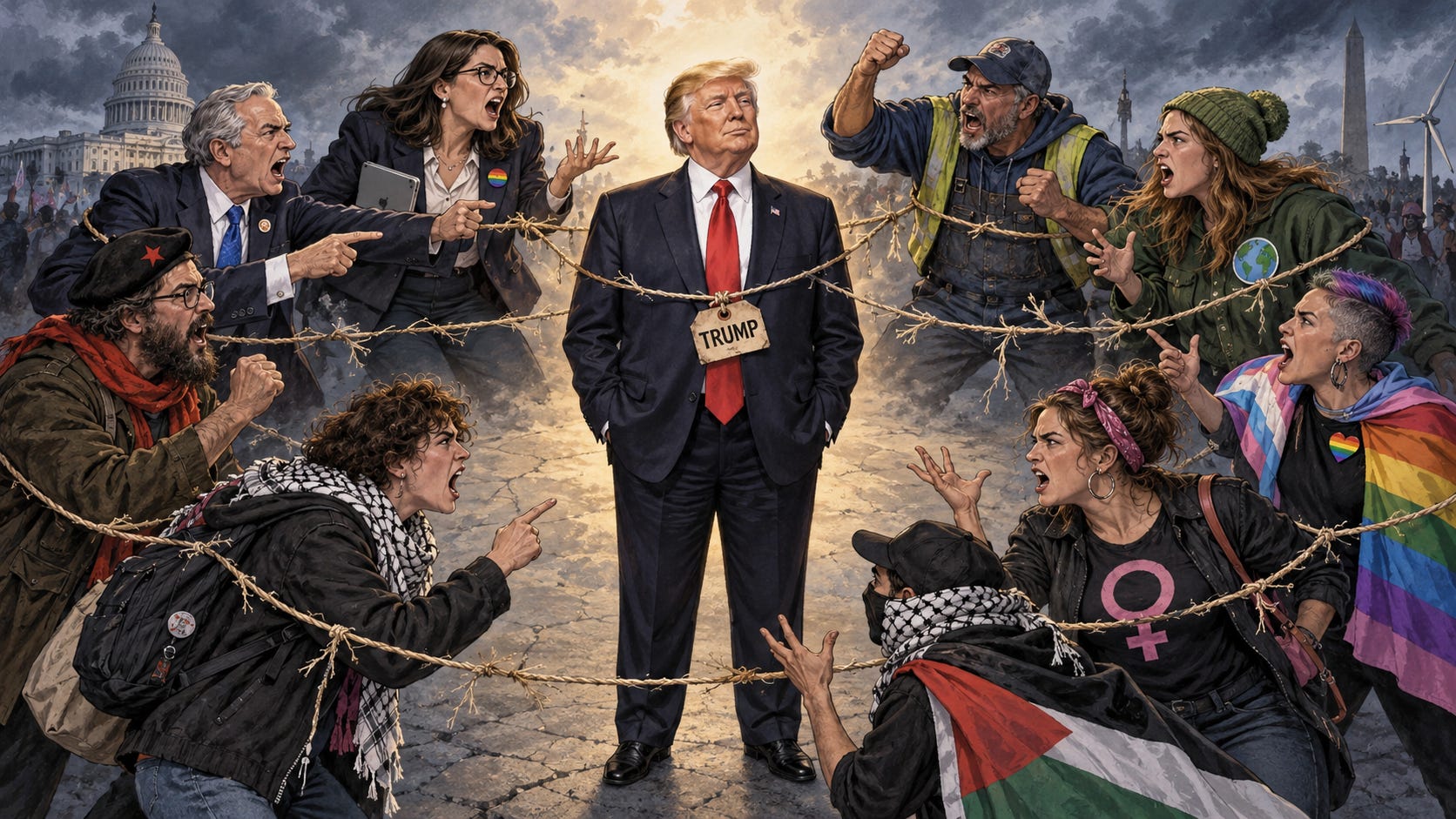
The Coalition That Hates Trump
And What Happens When He Is Gone?
By Jim Reynolds | www.reynolds.com
September 8, 2026
Jesse Watters tried to interview Abdul El-Sayed.
El-Sayed had another idea.
The Democratic candidate for the United States Senate from Michigan came prepared to talk, and talk he did—frequently while Watters was talking, occasionally while Watters was trying to ask a question, and almost continuously whenever a direct answer threatened to break out.
Watters asked whether boys should compete in girls’ sports. El-Sayed said such matters should be decided by the people who govern sports.
Watters asked whether he supported sex-change surgery for minors. El-Sayed responded by asking Watters whether he had been circumcised.
That was certainly an answer to something. It just wasn’t an answer to the question.
El-Sayed’s argument was that government should not interfere with medical decisions. But comparing circumcision to the surgical alteration of a child’s sexual anatomy was not clarification. It was an escape hatch. When a question became too specific, he widened the subject, changed the frame and consumed the clock.
The interview exchange was reported here:

This was more than an unruly television interview. It was a demonstration of how the modern Democratic coalition protects itself.
A direct answer produces a position.
A position can be examined.
And examination might reveal that the people united in hating Donald Trump are not remotely united about the country they intend to build.
Hatred as a Governing Philosophy
The Democratic Party currently contains establishment liberals, corporate progressives, Marxists, environmental absolutists, public-sector unions, campus radicals, LGBTQ activists, secular feminists, Muslim traditionalists and increasingly aggressive anti-Israel organizations.
These groups do not merely disagree around the edges. Some of their most basic convictions are incompatible.
Feminists march alongside religious movements whose doctrines subordinate women.
LGBTQ activists make common cause with people whose religious beliefs reject homosexuality altogether.
Labor advocates support immigration policies that increase competition for lower-wage workers.
Environmentalists oppose the dependable energy required to support the industries, data centers and electrification programs they simultaneously demand.
Civil libertarians discover exceptions to free speech whenever the wrong people are speaking.
Corporate executives finance activists who regard capitalism as organized theft.
Jewish Democrats remain inside a coalition increasingly comfortable with people who will not forthrightly condemn Hamas.
This is not a governing philosophy. It is a collection of unresolved arguments.
What holds it together?
Trump.
Hatred of Trump is not merely one belief the coalition shares. It performs the work that a coherent philosophy normally would. Every internal contradiction can be postponed because defeating Trump is always declared more urgent.
No one has to explain how the pieces fit.
They don’t.
They simply have a common enemy.
Never Let the Question Land
This helps explain why genuine debate with conservatives has become so difficult.
The purpose of debate is to refine differences until the actual point of disagreement becomes visible. But visibility is dangerous to a coalition held together by deliberate ambiguity.
Consider the questions Democrats often refuse to answer plainly:
At what age should a child be permitted to authorize irreversible medical treatment?
Should a biological male compete in women’s athletics?
How many illegal immigrants should the United States admit?
When does anti-Zionism become tolerance for terrorism?
How will restricting domestic energy production reduce energy costs?
When does “misinformation” become an excuse for government censorship?
Does a religious minority retain the right to reject progressive doctrines about sex and gender?
Those questions require boundaries. Boundaries produce winners and losers within the coalition.
So the question must never be permitted to land.
The speaker interrupts. He delivers a speech. He questions the questioner’s motives. He declares the subject a distraction. He changes the vocabulary. He finds a victim. He accuses the interviewer of cruelty.
Anything but an answer.
That was the pattern in El-Sayed’s interview. Watters attempted to locate his positions. El-Sayed attempted to prevent his positions from becoming locatable.
This was not a failure of communication.
It was coalition maintenance.
Hatred substitutes for policy. Filibuster substitutes for debate.
We Have Seen This Movie
In the late 1970s, the opposition to the Shah of Iran contained secular liberals, nationalists, Marxists, university students, Islamic socialists, bazaar merchants and Shiite clerics.
These groups had radically different visions of Iran’s future. What united them was not the government they wanted to create.
It was the government they wanted to destroy.
The Shah had become the organizing enemy. As long as he remained in power, the coalition did not have to resolve what would follow him. “Remove the Shah” was sufficient policy for the moment.
Ayatollah Khomeini understood the arrangement perfectly.
From exile, he spoke in the broad language of justice, independence, moral renewal and resistance to oppression. Secular liberals heard the promise of democracy. Marxists heard the language of class struggle and anti-imperialism. Religious Iranians heard the restoration of Islam.
Everyone heard what he wanted to hear.
Khomeini did not need to win the argument while the Shah stood. He needed the others to keep postponing it.
The Shah fell in February 1979. Then the coalition’s real argument began.
Khomeini’s faction possessed what the others did not: a national religious network, disciplined leadership, an unmistakable objective and no sentimental attachment to its temporary partners. Revolutionary committees, courts and security organizations consolidated clerical power. A new constitution established the supremacy of Islamic jurists. Liberals were sidelined. Leftist organizations that had helped overthrow the Shah were ultimately suppressed, imprisoned, driven underground or executed.
They had agreed about the enemy and assumed they could negotiate the future later.
Later belonged to someone else.
America Is Not Iran
Donald Trump is not the Shah, and the United States is not Iran.
Trump was elected. The Shah was a monarch. America has a durable Constitution, divided government, independent states, a large private economy and traditions Iran did not possess.
The comparison is not between the two men or the two political systems.
It is between coalition mechanisms.
A movement organized principally around removing one hated figure can appear far more coherent than it is. As long as the enemy remains, every faction can imagine that the final victory will serve its own purposes.
The Marxists believe the revolution will be Marxist.
The Islamists believe it will be Islamic.
The establishment believes it can harness both groups and remain in charge.
The students believe everyone wants justice.
Corporate donors believe their money will purchase protection.
They cannot all be right.
The Iranian revolution offers a particularly unpleasant lesson: the faction most useful in destroying the existing order is not necessarily the faction that inherits it. Power tends to pass to the group with the strongest organization, deepest commitment and fewest inhibitions about disposing of former allies.
The naïve participants think coalition means community.
The disciplined participants understand that coalition may mean sequence.
First we defeat the common enemy.
Then we settle matters among ourselves.
After Trump, What?
Trump cannot remain the center of American politics forever.
He will leave office. He will eventually leave the stage. At that point, the Democratic coalition will lose the figure who has allowed it to avoid defining itself.
Then what?
Will the party belong to its aging establishment or its socialist insurgents?
Will it defend Israel or the activists who regard Israel as an illegitimate colonial state?
Will it protect women’s sex-based rights or abolish sex as a meaningful legal category?
Will it preserve religious freedom when traditional religious beliefs collide with progressive orthodoxy?
Will it remain capitalist, become socialist or continue pretending those words no longer matter?
Will it support free expression or permit whichever faction controls the institutions to define dissent as danger?
These are not questions about Republican caricatures. They are disputes already taking place inside the Democratic coalition. Trump hatred merely keeps them from reaching a conclusion.
That is why direct questions are unwelcome. That is why debates become lectures and interviews become filibusters. Specificity would reveal that the coalition’s apparent unity is produced not by agreement, but by postponement.
The members agree completely about the man they hate and almost not at all about the country they intend to build.
History does not repeat with mechanical precision. America is unlikely to reenact Iran in costume. But political coalitions repeatedly make the same mistake: they assume that a shared enemy implies a shared destination.
It does not.
The Marxists think they are using the Islamists.
The establishment thinks it is using both.
The students think everyone is marching toward liberation.
The Islamists have seen this movie before.

Grok’s AI Assessment of “The Coalition That Hates Trump”
The Grok AI platform was asked whether this essay reads as human-written or AI-generated.
Its verdict: human-authored, AI-assisted at most.
Grok says the strongest evidence is not the polish of the prose, but the choices behind it — what the writer emphasizes, where the argument changes temperature, what comparisons are allowed to stand, where a boundary is drawn, and what conclusion is deliberately left unstated.
As Grok put it:
“The piece has a human’s priorities: a local specimen, a mechanism, a fenced analog, and a button that refuses to name the line you actually believe.”
It specifically highlighted this sentence:
“Khomeini did not need to win the argument while the Shah stood. He needed the others to keep postponing it.”
Grok called that the essay’s “unsaid thesis in mechanism form.”
It also noted that the ending does something AI often does poorly: it stops before explaining the conclusion to death. The final connection is left to the reader.
Its final judgment:
“If a model touched it, it was as a sharpener, not the author of the argument. The piece has a person in it who has decided what not to say.”
Grok’s larger point may be the more interesting one.
AI can help research, challenge, compress, and sharpen an argument.
But the argument still has to belong to somebody.
In Grok’s assessment, that somebody is Jim Reynolds.
